







Question: 3. Consumers have a unit demand for a good, if they don't buy it they get 0. A consumer gets q -p if he consumes
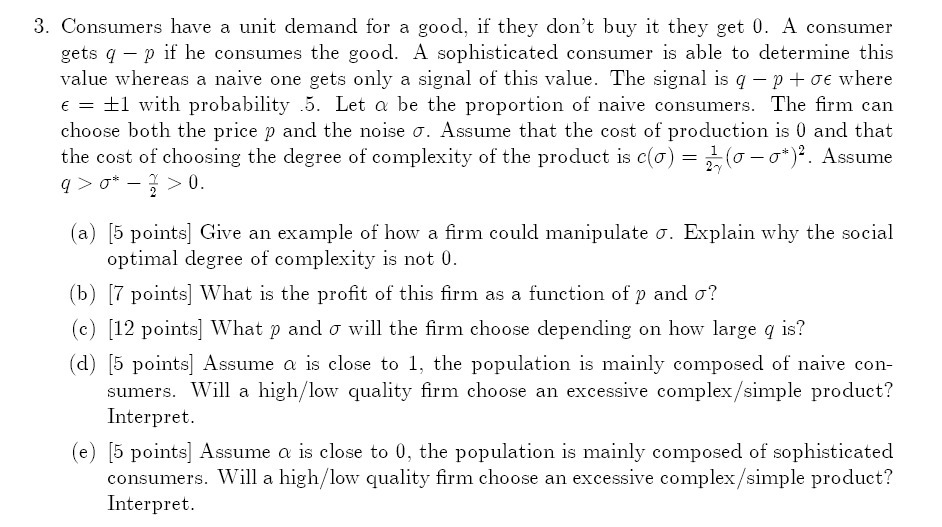
3. Consumers have a unit demand for a good, if they don't buy it they get 0. A consumer gets q -p if he consumes the good. A sophisticated consumer is able to determine this value whereas a naive one gets only a signal of this value. The signal is q - p + of where e = +1 with probability .5. Let a be the proportion of naive consumers. The firm can choose both the price p and the noise o. Assume that the cost of production is 0 and that the cost of choosing the degree of complexity of the product is c(o) = 1 (6 -0*)'. Assume 720 . (a) [5 points] Give an example of how a firm could manipulate o. Explain why the social optimal degree of complexity is not 0. (b) [7 points] What is the profit of this firm as a function of p and o? (c) [12 points] What p and o will the firm choose depending on how large q is? (d) [5 points] Assume a is close to 1, the population is mainly composed of naive con- sumers. Will a high/low quality firm choose an excessive complex / simple product? Interpret. (e) [5 points] Assume a is close to 0, the population is mainly composed of sophisticated consumers. Will a high/low quality firm choose an excessive complex/ simple product? Interpret
Step by Step Solution
There are 3 Steps involved in it

Get step-by-step solutions from verified subject matter experts
 Study Help