







Question: 3. Convert the nfa defined by (q 0 , a) = {q 0 , q 1 } (q 1 , b) = {q 1 ,
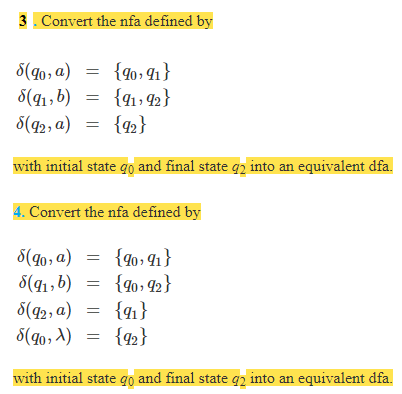
3. Convert the nfa defined by
(q0, a) = {q0, q1}
(q1, b) = {q1, q2}
(q2, a) = {q2}
with the initial state q0 and the final state q2 into an equivalent dfa.
4. Convert the nfa defined by
(q0, a) = {q0, q1}
(q1, b) = {q0, q2}
(q2, a) = {q1}
(q0, ) = {q2}
with the initial state q0 and the final state q2 into an equivalent dfa.
doing just one will be fine... i would really appreciate it if you help me with both though... thanks!
3 . Convert the nfa defined by with initial state go and final state q2 into an equivalent dfa. 4. Convert the nfa defined by 2,a with initial state go and final state q2 into an equivalent dfa
Step by Step Solution
There are 3 Steps involved in it
1 Expert Approved Answer
Step: 1 Unlock

Question Has Been Solved by an Expert!
Get step-by-step solutions from verified subject matter experts
Step: 2 Unlock
Step: 3 Unlock
 Study Help