







Question: 3. Create a timedelta object representing 100 days, 10 hours, and 13 minutes. >>> from datetime import timedelta >>>d-timedelta(microseconds--1) >>> (d.days, d.seconds, d.microseconds) (-1,86399,999999) 4.
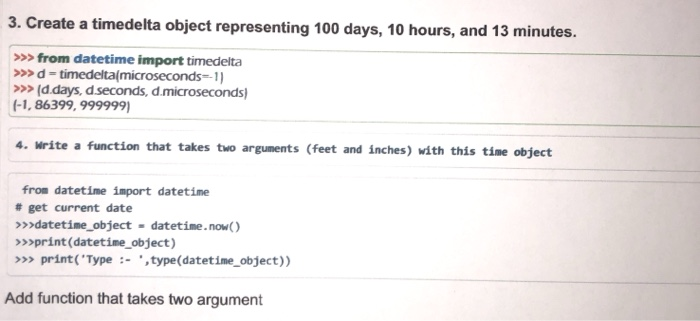
3. Create a timedelta object representing 100 days, 10 hours, and 13 minutes. >>> from datetime import timedelta >>>d-timedelta(microseconds--1) >>> (d.days, d.seconds, d.microseconds) (-1,86399,999999) 4. Write a function that takes two arguments (feet and inches) with this time object from datetime import datetime # get current date >>>datetime_object - datetime.now() >>>print(datetime_object) >>> print("Type:- ', type(datetime_object)) Add function that takes two argument 3. Create a timedelta object representing 100 days, 10 hours, and 13 minutes. >>> from datetime import timedelta >>>d-timedelta(microseconds--1) >>> (d.days, d.seconds, d.microseconds) (-1,86399,999999) 4. Write a function that takes two arguments (feet and inches) with this time object from datetime import datetime # get current date >>>datetime_object - datetime.now() >>>print(datetime_object) >>> print("Type:- ', type(datetime_object)) Add function that takes two argument
Step by Step Solution
There are 3 Steps involved in it

Get step-by-step solutions from verified subject matter experts
 Study Help