





Question: 3. d. In the same case-control study looking at risk factors for ovarian cancer, the investigators also wanted to examine whether parity (whether the women
3. d. In the same case-control study looking at
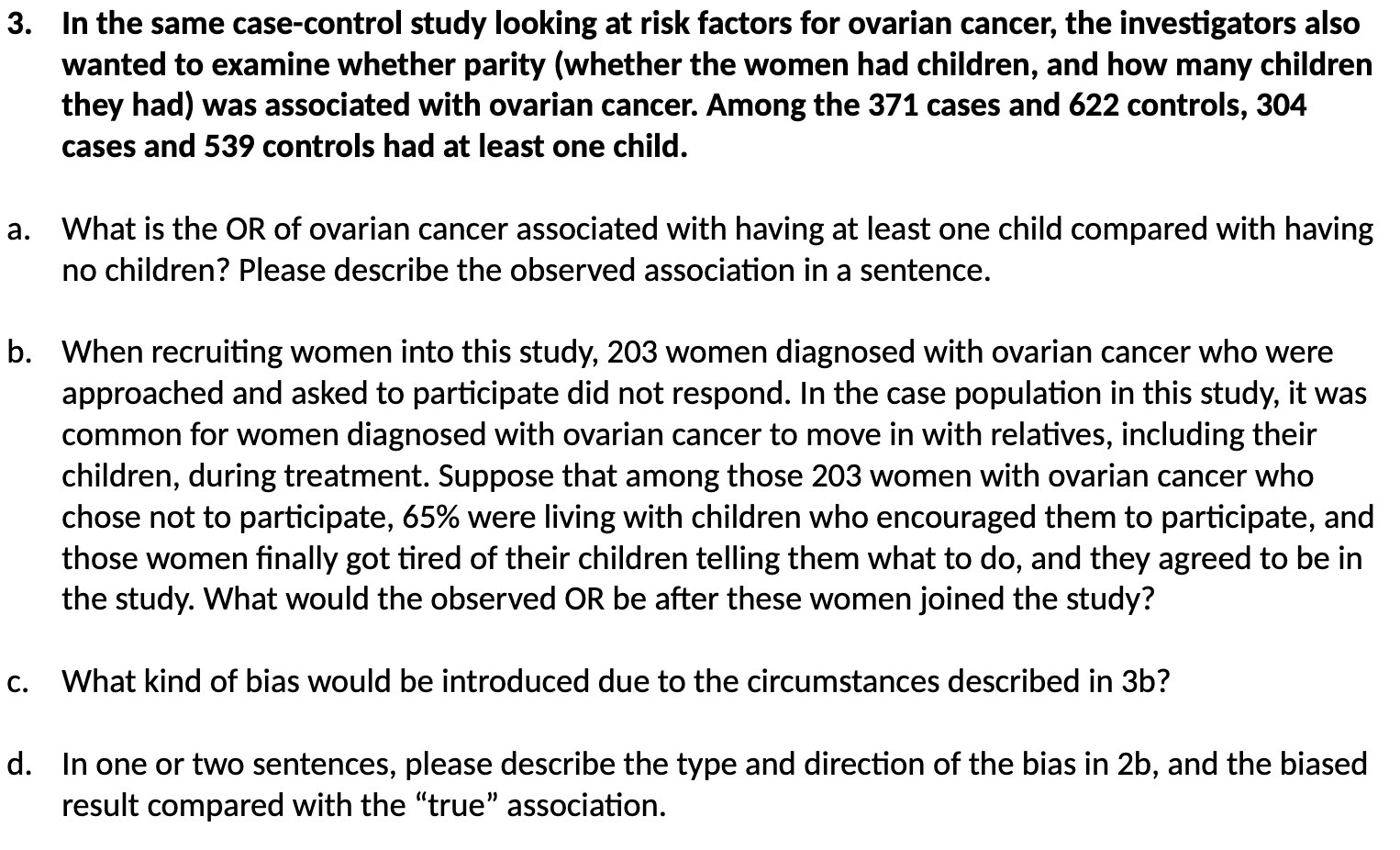
3. d. In the same case-control study looking at risk factors for ovarian cancer, the investigators also wanted to examine whether parity (whether the women had children, and how many children they had) was associated with ovarian cancer. Among the 371 cases and 622 controls, 304 cases and 539 controls had at least one child. What is the OR of ovarian cancer associated with having at least one child compared with having no children? Please describe the observed association in a sentence. When recruiting women into this study, 203 women diagnosed with ovarian cancer who were approached and asked to participate did not respond. In the case population in this study, it was common for women diagnosed with ovarian cancer to move in with relatives, including their children, during treatment. Suppose that among those 203 women with ovarian cancer who chose not to participate, 65% were living with children who encouraged them to participate, and those women nally got tired of their children telling them what to do, and they agreed to be in the study. What would the observed OR be after these women joined the study? What kind of bias would be introduced due to the circumstances described in 3b? In one or two sentences, please describe the type and direction of the bias in 2b, and the biased result compared with the \"true" association

Step by Step Solution

There are 3 Steps involved in it

1 Expert Approved Answer
Step: 1 Unlock blur-text-image

Question Has Been Solved by an Expert!

Get step-by-step solutions from verified subject matter experts

Step: 2 Unlock
Step: 3 Unlock

Students Have Also Explored These Related Mathematics Questions!