







Question: 3.) Detecting and discarding duplicate Entries (simplestats.cpp, simplestats.exe Use a one-dimensional vector to solve the following problem. Read in numbers from the command line. Store
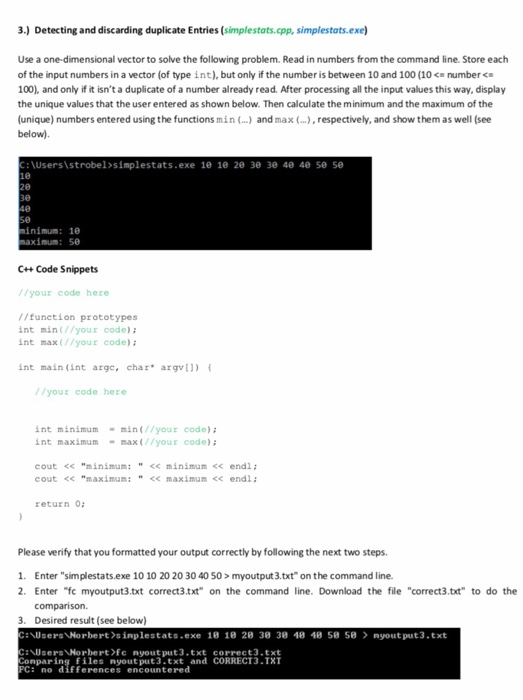
3.) Detecting and discarding duplicate Entries (simplestats.cpp, simplestats.exe Use a one-dimensional vector to solve the following problem. Read in numbers from the command line. Store each of the input numbers in a vector (of type int), but only if the number is between 10 and 100 (10 numberc 100), and only if it isn't a duplicate of a number already read. After processing all the input values this way, display the unique values that the user entered as shown below. Then calculate the minimum and the maximum of the (unique) numbers entered using the functions min (...) and max (...), respectively, and show them as well (see below). :\Usersistrobel simplestats.exe 1e le 2e 30 4e 4e se se 30 inimum: 10 aximum: 50 C+ Code Snippets //your code here //funetion prototypes int min(//your code)i int max(//your code) : int main (int arge, char argv) //your code here int minimummin(//your code) int maximum- max(//your code) cout myoutput 3.txt" on the command line. 2. Enter fc myoutput3.txt correct3.txt on the command line. Download the file "correct3.txt" to do the 3. Desired result (see below) Users Norbert sinplestats-exe 18 18 28 38 38 48 48 58 58 nyout put3.txt Users Norbert>fc nyout put3.txt correct3.txt onparing files nyout put3.txt and CORRECT3.TXT C: no differences encountered
Step by Step Solution
There are 3 Steps involved in it

Get step-by-step solutions from verified subject matter experts
 Study Help