







Question: 3 DIFFRACTION FROM A SINGLE SLIT 3 . 1 Purpose The purpose of this experiment is to examine the diffaction pattern formed by laser light
DIFFRACTION FROM A SINGLE SLIT
Purpose
The purpose of this experiment is to examine the diffaction pattern formed by laser light pasing through a single slit and verify that the positions of the minima in the diffraction pattern match the positions predicted ly theory,
Apparatus
View screen
Optics Track
Red Diode Laser
Diffraction Slits
Safety
Do not stare into the laser beam.
Procedure
Set up the red laser at one end of the optics track and place the diffraction slits about in front of the laser Figure
Put the screen on the other end of the optics track so that the aperture faces the laser.
Select the single slit by rotating the slit disk until the slit is centered in the slit holder. Turn on the laser and adjust the position of the laser beam until it is centered on the slit
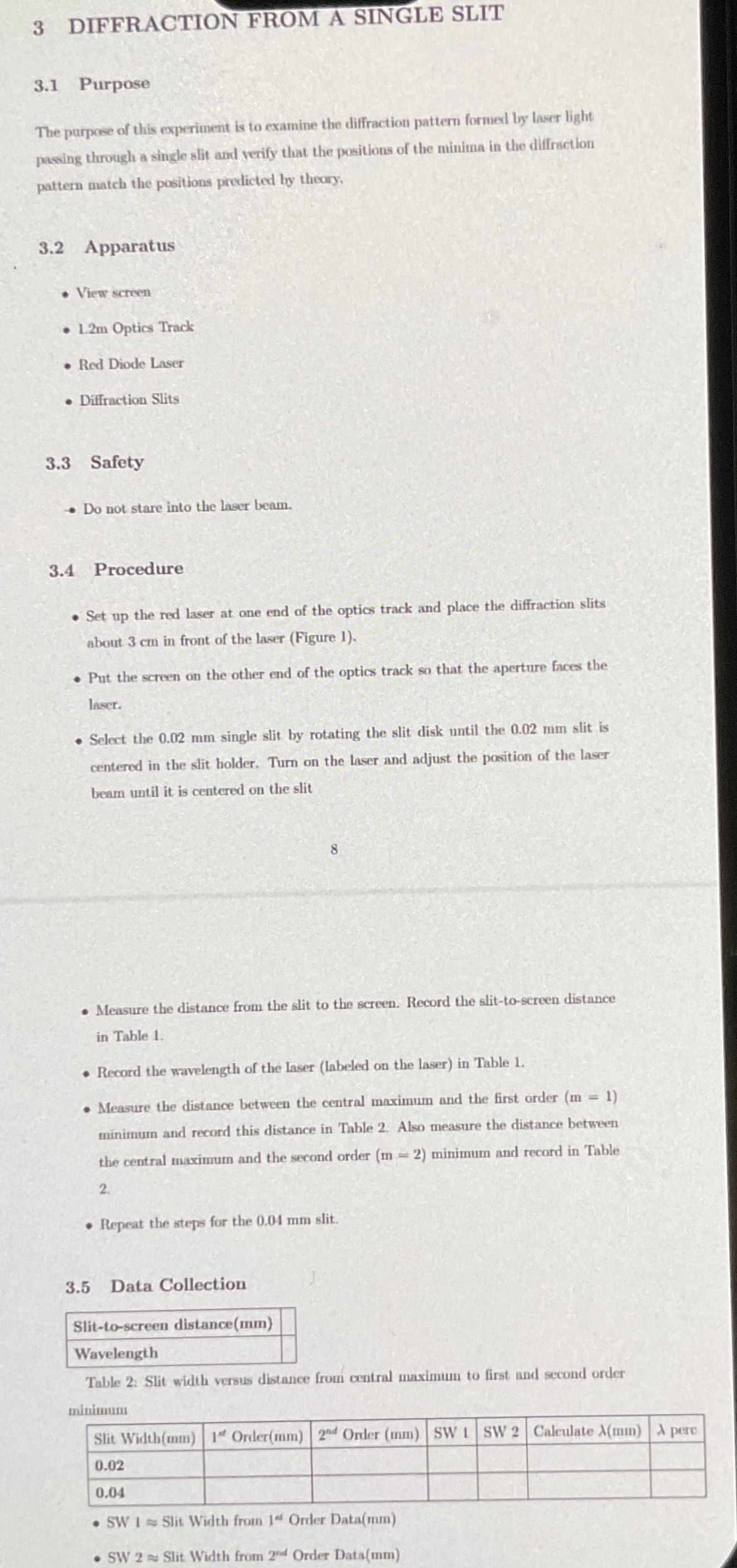
Measure the distance from the slit to the screen. Record the slittoscreen distance in Table
Record the wavelength of the laser labeled on the laser in Table
Measure the distance between the central maximum and the first order minimum and record this distance in Table Also measure the distance between the central maximum and the second order minimum and record in Table
Repeat the steps for the slit.
Data Collection
tableSlittoscreen distancemmWavelength
Table : Slit width versus distance from central maximum to first and second order minimum
tableSlit Width Oriler Order SW SW Calculate perc
SW ~~ Slit Width from Order Datamm
SW ~~ Slit Width from Order Datamm
Step by Step Solution
There are 3 Steps involved in it
1 Expert Approved Answer
Step: 1 Unlock

Question Has Been Solved by an Expert!
Get step-by-step solutions from verified subject matter experts
Step: 2 Unlock
Step: 3 Unlock
 Study Help