







Question: 3 ( ( ( Do it in python ) ) ) 1 . 3 Using the KNN Classifier for Classification The K - Nearest Neighbors
Do it in python
Using the KNN Classifier for Classification
The KNearest Neighbors KNN classifier offers a straightforward approach to classification
tasks by leveraging the properties of nearby data points. This task involves using the KNN
classifier to predict the class of new instances based on the nearest neighbors and
evaluating its performance on a test set.
Objective:
Use the KNN classifier to make predictions on a test dataset.
Evaluate the classifier's performance using metrics such as accuracy, precision, recall, true
positives, and true negatives.
Requirements:
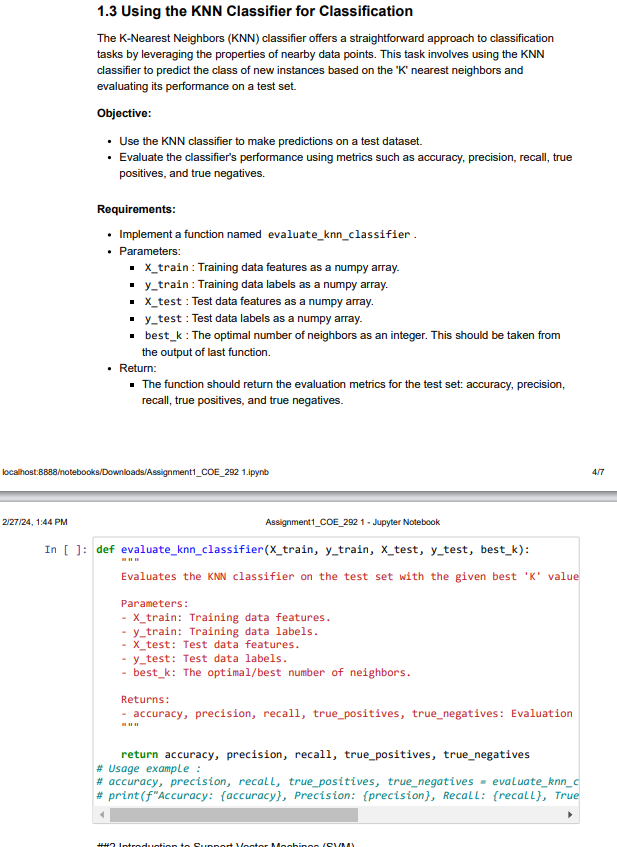
Implement a function named evaluateknnclassifier
Parameters:
Xtrain : Training data features as a numpy array.
ytrain : Training data labels as a numpy array.
Xtest : Test data features as a numpy array.
ytest : Test data labels as a numpy array.
bestk : The optimal number of neighbors as an integer. This should be taken from
the output of last function.
Return:
The function should return the evaluation metrics for the test set: accuracy, precision,
recall, true positives, and true negatives.
In : def evaluateknnclassifierxtrain, ytrain, xtest, ytest, bestk:
Evaluates the KNN classifier on the test set with the given best value
Parameters:
Xtrain: Training data features.
ytrain: Training data labels.
Xtest: Test data features.
ytest: Test data labels.
bestk: The optimalbest number of neighbors.
Returns:
accuracy, precision, recall, truepositives, truenegatives: Evaluation
return accuracy, precision, recall, truepositives, truenegatives
# Usage example :
# accuracy, precision, recall, truepositives, truenegatives evaluateknnc
# print Accuracy: accuracy Precision: precision Recall: recall True
Step by Step Solution
There are 3 Steps involved in it
1 Expert Approved Answer
Step: 1 Unlock

Question Has Been Solved by an Expert!
Get step-by-step solutions from verified subject matter experts
Step: 2 Unlock
Step: 3 Unlock
 Study Help