





Question: 3. Do you think it is right for a union and an employer to agree in a collective bargaining agreement that all of the workers

3. Do you think it is right for a union and an employer to agree in a collective bargaining agreement that all of the workers subject to the collective bargaining agreement have to join the union in order to keep their job?
3. Do you think it is right for a union and an
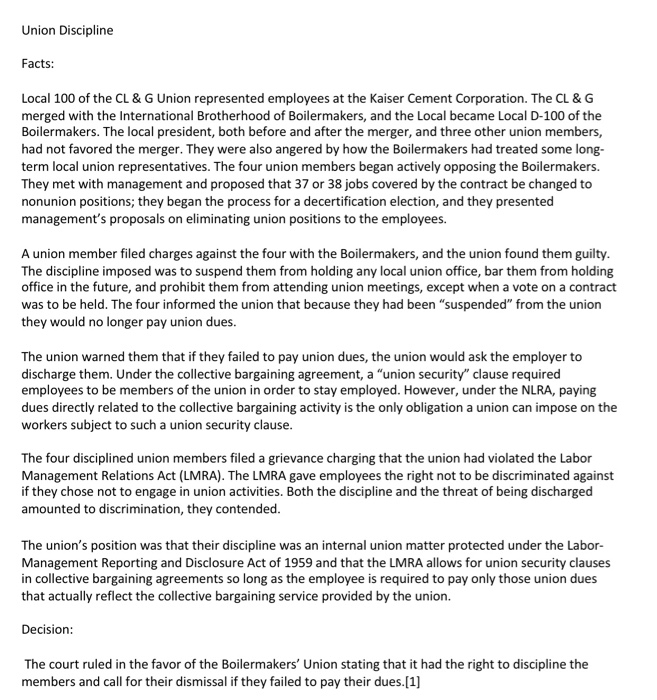
Union Discipline Facts: Local 100 of the CL & G Union represented employees at the Kaiser Cement Corporation. The CL & G merged with the International Brotherhood of Boilermakers, and the Local became Local D-100 of the Boilermakers. The local president, both before and after the merger, and three other union members, had not favored the merger. They were also angered by how the Boilermakers had treated some long- term local union representatives. The four union members began actively opposing the Boilermakers. They met with management and proposed that 37 or 38 jobs covered by the contract be changed to nonunion positions; they began the process for a decertification election, and they presented management's proposals on eliminating union positions to the employees. A union member filed charges against the four with the Boilermakers, and the union found them guilty. The discipline imposed was to suspend them from holding any local union office, bar them from holding office in the future, and prohibit them from attending union meetings, except when a vote on a contract was to be held. The four informed the union that because they had been "suspended" from the union they would no longer pay union dues. The union warned them that if they failed to pay union dues, the union would ask the employer to discharge them. Under the collective bargaining agreement, a "union security" clause required employees to be members of the union in order to stay employed. However, under the NLRA, paying dues directly related to the collective bargaining activity is the only obligation a union can impose on the workers subject to such a union security clause. The four disciplined union members filed a grievance charging that the union had violated the Labor Management Relations Act (LMRA). The LMRA gave employees the right not to be discriminated against if they chose not to engage in union activities. Both the discipline and the threat of being discharged amounted to discrimination, they contended. The union's position was that their discipline was an internal union matter protected under the Labor- Management Reporting and Disclosure Act of 1959 and that the LMRA allows for union security clauses in collective bargaining agreements so long as the employee is required to pay only those union dues that actually reflect the collective bargaining service provided by the union. Decision: The court ruled in the favor of the Boilermakers' Union stating that it had the right to discipline the members and call for their dismissal if they failed to pay their dues (1)

Step by Step Solution

There are 3 Steps involved in it

1 Expert Approved Answer
Step: 1 Unlock blur-text-image

Question Has Been Solved by an Expert!

Get step-by-step solutions from verified subject matter experts

Step: 2 Unlock
Step: 3 Unlock

Students Have Also Explored These Related General Management Questions!