



Question: 3. (Duration and Convexity for General Cashflow Streams) Equation (4) and (11) in the Lecture Notes 2 give the duration and convexity for the coupon
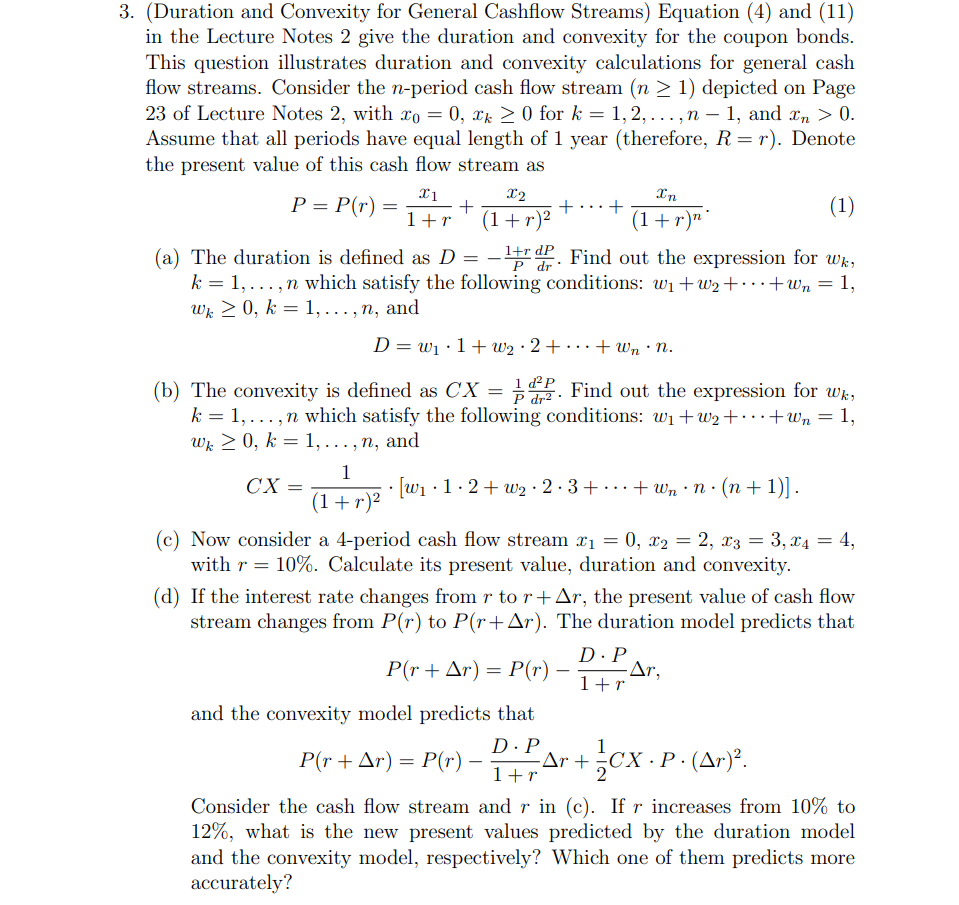
3. (Duration and Convexity for General Cashflow Streams) Equation (4) and (11) in the Lecture Notes 2 give the duration and convexity for the coupon bonds. This question illustrates duration and convexity calculations for general cash flow streams. Consider the n-period cash flow stream (n > 1) depicted on Page 23 of Lecture Notes 2, with Io = 0, 2x > 0 for k 1, 2, ...,n - 1, and In > 0. Assume that all periods have equal length of 1 year (therefore, R=r). Denote the present value of this cash flow stream as 21 I 2 P= P(r) + + + (1) 1+r (1+r) (1+r)n (a) The duration is defined as D 1tr dp Find out the expression for Wk, P dr k= 1,...,n which satisfy the following conditions: Wi+w2+...+wn = 1, wk > 0, k = 1,...,n, and D=W11+w2 2+...+wn: n. (b) The convexity is defined as CX = 1 . Find out the expression for wk, k= 1,..., n which satisfy the following conditions: Wi+w2+...+wn=1, wk > 0, k = 1,...,n, and 1 CX= - [w1 1 2 + W2 2-3 + ... + Wn:n: (n + 1)]. (1 + r)2 (C) Now consider a 4-period cash flow stream 21 = 0, C2 = 2, 13 = 3, 24 = 4, with r = 10%. Calculate its present value, duration and convexity. (d) If the interest rate changes from r to r+Ar, the present value of cash flow stream changes from P(r) to P(r+Ar). The duration model predicts that D. Par, -Ar + P(r + Ar) = P(r) 1+r and the convexity model predicts that D.P P(r + Ar) = P(r) P. (Ar)? 1+r Consider the cash flow stream and r in (c). If r increases from 10% to 12%, what is the new present values predicted by the duration model and the convexity model, respectively? Which one of them predicts more accurately? cx: 1 3. (Duration and Convexity for General Cashflow Streams) Equation (4) and (11) in the Lecture Notes 2 give the duration and convexity for the coupon bonds. This question illustrates duration and convexity calculations for general cash flow streams. Consider the n-period cash flow stream (n > 1) depicted on Page 23 of Lecture Notes 2, with Io = 0, 2x > 0 for k 1, 2, ...,n - 1, and In > 0. Assume that all periods have equal length of 1 year (therefore, R=r). Denote the present value of this cash flow stream as 21 I 2 P= P(r) + + + (1) 1+r (1+r) (1+r)n (a) The duration is defined as D 1tr dp Find out the expression for Wk, P dr k= 1,...,n which satisfy the following conditions: Wi+w2+...+wn = 1, wk > 0, k = 1,...,n, and D=W11+w2 2+...+wn: n. (b) The convexity is defined as CX = 1 . Find out the expression for wk, k= 1,..., n which satisfy the following conditions: Wi+w2+...+wn=1, wk > 0, k = 1,...,n, and 1 CX= - [w1 1 2 + W2 2-3 + ... + Wn:n: (n + 1)]. (1 + r)2 (C) Now consider a 4-period cash flow stream 21 = 0, C2 = 2, 13 = 3, 24 = 4, with r = 10%. Calculate its present value, duration and convexity. (d) If the interest rate changes from r to r+Ar, the present value of cash flow stream changes from P(r) to P(r+Ar). The duration model predicts that D. Par, -Ar + P(r + Ar) = P(r) 1+r and the convexity model predicts that D.P P(r + Ar) = P(r) P. (Ar)? 1+r Consider the cash flow stream and r in (c). If r increases from 10% to 12%, what is the new present values predicted by the duration model and the convexity model, respectively? Which one of them predicts more accurately? cx: 1
Step by Step Solution
There are 3 Steps involved in it

Get step-by-step solutions from verified subject matter experts