







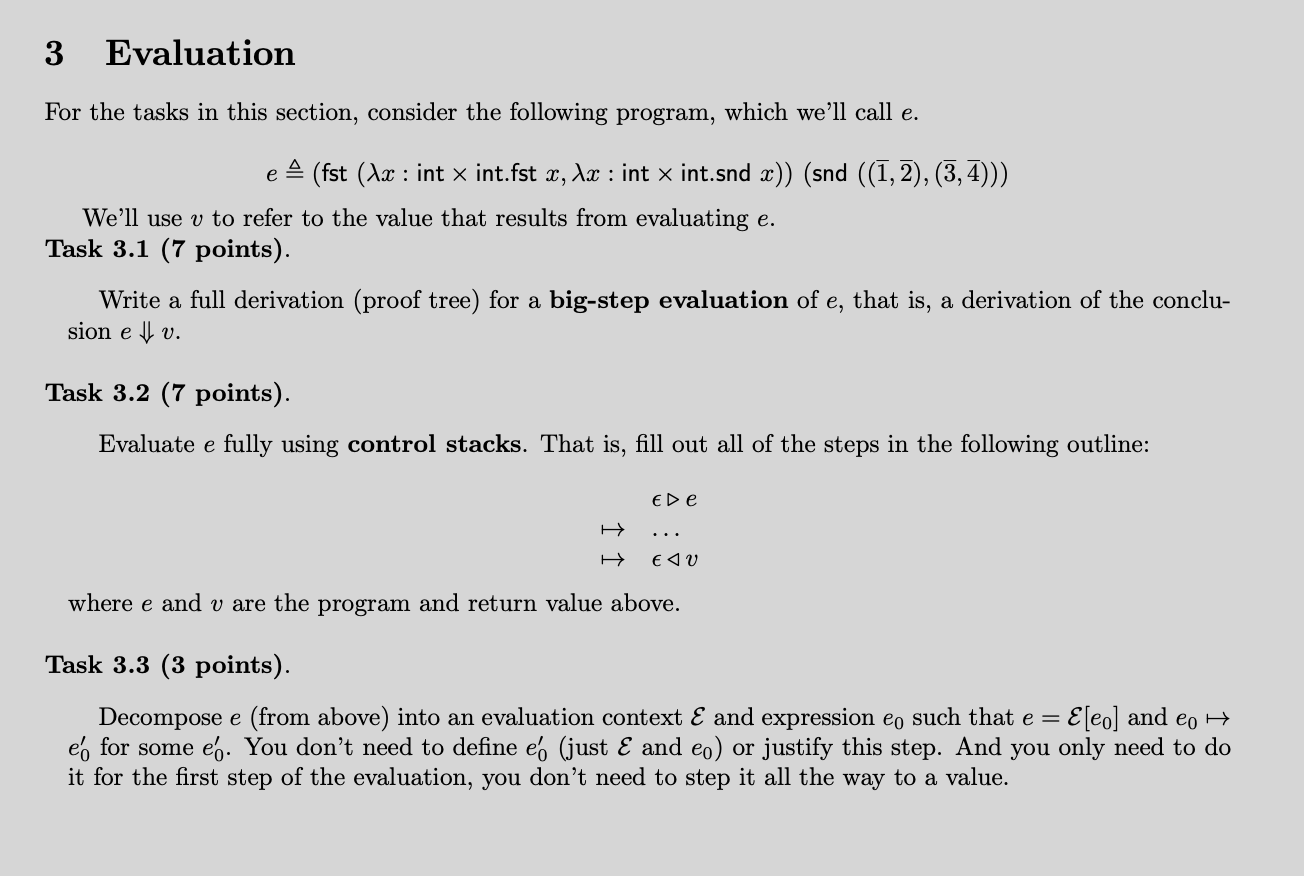
Question: 3 Evaluation For the tasks in this section, consider the following program, which we'll call e . e ( f s t ( x :
Evaluation
For the tasks in this section, consider the following program, which we'll call
: int int.: int int.
We'll use to refer to the value that results from evaluating
Task points
Write a full derivation proof tree for a bigstep evaluation of that is a derivation of the conclusion
Task points
Evaluate fully using control stacks. That is fill out all of the steps in the following outline:
where and are the program and return value above.
Task points
Decompose from above into an evaluation context and expression such that and for some You don't need to define just and or justify this step. And you only need to do it for the first step of the evaluation, you don't need to step it all the way to a value.
Step by Step Solution
There are 3 Steps involved in it
1 Expert Approved Answer
Step: 1 Unlock

Question Has Been Solved by an Expert!
Get step-by-step solutions from verified subject matter experts
Step: 2 Unlock
Step: 3 Unlock
 Study Help