







Question: 3 Examine how latencies of individual components of the datapath affect the clock cycle time of the entire datapath, and how these components are utilized
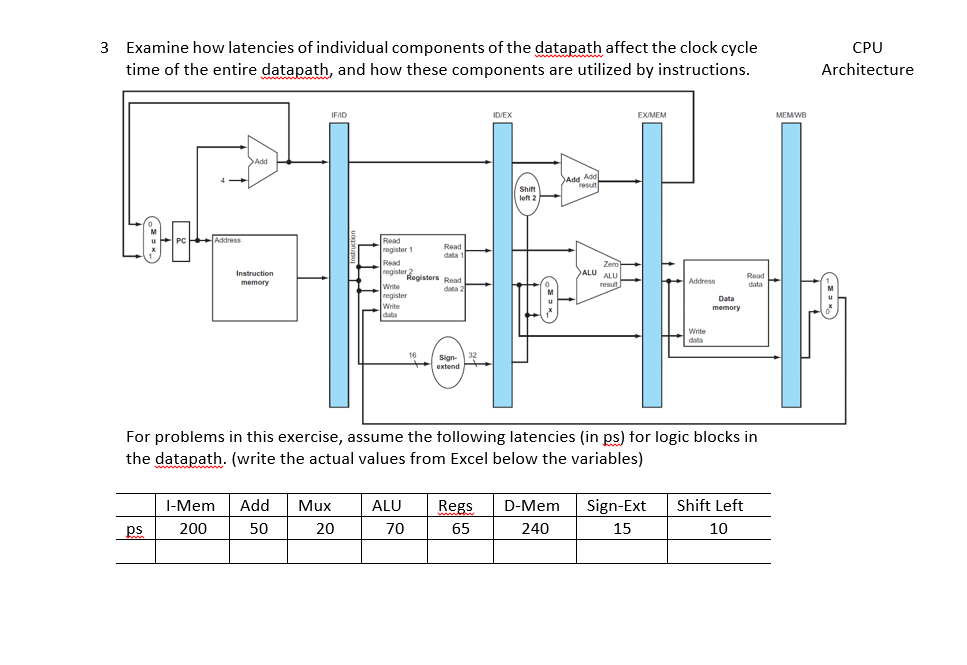
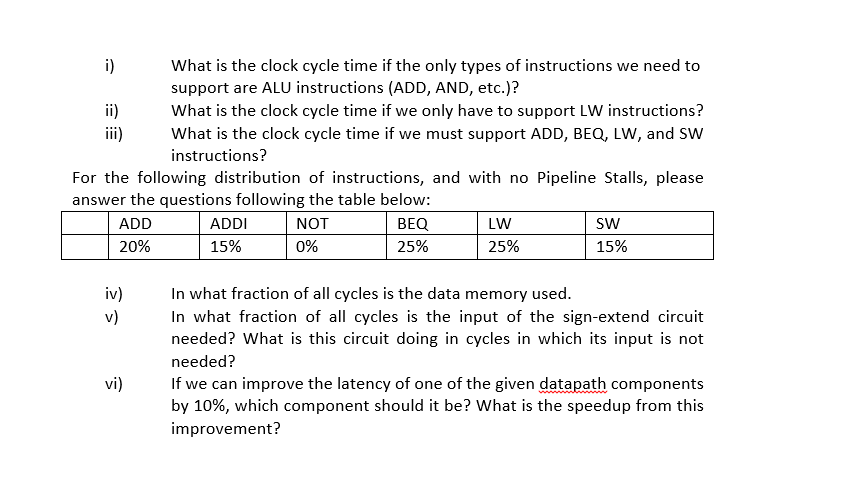
3 Examine how latencies of individual components of the datapath affect the clock cycle time of the entire datapath, and how these components are utilized by instructions. CPU Architecture IFAD ID/EX EX/MEM MEMWB > Add Add Add Shift loft 2 PC Address Read Zero Instruction memory Read register Read register Write register Write > ALU ALU hit Registers Read result Address Read data Data memory Write 16 Sign- extend 32 2 For problems in this exercise, assume the following latencies (in ps) for logic blocks in the datapath. (write the actual values from Excel below the variables) 1-Mem 200 Add 50 Mux 20 ALU 70 Regs 65 D-Mem 240 Sign-Ext 15 Shift Left 10 ps i) What is the clock cycle time if the only types of instructions we need to support are ALU instructions (ADD, AND, etc.)? ii) What is the clock cycle time if we only have to support LW instructions? What is the clock cycle time if we must support ADD, BEQ, LW, and SW instructions? For the following distribution of instructions, and with no Pipeline Stalls, please answer the questions following the table below: ADD ADDI NOT BEQ LW SW 20% 15% 0% 25% 25% 15% iv) v) In what fraction of all cycles is the data memory used. In what fraction of all cycles is the input of the sign-extend circuit needed? What is this circuit doing in cycles in which its input is not needed? If we can improve the latency of one of the given datapath components by 10%, which component should it be? What is the speedup from this improvement? vi)
Step by Step Solution
There are 3 Steps involved in it

Get step-by-step solutions from verified subject matter experts
 Study Help