







Question: 3. Explain corporate culture in light of ethical conduct. 4. Examine the compliance program ofa publicly held company. Does the company have a mission statement
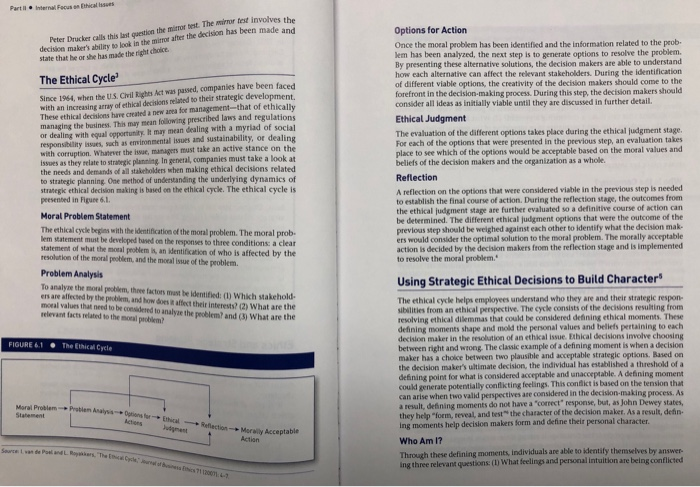
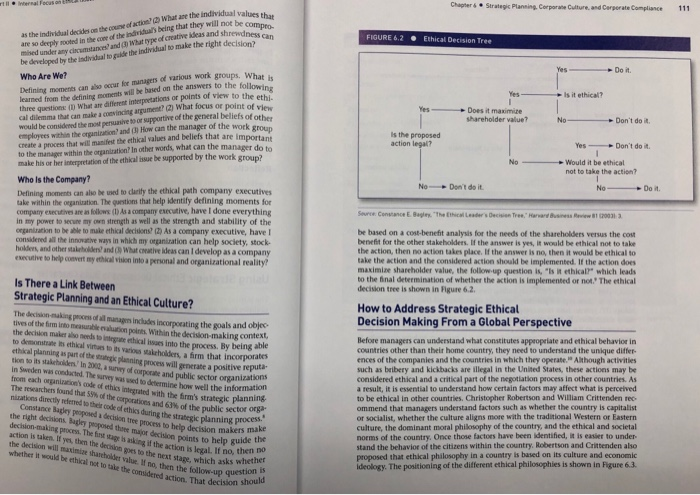
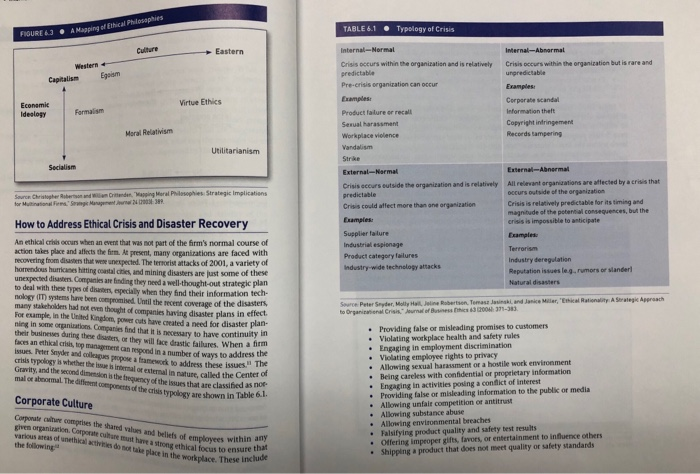
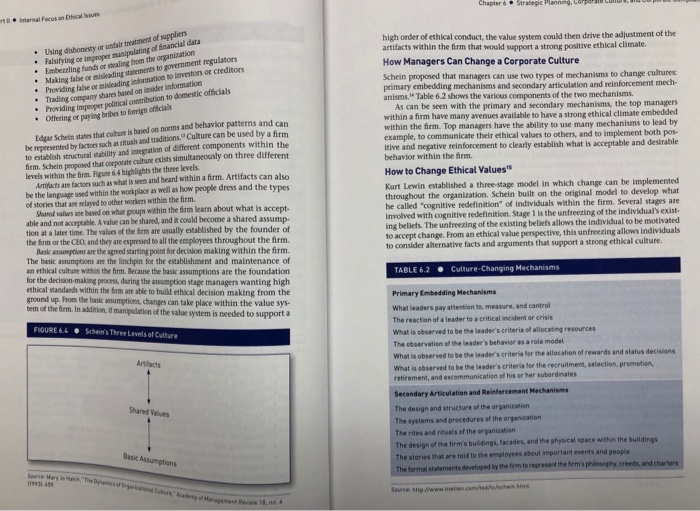
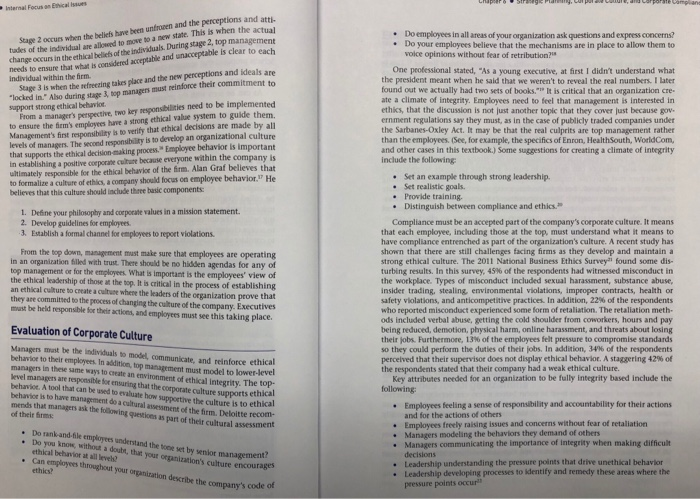
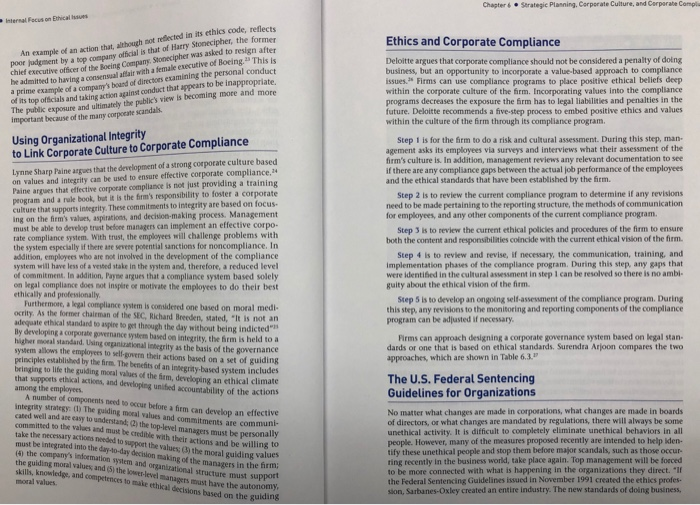
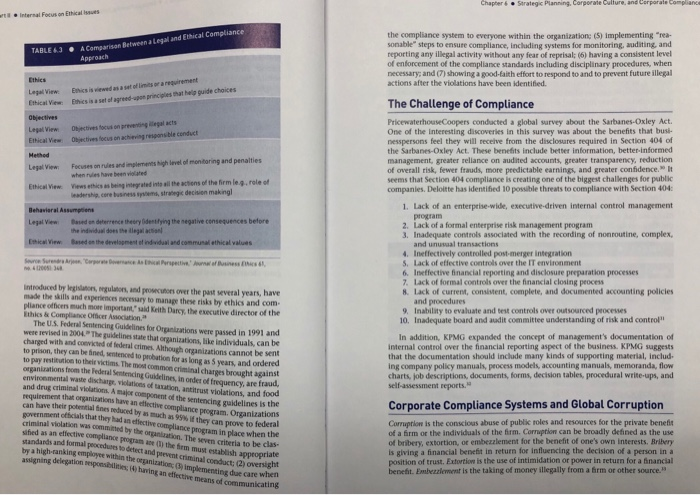
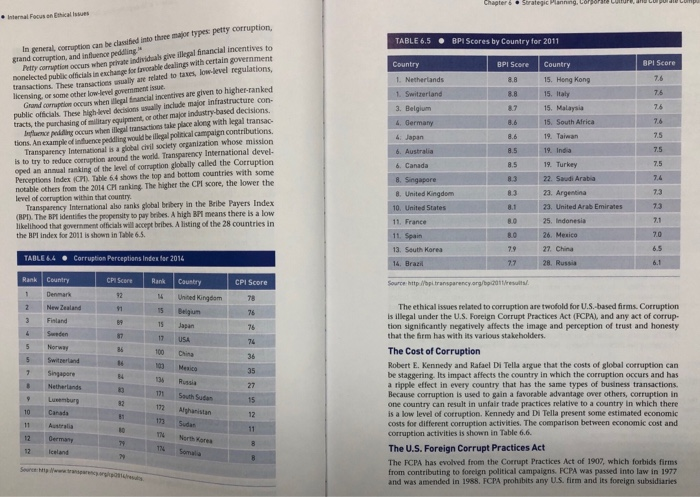
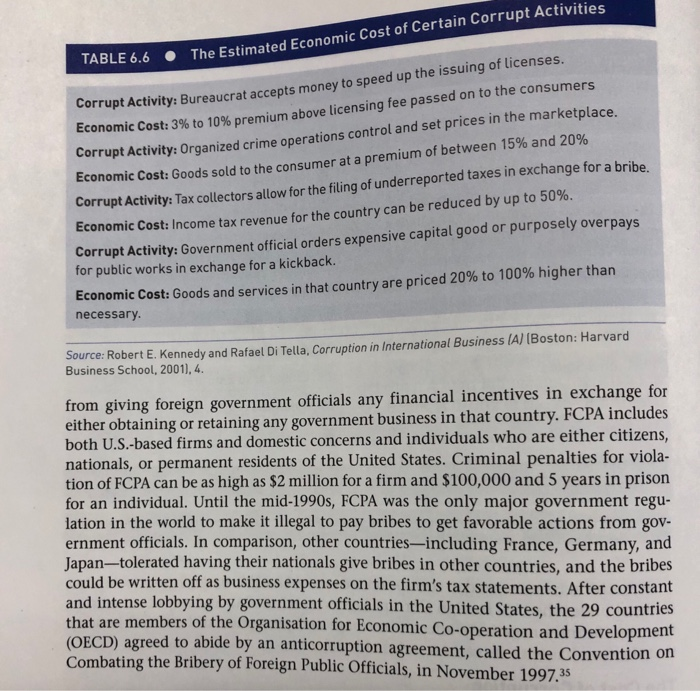
3. Explain corporate culture in light of ethical conduct. 4. Examine the compliance program ofa publicly held company. Does the company have a mission statement related to ethics? Comment on the program Part l Internal Focus on Ethical ssses decision maker's ability to look in the mitror after the decision has been made and state that he or she has made the right choice Options for Action Peter Drucker calls this last question the mitror Once the moral problem has been identified and the information related to the peob em has been analyzed, the next step is to generate options to resolve the peoblem. By presenting these alternative solutions, the decision makers are able to understand how each alternative can affect the relevant stakeholders. Duting the identification of different viable options, the creativity of the decision makers should come to the forefront in the decision-making process. During this step, the decision makers should consider all ideas as initially viable until they are discussed in further detail. The Ethical Cycle rice i964, when the US Chil Rights Act was passed, companies have been faced with an increasing array of ethical decisions related to their strategic developmen These ethical decisions have created a new area foe management-that of ethically managing the business This may men following prescribed laws and regulations Ethical Judgment or dealing with equal opportunily. It may mean dealing with a myriad of social responsiblilty lssues, such as environmental isues and sustainability, or dealing with corruption. Whatever the issue, managers must take an active stance on the issues as they relate to strategk planning In general, the needs and demands of all stakeholders when making ethical decisions related to strategic planning One method of understanding the underlying dynamics of strategk ethical decision making is based on the ethical cycle. The ethical cycle is peesented in Figure 6.1 The evaluation of the different options takes place during the ethical judgment stage. For each of the options that were presented in the previous step, an evaluation t place to see which of the options would be acceptable based on the moral values and beliefs of the decision makers and the organization as a whole. Reflection companies must take a look A reflection on the options that were considered viable in the peevious step is needed to establish the final course of action. During the reflection stage, the outcomes from the ethical judgment stage are further evaluated so a definitive course of action can be determined. The different ethical judgment options that were the outcome of the previous step should be weighed against each other to identify what the decision mak- ers would consider the optimal solution to the moral problem. The morally acceptable action is decided by the decision makers from the reflection stage and is implemented to resolve the moral problem Moral Problem Statement The ethical cycle begins with the identification of the moral problem. The moral prob lem statement must be developed bused on the responses to three statement of what the moral peoblem s, an identification of who is affected by the resolution of the moral peoblem, and the moeal issue of the peoblem Problem Analysis Using Strategic Ethical Decisions to Build Character To analyne the moral peoblem, thee factors mast be identified:(1) Whikh stakehold- ers are affected by the probilem, and how does iR affect their interests? (2) What are the moeal values that need to be considered to analyze the peoblem? and (3) What are the relevant facts related to the moal problem? The ethical cycle helps employees understand who they are and their strategic respon- ibilities from an ethical perspective. The cycle consists of the decisions resulting from resolving ethical dilemmas that could be considered defining ethical moments. These defining moments shape and mold the personal values and beliefs pertaining to each decision maker in the resolution of an ethical issue. Ethical decisions involve choosing between right and wrong. The classic example of a defining moment is when a decision maker has a choice between two plausible and acceptable strategic options. Based on the decision maker's ultimate decision, the individual has established a threshold of a FIGURE The EthicatCycle nt for what is considered acceptable and unacceptable. A defining moment ning poi coukd generate potentially contikting feelings. This conflict is based on the tension that can arise when two valild perspectives are considered in the decislon-making proc a result, defining they help "form, reveal, and test" the character of the decision maker. As a result, dein- ing moments help decision makers form and define their Who Am I? Moral Problem". Prebler,Analyss tor Ethical Statement moments do not have a "corect response, but, as John Dewey states, personal character * Actian these defining moments, individuals are able to identify themselves by answer ing threerelevant questions (a) What feelings and personal intuition are beting conflicted ChapterStrategic Planning, Corporate Culture and Cerperate Compliance 11 as the individual decides on the course of actioe d are so deply rooted in the core of the indiriduals being that they will not be c mised under any ciscumstances? and (3) Whut type of creative ideas and shrewde be developed tby the lndvidal t uide the indvisual to make the right decision?Can Who Are We? of action (2) What are the individual val be compro- FIGURE 6.2 Ethical Decision Tree Yes Defining moments can also occur for managers of various work grou learned from the defining moments will be based on the answers to the foll questions () What are different interpetations or points of view to the ett u be consideed the most persuasive to or s esIs it ethical? ethi- nt of view cal dilemma that can make a coevincing argument? (2) What focus or upportive of the general beliefs of other Does it maximize shareholder value? employees within the organization and (13) How can the manager of the work create a proces that will manifest the ethikal values and bellefs that are important to the manager within the organization? In other words, what can the manager do to is the proposed action legal Don't do it. muke his or her interpretation of the ethiail isue be supported by the work group? Who Is the Company? NoWould it be ethical not to take the action NoDon't do it No Defining moments can abo be u take within the oeganization The qurstions that help identify defining moments for company executives are an follows () As a company exccutive, have I done everything in my power to secune my own strength as well as the strength and stability of the oeganization to be able to make ethical decisons? () As a company executive, have I considened all the innovative ways in whikh my organization can help society, stock- holders, and other stakeholders and ) What cnative ideas can I develop as a company executive to help cnvert my ethical vision into a personal and organizational reality? used to clarify the ethical path company executives Serre. Constance E eagley, .The Ethical Leader . Decision Tree." HraryBesness Revvw81 0031.2 be based on a cost-benefit analysis for the needs of the shareholders versus the cos benefit for the other stakeholders. If the answer is yes, it would be ethical not to take the action, then no action takes place. If the answer is no, then it would be ethical to take the action and the considered action should be implemented. If the action does maximize shareholder value, the follow-up question is, "Is in ethical? which leads to the final determination of whether the action is implemented or not. The ethical decision tree is shown in Figure 6.2 Is There a Link Between Strategic Planning and an Ethical Culture? How to Address Strategic Ethical Decision Making From a Global Perspective The decision making processof ll mnages incluades incorpoeating the goals and objec tives of the firm into measuable evalution pones Within the decision-making cont the decision maker aso needs to intregane ethical insues into the process. By being to demonstrate its ethical vitaes to its various takehoilders, a firm that incorpor ethical planning as part of the stutegk planning process will generate a positive re tion to its stakeholdens In 2000, a survey of corporate and public sector organizatson in Sweden was condacted. The survey was used to determine how well the information from each organization' code of ethics integrated with the f6rm's strategic planning The researchers tund that 55% of the c Before managers can understand what constitutes appropriate and ethical behavior in countries other than their home country, they need to understand the unique differ- ences of the companies and the countries in which they operate." Although activities such as bribery and kickbacks are illegal in the United States, these actions may be considered ethical and a critical part of the negotiation process in other countries. As a result, it is essential to understand how certain factors may affect what is perceived to be ethical in other countries. Christopher Robertson and William Crittenden rec ommend that managers understand factors such as whether the country is capitalist or socialist, whether the culture aligns more with the traditional Western or Eastern culture, the dominant moral philosophy of the country, and the ethical and societal norms of the country. Once those factoes have been identified, it is easier to under- stand the behavior of the citizens within the country. Robertson and Crittenden also proposed that ethical philosophy in a country is based on its culture and economic ideology. The positioning of the different ethical philosophies is shown in Figure 6.3. Constance Bagley peoposed a decision the right decions Bagley peoposed thee major decision points to nizatikona directhy refote codk of ethiks during the strategic planning prak corporations and 63% of the public sector org dechion-making p tree process to help decision makers make process. The first stage is asking if the action is legal nther is taken. If yes, them the decislon the decsion will maximize sharcholder value If no, then the follow-up qustould will maxinize sharehoilder value. If no, then the follow-up it would be ethical not to take the considered action. That apes to the next stage, which asks wheth p question is TABLE 6.1 Typology of Crisis FIGURE 63 A Mapping of Ethic Culture Eastern Crisis occurs within the organization and is relatively Crisis occurs within the organization but is rare and predictable Pre-crisis organization can oecur Examples Product falure or recal Sexual harassment Workplace vielence unpredictable CapitalismEgoism Corporabe scandal Ieformation theft Virtue Ethics Econemic Idealogy Copyright infringement Records tampering Moral Relativism Utilitarianism Strke Secialism xternal-Narmal Crisis eccurs eutside the organizatien and is relatively All relevant organizations are affected by a crisis that lesophie. Strategic Implications occurs outside of the organization predictable Crisis could affect more than one organization Examples Supplier failure Industrial espionage Product category failures Industry- wide technelogy attacks Chilophe,Renonand wuan Crnandee, appingMral P Crisis is relatively predictablie for its timing and magnitude of the petential consequences, but the crisis is impossible to anticipate How to Address Ethical Crisis and Disaster Recovery Examples Anethical crisis con hn an event that was part of the firm's normal course of action takes place and affects the irm. At present, many organizations are faced with recovering from disasters that wese unexpected. The ternorise attacks of 2001, a variety of horrendous hurricanes hitting coastal citlies, and mining disasters are just some unexpected disasners, Compunis are inding they need a well-thought-out s to deal with these types of disaters, especially when they find their information tech nology (IT) systems huve been compromised Until the recent coverage of the disasters many stakehoilders had not even thought of companies having disaster plans in effect For example, in the United Kingdom, power cuts have created a need for disaster plan- ning in some orpanizations Comparies find that it is necessary to have continuity in their busineses during these disasters, or they will face drastic failures. When a hai faces an ethical crists, top management can respond in a number of ways to ad e issues Peter Snyder and colleaues peopose a framewock to address these crisis typology is whether the issue is indernal or external in nature, called the Gravity, and the second dinension is the frequency of the issues that are classibed as Industry deregulation Reputation issues leg rumors or slanderl of these strategic plarn Robertsen Temass Jasingkl and Janice iller,Ethical Rationality A Strategkc Appraac Saurce Peter Sryder,Molly Hall Jeline R to Organinatienal Crisis," Journal of Business thic 63 12004 371-383 Providing false or misleading promises to customers Violating workplace health and safety rules Engaging in employment discrimination Violating employee rights to privacy .Allowing sexual harassment or a hostile work environment mal or sheormal The diffen components of the ahsis typology are shown in Table Corporate Culture Corponate cwhere Being careless with confidential or propeietary information Engaging in activities posing a confict of interest Providing false or misleading information to the public or media Allowing unfair competition or antitrust Allowing substance abuse Allowing environmental breaches Falsifying product quality and safety test resalts Offering impeoper gifts, favors, or entertainment to influence others Shippinga product that does not meet quality or safety standards Center of Table 6 uiture comprises the shared values and bellefs of employees with within any organiration, Corpoate cultare must have a strong ethical focus to ene nclude . varius areas of unethical actvitles do not take place in the workplace. T the following workplace. These include i tInternal Focus on Ethical Isus high order of ethical conduct, the value system could then drive the adjustment of the artifacts within the firm that would support a strong positive unfair treatment of suppliers Using dishonesty or untair treatment of alsifying or improper manipulating of Snancial data ethical climate. Making false oe miskading statements to government regulators Providing false or miseading indormation to lnvestoes or Ing funds or stealing from the onganization How Managers Can Change a Corporate Culture Schein proposed that managers can use two types of mechanisms to change cultures primary embedding mechanisms and anisms.1 Table 6.2 shows the various components of the two mechanisms Trading company shares buased on insider information secondary articulation and reinforcement mech- Providing Impeoper political contribation to Offering or paying bribes to foreign offcials As can be seen with the primary and secondary mechanisms, the top managers within a firm have many avenues available to have a strong within the firm. Top managers have the ability to use many mechanisms to lead by example, to communicate their ethical values to others, and to implement both pos- ethical climate embedded repeesented by factors such as rituals and traditions. Culture can be used levels within the firm. Figune 6.4 highlights the theee levels of stories that are relayed to other workers within the firm. Edgar Schein states that cultune is based on norms and behavior patterns and ca to estalblish structural sability and integration of different components within the frm. Schein proposed that corporate culture exists simultancously on three different tive and negative reinforcement to clearly establish what is acceptable and desirable behavior within the irm. How to Change Ethical Values Aifacts are factons such as what is seen and heard within a firm. Artifacts can also be the language used within the workplace as we'll as how people dress and the types Kurt Lewin established a three-stage model in which change can be implemented throug he called "cognitive redefinition of individuals within the firm. Several stages a involved with cognitive redefinition. Stage 1 is the unfreezing of the individual's exist ing beliefs. The unfreezing of the existing beliefs allows the individual to be mot to accept change. From an ethical value perspective, this unfreezing allows individuals to consider alternative facts and arguments that support a strong ethikal c hout the organization. Schein built on the original model to develop what Shand valwes ane based on what gpoups within the firm learn about what is accept a shared assump- tion at a later time. The values of the frm are usually established by the founder of the hrm or the CEO, and they are expressed to all the employees throughout the firm. Rasic assumprions are the agreed starting point for decision making within the firm. The basic assumptions are the linchpin for the establishment and maintenance of an ethical culture within the firm. Because the basik assumptions are the foundation for the decision-making proces, during the assumption stage managers wanting high ethical standards within the firm are able to build ethical decision making from the ground up. From the baskc assumptions, changes can take place within the value sys- em of the 6rm. In addeion, if manipulation of the value system is needed to support a TABLE 6.2 Culture-Changing Mechanisms What leaders pay attention to, measure, and control The reaction of a leader to a critical incident or crisis What is observed to be the leader's criteria of allocating resources The observation of the leader's behavior as a role model What is observed to be the leader's criteria for the allocation of rewards and status decisions What is observed to be the leader's criteria fer the recruitment, selection, retirement, and excommunication of his or her subordinates Secondary Articulation and Reinfercement Hechanisms The design and structure of the arganization The systems and procedures of the organiration The rites and nituals of the organization The design of the firm's buildings, facades, and the physical space within the buildings The stories that are toid to the eemogloyees about important events and people The formal statements developed by the frm to represent the Srm's philesophy FIGURE 64 Schein's Three Levels of Culture Artfacts promotion, and charters view 18, no Chapter&Strategic Planning, Carperate Culture, and Cerparabe Complia Internal Focus on Ethical hsus ot re ected in its ethics code, reflects Ethics and Corporate Compliance An example of an action that, although poor judgment by a top company oficial is that of Harry St chief executive officer of the Boeing he admithed to having a consensual af lair with a temale executive of Boeing.3 This is a prime example of a compamy's board of directors examining the personal conduct Deloitte argues that corporate compliance should not be considered a penalty of doing business, but an opportunity to incorporate a value-based approach to compliance issues.3 Firms can use compliance programs to place positive ethical beliets deep within the corporate culture of the firm. Incorporating values into the compliance programs decreases the exposure the 6rm has to legal liabilities and penalties in the future. Deloitte recommends a five-step process to embed positive ethics and values within the culture of the firm through its compliance program. Company. Stonecipher was asked to resign after of its top officials and taking action against conduct that appears to be inappropriate, The public exposure and ultimately the publkc's view is becoming more and more important because of the many corpoeate scandals Using Organizational Integrity to Link Corporate Culture to Corporate Compliance Step 1 is for the firm to do a risk and cultural assessment. During this step, man- agement asks its employees via surveys and interviews what their assessment of the firm's culture is. In addition, management reviews any relevant documentation to see if there are any compliance gaps between the actual job performance of the employees Lynne Sharp Paine argues that the development of a strong corporate culture based on values and integrity can be used to ensure effective corporate compliance, 14 Paine argues that effective corporate compliance is not just providing a training peogram and a rule book, but it is the frm's responsibility to foster a corporate culture that supports integrity. These commitments to integrity are based on focus- ing on the frm's values, aspirations, and decision-making process. Management must be able to develop trust before managers can implement an effective corpo- rate compliance system. With trust, the employees will challenge problems with the system especially if there are severe poeential sanctions for noncompliance. In addition, employees who are not involved in the development of the compliance system will have less of a vested stake in the system and, therefore, a reduced level of commitment. ln addition, Payse argues that a compliance system based solely on legal compliance does not inspire oe motivate the employees to do their best ethically and professionally and the ethical standards that have been established by the firm. Step 2 is to review the current compliance program to determine if any revisions need to be made pertaining to the reporting structure, the methods of communication for employees, and any other components of the current compliance program Step 3 is to review the current ethical policies and procedures of the firm to ensure both the content and responsibilities colncide with the current ethical vision of the firm. Step 4 is to review and revise, if necessary, the communication, training, and implementation phases of the compliance program. During this step, any gaps that were identied in the cultural assessment in step 1 can be resolved so there is no ambi- guity about the ethical vision of the firm. Step 5 is to develop an ongoling self-assessment of the compliance program. During this step, any revisions to the monitoring and reporting components of the compliance Furthermore, a legal compliance system is considered one based on ocrity. As the former chairman of the SEC, Richard Breeden, stated, "It is not an adequate ethical standard to aspine to get through the day without being indicted" program can be adjusted if necessary By developing a corporate governance system based on integrity, the frm is held to a higher moal standard. Using oeganizational integrity as the basis of the governance ystem allows the employees to self-govern their actions based on a set of guiding peinciples etablished by the frm. The benefits of an integrity-based system includes Firms can approach designing a corporate governance system based on legal stan- dards or one that is based on ethical standards. Surendra Arjoon compares the two approaches, which are shown in Table 6.3. to life the gukding moeal values of the frm, developing an eth that supports ethical actioes, and developing unifed accountability of the ac climate actions The U.S. Federal Sentencing Guidelines for Organizations A number of components need to occur before a firm can develop an effective integrity strategy: (1) The guiding mocal values and commitments are comm cated well and ase easy to understand, (2) the top-level managers must be personally commited to the valaes and must be credible with their actions and be willing to take the necessary actioes needed to support the values:(3) the moral guiding values must be integrated into the dary-to-day decision i the company's information system and organirational structure must suppor the guiding moral values and (5) the lower-level skills, knowledge, and competences to make No matter what changes are made in corporations, what changes are made in boards of directors, or what changes are mandated by regulations, there will always be some unethical activity. It is difficult to completely eliminate unethical behaviors in all people. However, many of the measures proposed recently are intended to help iden- tify these unethical people and stop them before major scandas, such as those occur- ring recently in the business world, take place again. Top management will be foeced to be more connected with what is happening in the organizations they direct. the Federal Sentencing Guidelines issued in November 1991 created the ethics profes making of the managers in the firm managers must have the autonomy, created an entire industry. The new standards of doing business, a Internal Focus on Ethical Issues the compliance system to everyone within the organization; (5) Implementing "rea sonable" steps to ensure compliance, including systems foe monitoring, auditing, and reporting any illegal activity without any fear of reprisal; (6) having a consistent level of enforcement of the compliance standards including disciplinary procedures, when necessary; and (7) showing a good-faith effort to respond to and to prevent future illegal actions after the violations have been identified. TABLE 3 A Comparison Between a Legal and Ethical Compliance Legl iw cs iwd as a set of liis or a requirement Ettical Viw: Ethics is a set of agreed-upan principles that help guide choices Objectives Legal ViewObjectives focus on preventing legal acts Ethical View Objectives fecus on achieving responsble conduct Methed Legal Viw Fecuses on rules and inglements high levet of menitaring and penalties The Challenge of Compliance I survey about the One of the interesting discoverles in this survey was about the benefits that busi- nesspersons feel they will receive from the disclosuares required in Section 404 of the Sarbanes-Oxley Act. These benelits include better information, better-informed management, greater relance on audited accounts, greater transparency, reduction of overall risk, fewer frauds, more predictable earnings, and greater confidence. It seems that Section 404 compliance is creating one of the biggest chalenges for public companies. Deloitte has identified 10 possible threats to compliance with Section 404: when rules have been visate Ethical Viewe Views ethics as being integ ated into all the aciens of the firm leg. rolef nadershig core business sysiems, strategic decisien makingl 1. Lack of an enterprise-wide, executive-driven internal control management Behavioral Assumpiens Legal v"", ed d'errenc. theery Gdentrying the negative consequences before program 2. Lack of a formal enterprise risk management program the individual does the dlegalac 3. Inadequate controls associated with the recording of nonroutine, complex, iew Based on the development et indvidual and commusal ethical values and unusaal transactions 4. Ineffectively controlled post-merger integration 5, Lack of effective controls over the IT environment 6. Ineffective financial repoeting and disclosure preparation processes 7. Lack of formal controls over the financial closing peocess introduced by legsnons,egulasors,and prosmecutors over the past several years, have made the skills and experinces necessary to manage these risks by ethics and com pliance officern much more important sald Keith Darcy, the executive directoe of the Ethics & Compliance Officer Asociation 8. Lack of current, consistent, complete, and documented accounting policies and procedures 9 Inability to evaluate and test controls over outsourced processes 10, Inadequate board and audit committee understanding of risk and control" The U.S. Federall Sentencing Guidelines for Organirations were passed in 1991 and were revised in 2004 The guidelines state that organizations, like individuals, can be charged with and coevicted of federal crimes. Although to pay restitution to their victims The most common criminal charge environmental waste discharge, viclations of taxation, antitrust violations, In addition, KPMG expanded the concept of management's documentation of internal control over the financial reporting aspect of the business.KPMG suggests that the documentation should include many kinds of supporting material, includ- ing company policy manuals, peocess models, accounting manuals, memoranda, flow charts, job descriptions, documents, forms, decision tables, procedural write-ups, and to prison, they can be fned sentenced to probation for as long as 5 years, and ordered organizations cannot be sent organirations fnom the Federal Semtencing Guidelines, in order of frequency, are fraud and drug criminal viclations. A majoe component of the sentencing guidelines is the requirement that organizations have an efective compliance program. Organizations can have their potential tnes reduced by as much as 95% if theycan prove to federal self-assessment reports. Corporate Compliance Systems and Global Corruption and food nt otticials that they had an efective compliance criminal violation was commisted by the standards and formal peoceduses to detect and assigning delegation besponslties; (4) hurvin Corraption is the conscious abuse of public roles and resources for the private benetit of a firm or the individuals of the firm. Corruprion can be broadly defined as the use of bribery, extortion, or embezzlement for the benefit of one's own interests. Brilvery is giving a financial benetit in return for influencing the decision of a person in a position of trust. Extortiow is the use of intimidation or power in return for a inancial sifed as an etfective compliance program ace () the firm must establish appeopriate The seven criteria to be clas- high-canking employe within theiminal conduct: (2) oversight rganization (3) implementing due care when ng an effective means of coemmunicatinjg benefit. Embezzlement is the taking of money illegally from a hrm or other source.a a * Internal Focus on Ethical Issues TABLE 6.5 BPIScores by Country for 2011 Petty carmuption occurs when private individsals give illegal financial incentives to onelected publik officials in exchange for favceable dealings with certain government transactions. These transactioes usually are related to taxes, low-lJevel regulations a general, coeruption can be classified into three major types: petty corruption, grand corruption, and influence peddling BPI Score Country 1. Netherlands Grand cormupeion occurs when ilegal francial incentives are given to higher-ranked public officials These high level decisions usually inchade major infrastructure con tracts, the purchasing of military equipment, or other majoe induastry-based decisions. 15. Heng Kong 15. Italy 15. Malaysa 7.6 lcensing, or some other low-level government issue. 3. Belgium 15. South Africa lyfwence peiding tions. An example of intruence pedding would be illegal polrica Germany 4: Japan occurs when ilkgal transactions take place along with legal transac- al ampaign contributions. 7.5 7.5 7.5 19. Taiwan 19. India 19. Turkey 22. Saudi Arabia 23. Argentina 23. United Arab Emirates 25. Indonesia 26. Mexico 27. China Transparency International is a global civil society organization whose mission is to try to reduce coeruption around the world. Transparency International devel- oped an anual ranking of the level of corruption globally called the Corruption Perceptions Index (CPI). Table 64 shows the top and bottom countries with some notable others from the 2014 CPH ranking The higher the CPI score, the lower the 6. Canada 8. Singapore 8. United Kingdom 8.5 8.5 83 7.3 level of corruption within that country Transparency International also tanks global bribery in the Bribe Payers Index (BPT). The BPI identifes the peopensity to pay bribes. A high BPi means there is a low lilkelihood that government officials will accept bribes. A listing of the 28 countries in 10. United State 11. France 7.1 the BPl index for 2011 is shown in Table 6.5. 13. South Korea TABLE &4 Corruption Perceptions Index for 2014 CPI Scere Rank Country CPI Score Source http Mbpi transparency.arg/bp s 4 United Kingdom Beigum 2 NewZealand The ethical issues related to corruption are twoold for U.S.-based firms. Corruption is illegal under the U.S. Foreign Corrupt Practices Act (FCPA) and any act of corrup- tion significantly negatively affects the image and perception of trust and honesty that the frm has with its various stakeholders. 3 Finland 15 Japan 17 USA 100 China 03 Mesico 136 Russia 171 Sauth 172 Alghanistan 173 Suda 4 North Korea 87 5 Norway 5 Switeerland 7 Singapore 86 The Cost of Corruption Robert E. Kennedy and Rafael Di Tella argue that the costs of global corruption can be staggering. Its impact affects the country in which the corruption occurs and has ripple effect in every country that has the same types of business transactions Because corruption is used to gain a favorable advantage over others, corruption in one country can result in unfair trade practices relative to a country in which there is a low level of corruption. Kennedy and Di Tella present some estimated economic costs foe different corruption activities. The comparison between economic cost and corruption activities is shown in Table 6.6 The U.S. Foreign Corrupt Practices Act The FCPA has evolved from the Corrupt Practices Act of 1907, which forbids firms from contributing to foeeign political campaigns. FCPA was passed into law in 1977 and was amended in 1988. FCPA prohibits any US. firm and its foreign subsidiaries 27 12 Iceland
Step by Step Solution
There are 3 Steps involved in it

Get step-by-step solutions from verified subject matter experts
 Study Help