







Question: 3 Filling in a simple linear regression ANOVA table Suppose we have a simple linear regression setting, where we have sampled 100 (X, Y) pairs
3 Filling in a simple linear regression ANOVA table
Suppose we have a simple linear regression setting, where we have sampled 100 (X, Y) pairs of values. When running a simple linear regression on this data, we find that 12% of the variance in Y can be explained by the linear relationship with X. If we completely ignore X, and calculate the sample variance of the Y values, we find that it's 50.0.
Complete the simple linear regression ANOVA table (the full table, as seen in class). Use R to find the p-value, and include that as well.
Filling in a one-way ANOVA table
To find the p-value for this question, you'll need to use R's pfcommand. pf yields values of the cumulative distribution function of the F distribution. For example,
pf(2.712,14,104)
yields 0.9980472, which is the area to the left of 2.712 under an F distribution with 14 and 104 degrees of freedom. (In other words, if X? F14,104, then P(X? 2.712) = 0.9980472.The p-value is not the area to the left, but we can use this area to find the p-value.
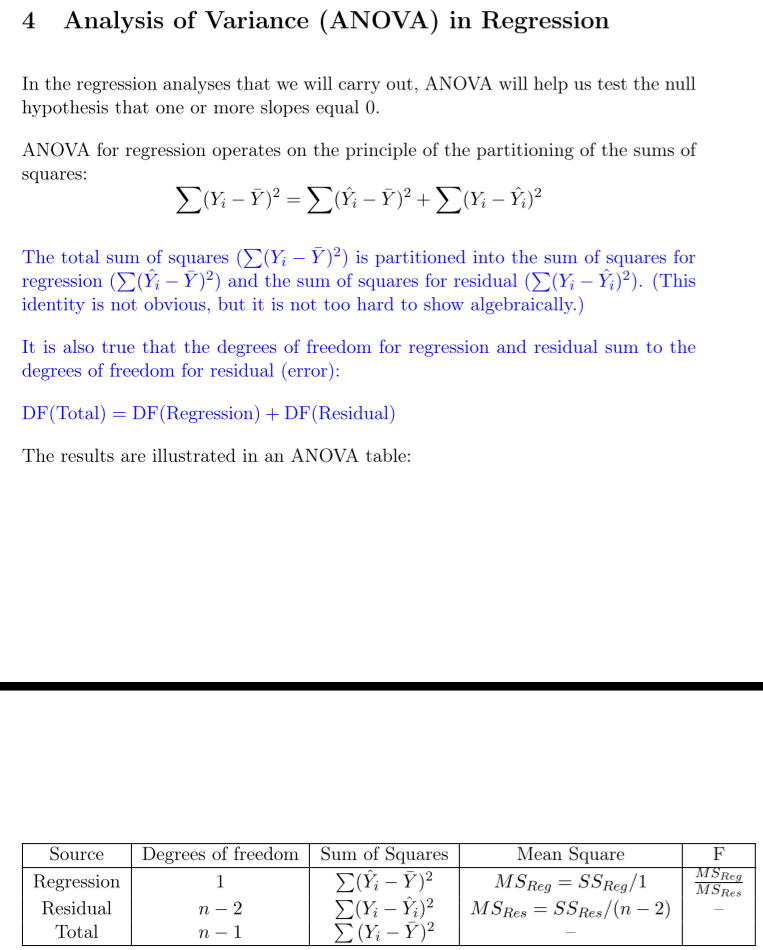
4 Analysis of Variance (ANOVA) in Regression In the regression analyses that we will carry out, ANOVA will help us test the null hypothesis that one or more slopes equal 0. ANOVA for regression operates on the principle of the partitioning of the sums of squares: [ (vi - n) = [ m - ) + [(x-x)? The total sum of squares (E(Y; - Y)?) is partitioned into the sum of squares for regression (E(Y - Y)2) and the sum of squares for residual (E(Y; - Y;)?). (This identity is not obvious, but it is not too hard to show algebraically.) It is also true that the degrees of freedom for regression and residual sum to the degrees of freedom for residual (error): DF(Total) = DF(Regression) + DF(Residual) The results are illustrated in an ANOVA table: Source Degrees of freedom Sum of Squares Mean Square F Regression E( Yi - Y)2 MSReg = SSReg/ 1 MSReg MSRes Residual n 2 E(Yi - Y:)2 MSRes = SSRes/ (n - 2) Total E(Y - Y)2
Step by Step Solution
There are 3 Steps involved in it

Get step-by-step solutions from verified subject matter experts
 Study Help