







Question: #3. For this question you will be working with data I have downloaded from https://databank.worldbank.org/source/world-development-indicators. The data provided in EXCEL (which you can open/copy paste
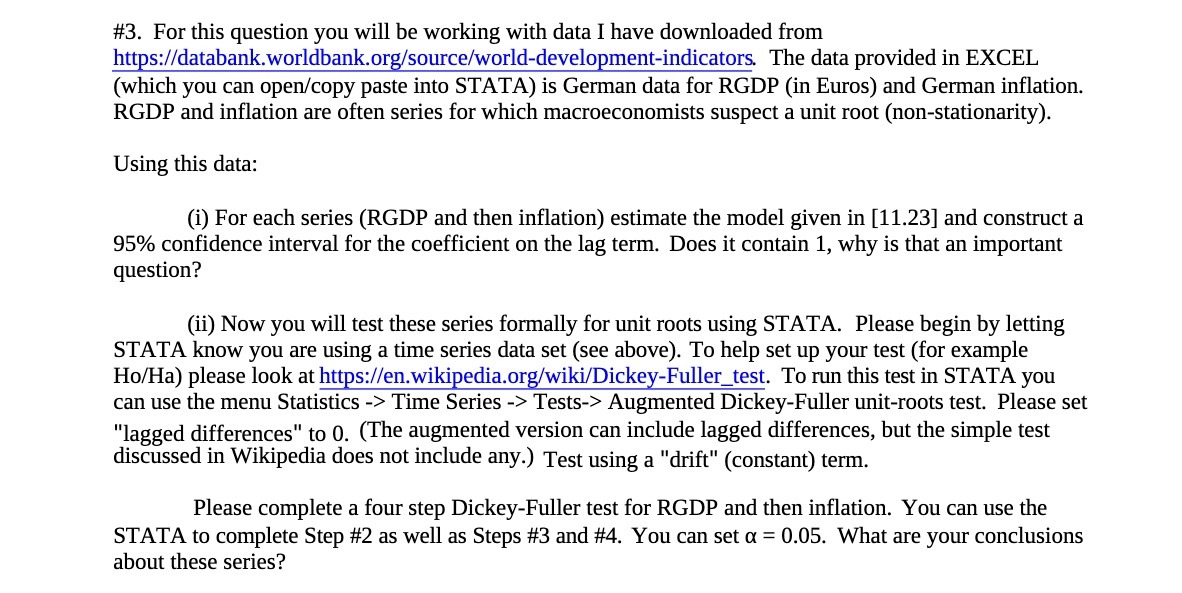
#3. For this question you will be working with data I have downloaded from https://databank.worldbank.org/source/world-development-indicators. The data provided in EXCEL (which you can open/copy paste into STATA) is German data for RGDP (in Euros) and German inflation. RGDP and inflation are often series for which macroeconomists suspect a unit root (non-stationarity). Using this data: (i) For each series (RGDP and then inflation) estimate the model given in [11.23] and construct a 95% confidence interval for the coefficient on the lag term. Does it contain 1, why is that an important question? (ii) Now you will test these series formally for unit roots using STATA. Please begin by letting STATA know you are using a time series data set (see above). To help set up your test (for example Ho/Ha) please look at https://en.wikipedia.org/wiki/Dickey-Fuller_test. To run this test in STATA you can use the menu Statistics -> Time Series -> Tests-> Augmented Dickey-Fuller unit-roots test. Please set "lagged differences" to 0. (The augmented version can include lagged differences, but the simple test discussed in Wikipedia does not include any.) Test using a "drift" (constant) term. Please complete a four step Dickey-Fuller test for RGDP and then inflation. You can use the STATA to complete Step #2 as well as Steps #3 and #4. You can set a = 0.05. What are your conclusions about these series
Step by Step Solution
There are 3 Steps involved in it

Get step-by-step solutions from verified subject matter experts
 Study Help