







Question: 3. Given the flowing languagefa.b) Show that the language L is decidable by constructing a Turing Machine to decide if any string is in L
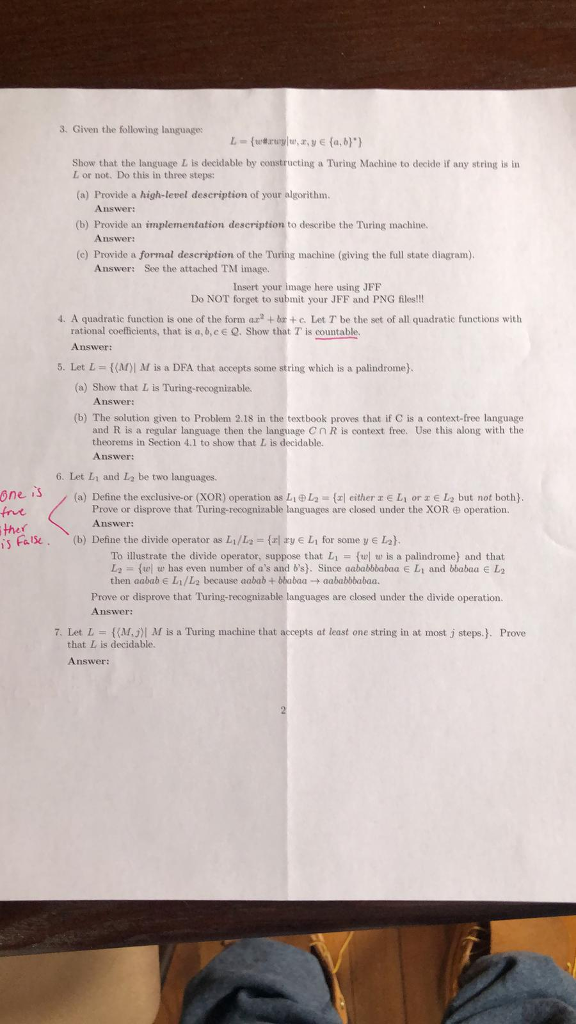
3. Given the flowing languagefa.b) Show that the language L is decidable by constructing a Turing Machine to decide if any string is in L or not. Do this in three steps: (a) Provide a high-level description of your algorithm Answer: (b) Provide an implementation description to describe the Turing machine Answer: (c) Provide a formal description of the Turing machine (giving the full state diagram) Answer: See the attached TM image. the attached TM image Insert your image here using JFF Do NOT forget to submit your JFF and PNG files!!! 4. A quadratie function is one of the form ar+r. Let T be the set of all quadratic functions with rational coefficients, that is a, b,ceQ. Show that T is countable. Answer: 5. Let L-M) M is a DFA that accepts some string which is a palindrome) (a) Show that L is Turing-recogn Answer: (b) The solution given to Problem 2.18 in the textbook proves that if C is a context-free language and R is a regular language then the language Cn R is context free. Use this along with the theorems in Section 4.1 to show that L is decidable. Answer: 6. Let Li and La be two languages. one . s frue (a) Define the exclusive-or (XOR) operation as Li 2-( either z E Li or z E L2 but not both). Prove or disprove that Turing-recognizable languages are closed under the XOR Answer: / operation. is faise (b) Define the divide operator as Li/L2-tr(ry e li for some y E L2). To illustrate the divide operator, suppose that L1 = w is a palindrome) and that L fl w has even number of a's and b's). Since aababbabaa e L and bbabea e L2 then eabab E L/L2 because aabab +bbabaa+ aababbbabaa. Prove or disprove that Turing-recognizable languages are closed under the divide operation. Answer: 7. Let L = {{M,j)| M is a Turing machine that accepts at least one string in at most j steps.), Prove that L is decidable. Answer: 3. Given the flowing languagefa.b) Show that the language L is decidable by constructing a Turing Machine to decide if any string is in L or not. Do this in three steps: (a) Provide a high-level description of your algorithm Answer: (b) Provide an implementation description to describe the Turing machine Answer: (c) Provide a formal description of the Turing machine (giving the full state diagram) Answer: See the attached TM image. the attached TM image Insert your image here using JFF Do NOT forget to submit your JFF and PNG files!!! 4. A quadratie function is one of the form ar+r. Let T be the set of all quadratic functions with rational coefficients, that is a, b,ceQ. Show that T is countable. Answer: 5. Let L-M) M is a DFA that accepts some string which is a palindrome) (a) Show that L is Turing-recogn Answer: (b) The solution given to Problem 2.18 in the textbook proves that if C is a context-free language and R is a regular language then the language Cn R is context free. Use this along with the theorems in Section 4.1 to show that L is decidable. Answer: 6. Let Li and La be two languages. one . s frue (a) Define the exclusive-or (XOR) operation as Li 2-( either z E Li or z E L2 but not both). Prove or disprove that Turing-recognizable languages are closed under the XOR Answer: / operation. is faise (b) Define the divide operator as Li/L2-tr(ry e li for some y E L2). To illustrate the divide operator, suppose that L1 = w is a palindrome) and that L fl w has even number of a's and b's). Since aababbabaa e L and bbabea e L2 then eabab E L/L2 because aabab +bbabaa+ aababbbabaa. Prove or disprove that Turing-recognizable languages are closed under the divide operation. Answer: 7. Let L = {{M,j)| M is a Turing machine that accepts at least one string in at most j steps.), Prove that L is decidable
Step by Step Solution
There are 3 Steps involved in it

Get step-by-step solutions from verified subject matter experts
 Study Help