



Question: 3. Graphing quadratic polynomials. Consider the functions f (z) = % (z + 2)2 + % and g (z) = (@+3)(z1): (a) One of the
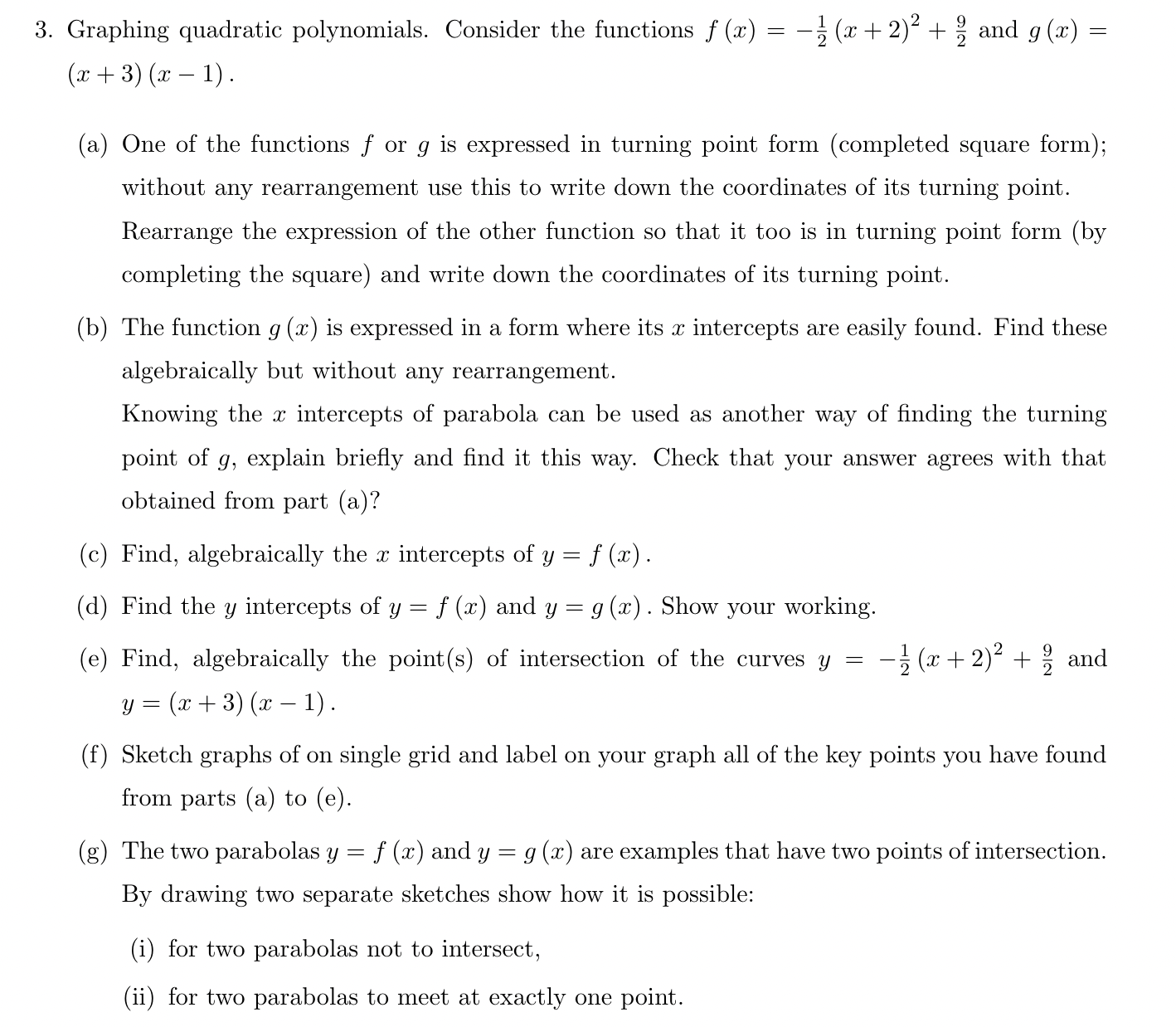
3. Graphing quadratic polynomials. Consider the functions f (z) = % (z + 2)2 + % and g (z) = (@+3)(z1): (a) One of the functions f or g is expressed in turning point form (completed square form); (b) (c) (d) (e) (f) without any rearrangement use this to write down the coordinates of its turning point. Rearrange the expression of the other function so that it too is in turning point form (by completing the square) and write down the coordinates of its turning point. The function g () is expressed in a form where its x intercepts are easily found. Find these algebraically but without any rearrangement. Knowing the x intercepts of parabola can be used as another way of finding the turning point of g, explain briefly and find it this way. Check that your answer agrees with that obtained from part (a)? Find, algebraically the x intercepts of y = f (). Find the y intercepts of y = f (z) and y = g (). Show your working,. Find, algebraically the point(s) of intersection of the curves y = % fex9)* g g and y=(z+3)(x1). Sketch graphs of on single grid and label on your graph all of the key points you have found from parts (a) to (e). The two parabolas y = f (x) and y = g (x) are examples that have two points of intersection. By drawing two separate sketches show how it is possible: (i) for two parabolas not to intersect, (ii) for two parabolas to meet at exactly one point
Step by Step Solution
There are 3 Steps involved in it

Get step-by-step solutions from verified subject matter experts