







Question: 3. If a program has 471 bytes and will be loaded into page frames of 100 bytes each, and the instruction to be used is
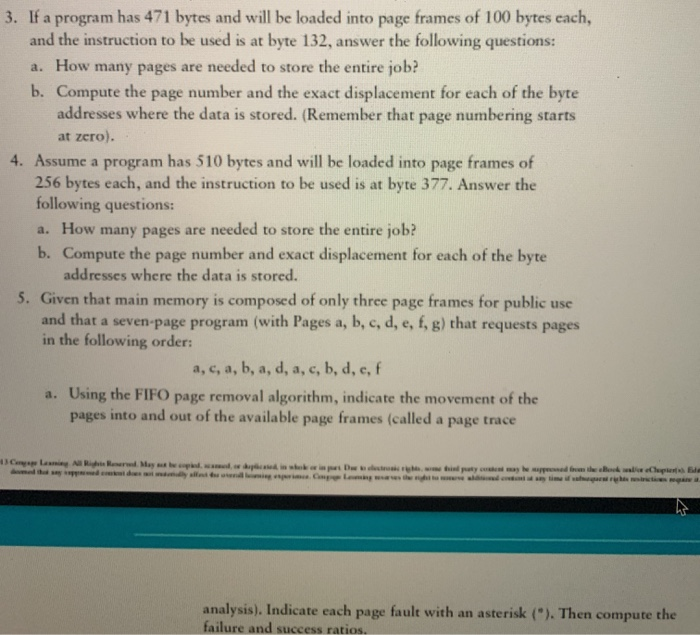
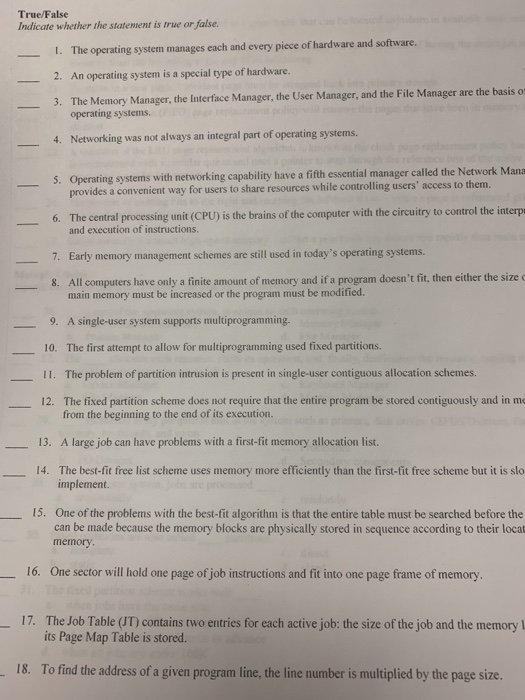
3. If a program has 471 bytes and will be loaded into page frames of 100 bytes each, and the instruction to be used is at byte 132, answer the following questions: a. How many pages are needed to store the entire job? b. Compute the page number and the exact displacement for each of the byte addresses where the data is stored. (Remember that page numbering starts at zero). 4. Assume a program has 510 bytes and will be loaded into page frames of 256 bytes each, and the instruction to be used is at byte 377. Answer the following questions: a. How many pages are needed to store the entire job? b. Compute the page number and exact displacement for each of the byte addresses where the data is stored. 5. Given that main memory is composed of only three page frames for public use and that a seven-page program (with Pages a, b, c, d, e, f, g) that requests pages in the following order: a, c, a, b, a, d, a, c, b, d, c, f a. Using the FIFO page removal algorithm, indicate the movement of the pages into and out of the available page frames (called a page trace analysis). Indicate each page fault with an asterisk (*). Then compute the failure and success ratios. True/False Indicate whether the statement is true or false. 1. The operating system manages each and every piece of hardware and software. 2. An operating system is a special type of hardware. 3. The Memory Manager, the Interface Manager, the User Manager, and the File Manager are the basis o operating systems. 4. Networking was not always an integral part of operating systems. 5. Operating systems with networking capability have a fifth essential manager called the Network Mana provides a convenient way for users to share resources while controlling users' access to them. The central processing unit (CPU) is the brains of the computer with the circuitry to control the interp and execution of instructions. 7. Early memory management schemes are still used in today's operating systems. 8. All computers have only a finite amount of memory and if a program doesn't fit, then either the size main memory must be increased or the program must be modified 9. A single-user system supports multiprogramming. 10. The first attempt to allow for multiprogramming used fixed partitions. II. The problem of partition intrusion is present in single-user contiguous allocation schemes. 12. The fixed partition scheme does not require that the entire program be stored contiguously and in me from the beginning to the end of its execution. 13. A large job can have problems with a first-fit memory allocation list. 14. The best-fit free list scheme uses memory more efficiently than the first-fit free scheme but it is slo implement 15. One of the problems with the best-fit algorithm is that the entire table must be searched before the can be made because the memory blocks are physically stored in sequence according to their locat memory 16. One sector will hold one page of job instructions and fit into one page frame of memory. 17. The Job Table (JT) contains two entries for each active job: the size of the job and the memory its Page Map Table is stored. 18. To find the address of a given program line, the line number is multiplied by the page size. 3. If a program has 471 bytes and will be loaded into page frames of 100 bytes each, and the instruction to be used is at byte 132, answer the following questions: a. How many pages are needed to store the entire job? b. Compute the page number and the exact displacement for each of the byte addresses where the data is stored. (Remember that page numbering starts at zero). 4. Assume a program has 510 bytes and will be loaded into page frames of 256 bytes each, and the instruction to be used is at byte 377. Answer the following questions: a. How many pages are needed to store the entire job? b. Compute the page number and exact displacement for each of the byte addresses where the data is stored. 5. Given that main memory is composed of only three page frames for public use and that a seven-page program (with Pages a, b, c, d, e, f, g) that requests pages in the following order: a, c, a, b, a, d, a, c, b, d, c, f a. Using the FIFO page removal algorithm, indicate the movement of the pages into and out of the available page frames (called a page trace analysis). Indicate each page fault with an asterisk (*). Then compute the failure and success ratios. True/False Indicate whether the statement is true or false. 1. The operating system manages each and every piece of hardware and software. 2. An operating system is a special type of hardware. 3. The Memory Manager, the Interface Manager, the User Manager, and the File Manager are the basis o operating systems. 4. Networking was not always an integral part of operating systems. 5. Operating systems with networking capability have a fifth essential manager called the Network Mana provides a convenient way for users to share resources while controlling users' access to them. The central processing unit (CPU) is the brains of the computer with the circuitry to control the interp and execution of instructions. 7. Early memory management schemes are still used in today's operating systems. 8. All computers have only a finite amount of memory and if a program doesn't fit, then either the size main memory must be increased or the program must be modified 9. A single-user system supports multiprogramming. 10. The first attempt to allow for multiprogramming used fixed partitions. II. The problem of partition intrusion is present in single-user contiguous allocation schemes. 12. The fixed partition scheme does not require that the entire program be stored contiguously and in me from the beginning to the end of its execution. 13. A large job can have problems with a first-fit memory allocation list. 14. The best-fit free list scheme uses memory more efficiently than the first-fit free scheme but it is slo implement 15. One of the problems with the best-fit algorithm is that the entire table must be searched before the can be made because the memory blocks are physically stored in sequence according to their locat memory 16. One sector will hold one page of job instructions and fit into one page frame of memory. 17. The Job Table (JT) contains two entries for each active job: the size of the job and the memory its Page Map Table is stored. 18. To find the address of a given program line, the line number is multiplied by the page size
Step by Step Solution
There are 3 Steps involved in it

Get step-by-step solutions from verified subject matter experts
 Study Help