







Question: 3. In baseball, it is hypothesized that we can use the run differential to predict the number of wins a team will have by the
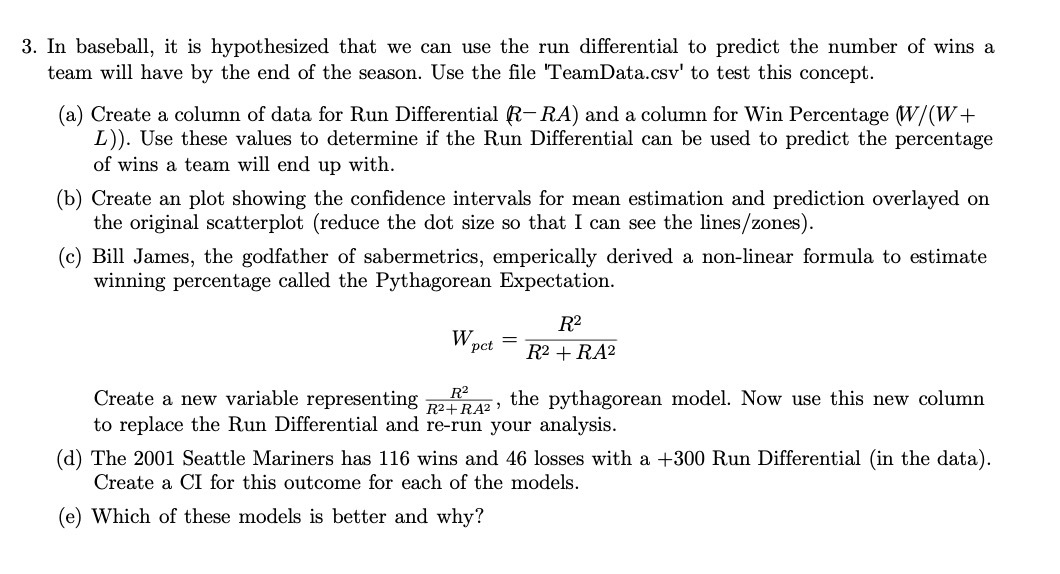
3. In baseball, it is hypothesized that we can use the run differential to predict the number of wins a team will have by the end of the season. Use the le 'TeamData.csv' to test this concept. (a) Create a column of data for Run Differential 3 RA) and a column for Win Percentage G/V/(W+ 15)). Use these values to determine if the Run Differential can be used to predict the percentage of wins a team will end up with. (b) Create an plot showing the condence intervals for mean estimation and prediction overlayed on the original scatterplot (reduce the dot size so that I can see the lines /zones). (c) Bill James, the godfather of sabermetrics, emperically derived a non-linear formula to estimate winning percentage called the Pythagorean Expectation. R2 W?\" Z R2 +RA2 Create a new variable representing 32:32.42 , the pythagorean model. Now use this new column to replace the Run Differential and rerun your analysis. (d) The 2001 Seattle Mariners has 116 wins and 46 losses with a +300 Run Differential (in the data). Create a CI for this outcome for each of the models. (e) Which of these models is better and why
Step by Step Solution
There are 3 Steps involved in it

Get step-by-step solutions from verified subject matter experts
 Study Help