







Question: 3. In class we showed how to get real forms from the complex ()=21eime functions (m=0,1,2,). For problem 1 we gave expressions for the legendre
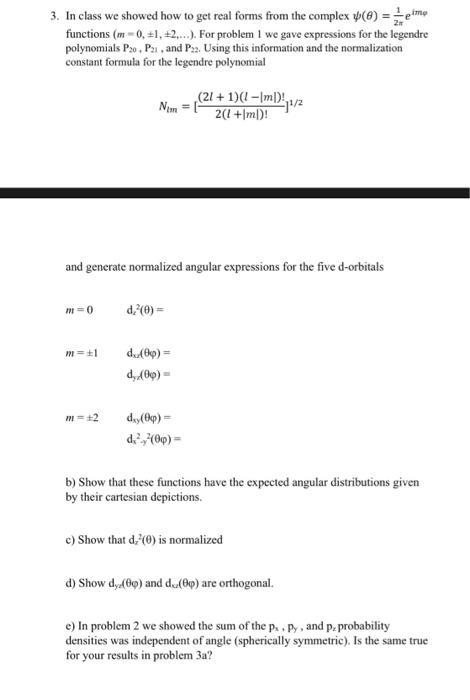
3. In class we showed how to get real forms from the complex ()=21eime functions (m=0,1,2,). For problem 1 we gave expressions for the legendre polynomials P20,P21, and P22. Using this information and the normalization constant formula for the legendre polynomial Nlm=[2(l+m)!(2l+1)(lm)!]1/2 and generate normalized angular expressions for the five d-orbitals m=0dz2()= m=1m=2dxu()=dy()=dxy()=dx2y2()= b) Show that these functions have the expected angular distributions given by their cartesian depictions. c) Show that dx2() is normalized d) Show dya() and dv() are orthogonal. e) In problem 2 we showed the sum of the px,py, and pz probability densities was independent of angle (spherically symmetric). Is the same true for your results in problem 3 a
Step by Step Solution
There are 3 Steps involved in it

Get step-by-step solutions from verified subject matter experts
 Study Help