







Question: 3. In this question, we study the relationship between body fat and certain body measurements. We have a data set on 252 men, and
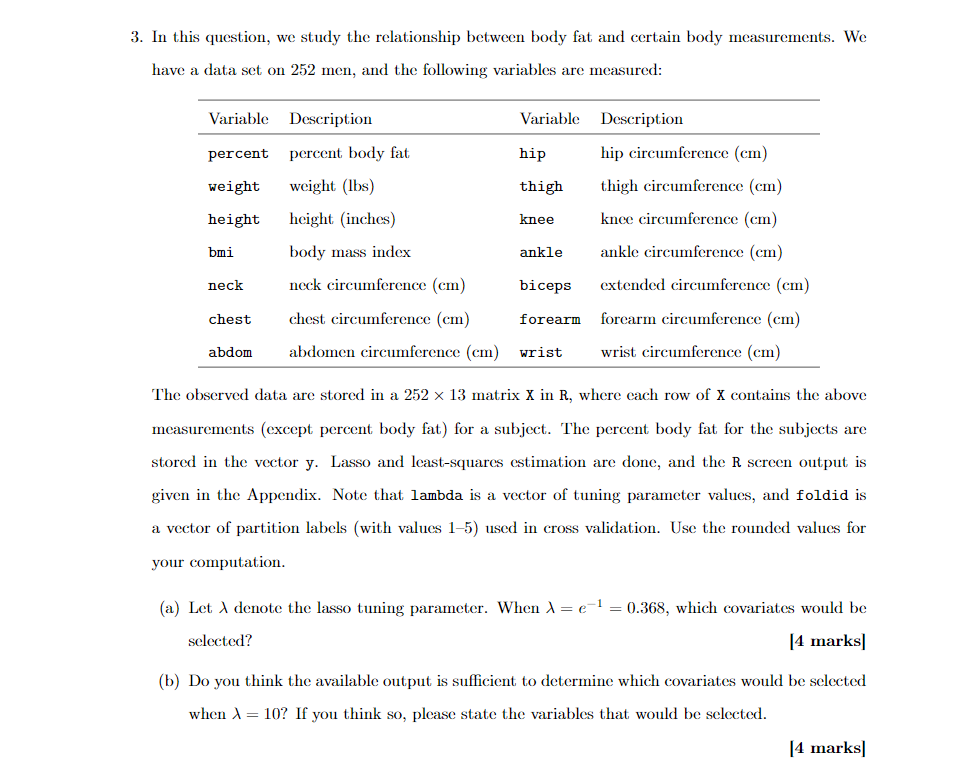
3. In this question, we study the relationship between body fat and certain body measurements. We have a data set on 252 men, and the following variables are measured: Variable Description Variable Description percent percent body fat hip hip circumference (cm) weight weight (lbs) thigh thigh circumference (cm) height height (inches) knee knee circumference (cm) bmi body mass index ankle ankle circumference (cm) neck neck circumference (cm) biceps extended circumference (cm) chest chest circumference (cm) forearm forearm circumference (cm) abdom wrist circumference (cm) abdomen circumference (cm) wrist The observed data are stored in a 252 13 matrix X in R, where each row of X contains the above measurements (except percent body fat) for a subject. The percent body fat for the subjects are stored in the vector y. Lasso and least-squares estimation are done, and the R screen output is given in the Appendix. Note that lambda is a vector of tuning parameter values, and foldid is a vector of partition labels (with values 1-5) used in cross validation. Use the rounded values for your computation. selected? (a) Let denote the lasso tuning parameter. When A = e = 0.368, which covariates would be [4 marks] (b) Do you think the available output is sufficient to determine which covariates would be selected when = 10? If you think so, please state the variables that would be selected. 4 marks]
Step by Step Solution
There are 3 Steps involved in it

Get step-by-step solutions from verified subject matter experts
 Study Help