







Question: 3. John has a utility function for money that is the 4th root of the amount of money. John has a total net Page 22
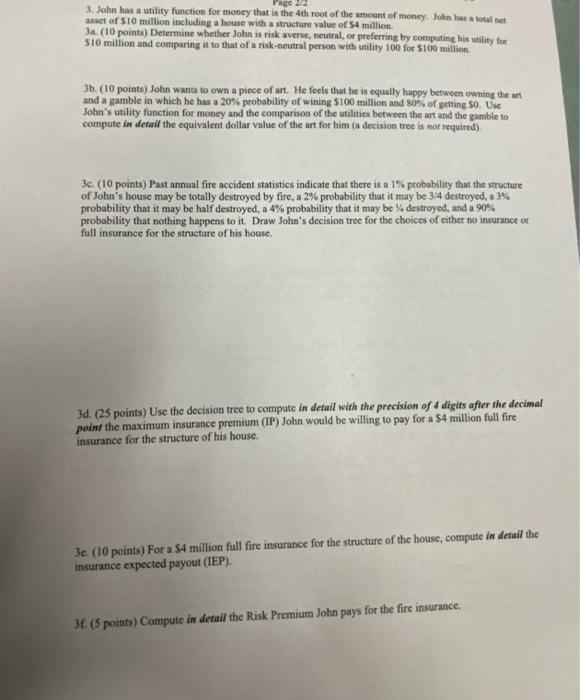
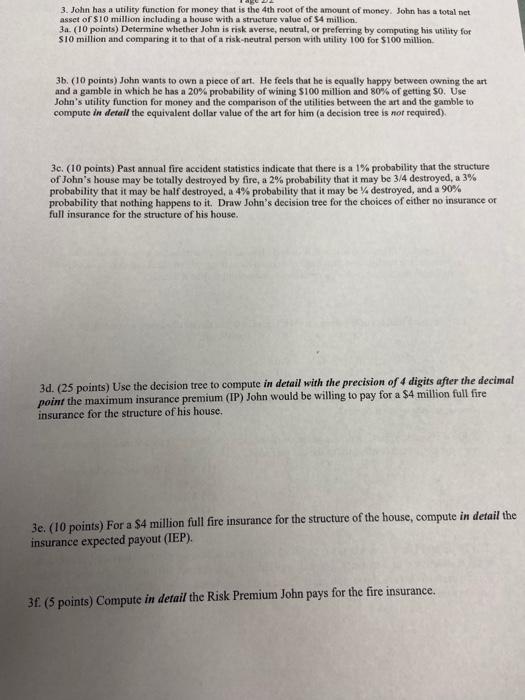
3. John has a utility function for money that is the 4th root of the amount of money. John has a total net Page 22 asset of $10 million including a house with a structure value of S4 million 3a. (10 points) Determine whether John is risk averse, neutral, or preferring by computing his utility for $10 million and comparing it to that of a risk-neutral person with utility 100 for $100 million 36. (10 points) John wants to own a piece of art. He feels that he is equally happy between owning the art and a gamble in which he has a 20% probability of wining 5100 million and 80% of getting $0 Ute John's utility function for money and the comparison of the utilities between the art and the gamble to compute in detail the equivalent dollar value of the art for him (a decision tree is not required) 3c. (10 points) Past annual fire accident statistics indicate that there is a 1% probability that the structure of John's house may be totally destroyed by fire, a 2% probability that it may be 3/4 destroyed, a 3% probability that it may be half destroyed, a 4% probability that it may be destroyed, and a 90% probability that nothing happens to it. Draw John's decision tree for the choices of either no insurance or full insurance for the structure of his house. 3d. (25 points) Use the decision tree to compute in detail with the precision of 4 digits after the decimal point the maximum insurance premium (IP) John would be willing to pay for a $4 million full fire insurance for the structure of his house. 3e. (10 points) For a S4 million full fire insurance for the structure of the house, compute in detail the insurance expected payout (IEP). 30 (5 points) Compute in detail the Risk Premium John pays for the fire insurance. 3. John has a utility function for money that is the 4th root of the amount of money. John has a total net asset of $10 million including a house with a structure value of S4 million. 3a. (10 points) Determine whether John is risk averse, neutral, or preferring by computing his utility for S10 million and comparing it to that of a risk-neutral person with utility 100 for $100 million 3b. (10 points) John wants to own a piece of art. He feels that he is equally happy between owning the art and a gamble in which he has a 20% probability of wining S100 million and 80% of getting so. Use John's utility function for money and the comparison of the utilities between the art and the gamble to compute in detall the equivalent dollar value of the art for him (a decision tree is not required) 3c. (10 points) Past annual fire accident statistics indicate that there is a 1% probability that the structure of John's house may be totally destroyed by fire, a 2% probability that it may be 3/4 destroyed, a 3% probability that it may be half destroyed, a 4% probability that it may be destroyed, and a 90% probability that nothing happens to it. Draw John's decision tree for the choices of either no insurance or full insurance for the structure of his house. 3d. (25 points) Use the decision tree to compute in detail with the precision of 4 digits after the decimal point the maximum insurance premium (IP) John would be willing to pay for a $4 million full fire insurance for the structure of his house. 3e. (10 points) For a $4 million full fire insurance for the structure of the house, compute in detail the insurance expected payout (IEP). 3. (5 points) Compute in detail the Risk Premium John pays for the fire insurance. 3. John has a utility function for money that is the 4th root of the amount of money. John has a total net Page 22 asset of $10 million including a house with a structure value of S4 million 3a. (10 points) Determine whether John is risk averse, neutral, or preferring by computing his utility for $10 million and comparing it to that of a risk-neutral person with utility 100 for $100 million 36. (10 points) John wants to own a piece of art. He feels that he is equally happy between owning the art and a gamble in which he has a 20% probability of wining 5100 million and 80% of getting $0 Ute John's utility function for money and the comparison of the utilities between the art and the gamble to compute in detail the equivalent dollar value of the art for him (a decision tree is not required) 3c. (10 points) Past annual fire accident statistics indicate that there is a 1% probability that the structure of John's house may be totally destroyed by fire, a 2% probability that it may be 3/4 destroyed, a 3% probability that it may be half destroyed, a 4% probability that it may be destroyed, and a 90% probability that nothing happens to it. Draw John's decision tree for the choices of either no insurance or full insurance for the structure of his house. 3d. (25 points) Use the decision tree to compute in detail with the precision of 4 digits after the decimal point the maximum insurance premium (IP) John would be willing to pay for a $4 million full fire insurance for the structure of his house. 3e. (10 points) For a S4 million full fire insurance for the structure of the house, compute in detail the insurance expected payout (IEP). 30 (5 points) Compute in detail the Risk Premium John pays for the fire insurance. 3. John has a utility function for money that is the 4th root of the amount of money. John has a total net asset of $10 million including a house with a structure value of S4 million. 3a. (10 points) Determine whether John is risk averse, neutral, or preferring by computing his utility for S10 million and comparing it to that of a risk-neutral person with utility 100 for $100 million 3b. (10 points) John wants to own a piece of art. He feels that he is equally happy between owning the art and a gamble in which he has a 20% probability of wining S100 million and 80% of getting so. Use John's utility function for money and the comparison of the utilities between the art and the gamble to compute in detall the equivalent dollar value of the art for him (a decision tree is not required) 3c. (10 points) Past annual fire accident statistics indicate that there is a 1% probability that the structure of John's house may be totally destroyed by fire, a 2% probability that it may be 3/4 destroyed, a 3% probability that it may be half destroyed, a 4% probability that it may be destroyed, and a 90% probability that nothing happens to it. Draw John's decision tree for the choices of either no insurance or full insurance for the structure of his house. 3d. (25 points) Use the decision tree to compute in detail with the precision of 4 digits after the decimal point the maximum insurance premium (IP) John would be willing to pay for a $4 million full fire insurance for the structure of his house. 3e. (10 points) For a $4 million full fire insurance for the structure of the house, compute in detail the insurance expected payout (IEP). 3. (5 points) Compute in detail the Risk Premium John pays for the fire insurance
Step by Step Solution
There are 3 Steps involved in it

Get step-by-step solutions from verified subject matter experts
 Study Help