







Question: 3. Let D be a data structure that stores distinct integers between 1 and n. D supports the following operations: PRESENT(x) returns 1 if x
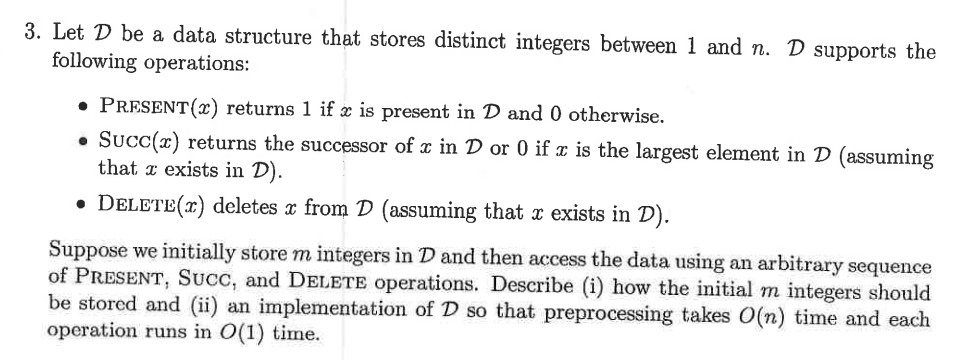
3. Let D be a data structure that stores distinct integers between 1 and n. D supports the following operations: PRESENT(x) returns 1 if x is present in D and 0 otherwise. Succ(2) returns the successor of x in D or 0 if x is the largest element in D (assuming that I exists in D). DELETE(X) deletes x from D (assuming that x exists in D). Suppose we initially store m integers in D and then access the data using an arbitrary sequence of PRESENT, SUCC, and DELETE operations. Describe (i) how the initial m integers should be stored and (ii) an implementation of D so that preprocessing takes O(n) time and each operation runs in O(1) time
Step by Step Solution
There are 3 Steps involved in it
1 Expert Approved Answer
Step: 1 Unlock

Question Has Been Solved by an Expert!
Get step-by-step solutions from verified subject matter experts
Step: 2 Unlock
Step: 3 Unlock
 Study Help