







Question: 3. Let f:R? > R2 be defined by (11,12) if 11 > 22, f(x) (12, 11) if 12 > 013 for all x = (21,12)
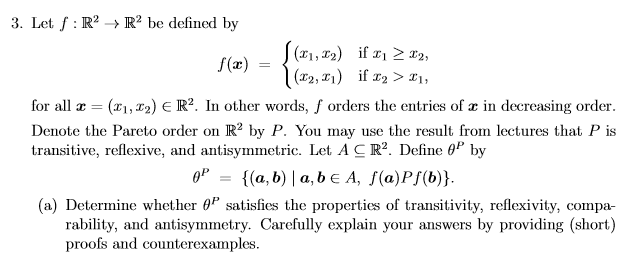


3. Let f:R? > R2 be defined by (11,12) if 11 > 22, f(x) (12, 11) if 12 > 013 for all x = (21,12) R2. In other words, f orders the entries of r in decreasing order. Denote the Pareto order on R2 by P. You may use the result from lectures that P is transitive, reflexive, and antisymmetric. Let A CR2. Define 0P by OP = {(a,b) | a, b e A, f(a)Pf(b)}. (a) Determine whether OP satisfies the properties of transitivity, reflexivity, compa- rability, and antisymmetry. Carefully explain your answers by providing (short) proofs and counterexamples. (b) Let A = {(5,2), (2, 1), (2,3), (3,2), (1,4)}. (i) Using the graphical representation, determine all minimal and maximal elements with respect to P. (ii) Using the Boolean matrix representation, determine all minimal and maximal elements with respect to OP 3. Let f:R? > R2 be defined by (11,12) if 11 > 22, f(x) (12, 11) if 12 > 013 for all x = (21,12) R2. In other words, f orders the entries of r in decreasing order. Denote the Pareto order on R2 by P. You may use the result from lectures that P is transitive, reflexive, and antisymmetric. Let A CR2. Define 0P by OP = {(a,b) | a, b e A, f(a)Pf(b)}. (a) Determine whether OP satisfies the properties of transitivity, reflexivity, compa- rability, and antisymmetry. Carefully explain your answers by providing (short) proofs and counterexamples. (b) Let A = {(5,2), (2, 1), (2,3), (3,2), (1,4)}. (i) Using the graphical representation, determine all minimal and maximal elements with respect to P. (ii) Using the Boolean matrix representation, determine all minimal and maximal elements with respect to OP
Step by Step Solution
There are 3 Steps involved in it

Get step-by-step solutions from verified subject matter experts
 Study Help