







Question: 3. Let $S_{1}^{2}$ be the sample variance of random sample of sizes $n_{1}$ from normal distribution $Nleft(mu_(1). sigma_{1}^{2} ight)$, and $S_{2}^{2}$ be the sample variance
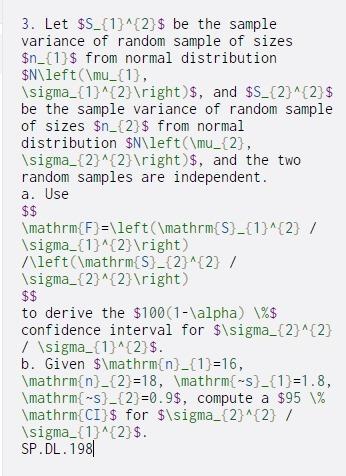
3. Let $S_{1}^{2}$ be the sample variance of random sample of sizes $n_{1}$ from normal distribution $N\left(\mu_(1). \sigma_{1}^{2} ight)$, and $S_{2}^{2}$ be the sample variance of random sample of sizes $n_{2}$ from normal distribution $N\left\mu_{2}, \sigma_{2}^{2} ight)$, and the two random samples are independent. a. Use $$ \mathrm{F}=\left(\mathrm{S}_{1}^{2} / \sigma_{1}^{2} ight) Aleft(\mathrm{S}_{2}^{2} / \sigma_{2}^{2} ight) $$ to derive the $100(1-\alpha) \%$ confidence interval for $\sigma_{2}^{2} / \sigma_{1}^{2}$. b. Given $\mathrm{n}_{1}=16, \mathrm{n}_{2}=18, \mathrm{-s}_{1}=1.8, \mathrm{-s}_{2}=0.9$, compute a $95 % \mathrm{CI}$ for $\sigma_{2}^{2} / \sigma_{1}^{2} $. SP.DL.198|
Step by Step Solution
There are 3 Steps involved in it

Get step-by-step solutions from verified subject matter experts
 Study Help