







Question: 3. Let u be a utility function for (incremental) amounts of money x and suppose that u is chosen such that u(100)=0 and u(300)=1. Show
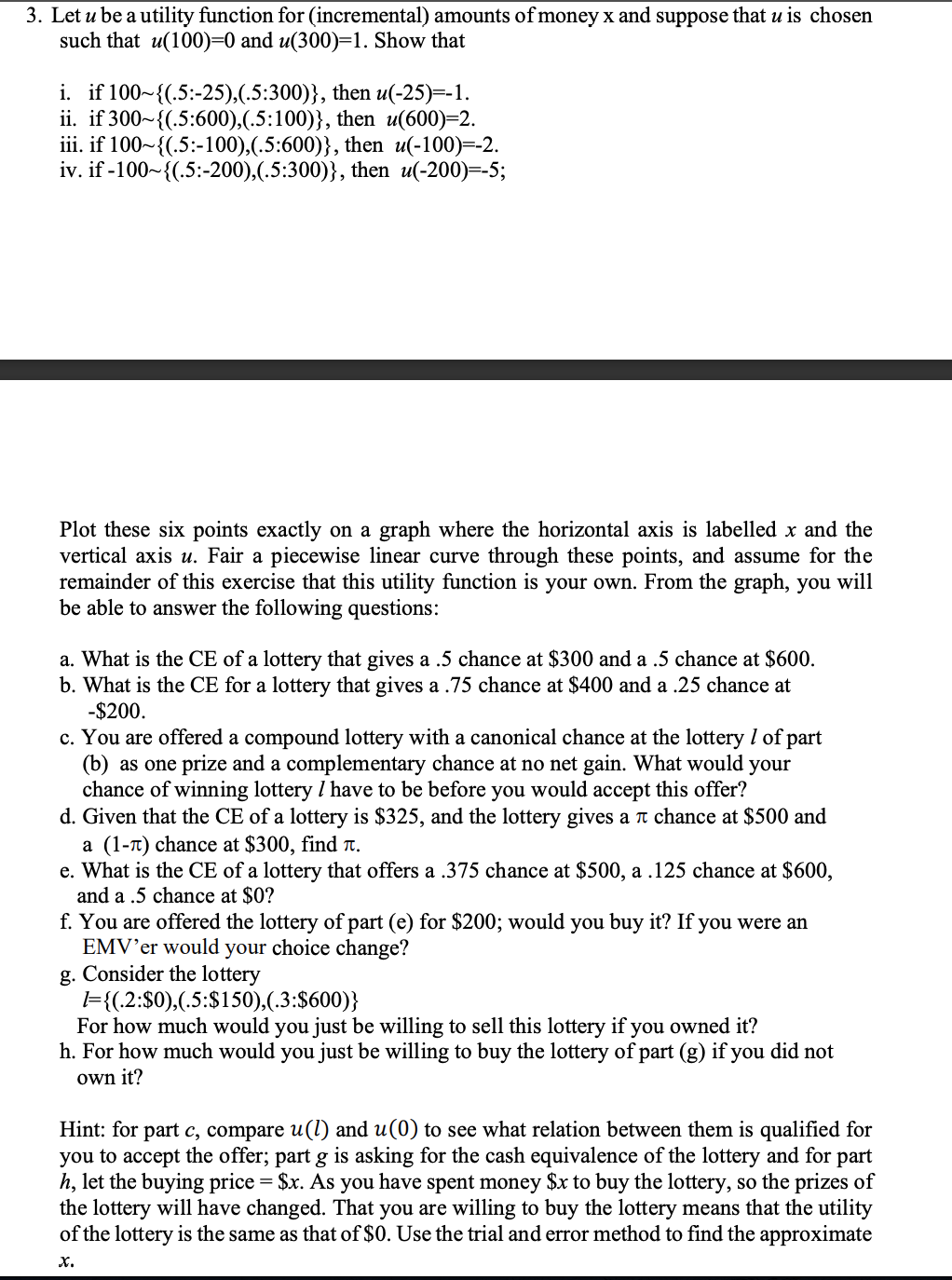
3. Let u be a utility function for (incremental) amounts of money x and suppose that u is chosen such that u(100)=0 and u(300)=1. Show that i. if 100~{(.5:-25),(.5:300)}, then u(-25)=-1. ii. if 300~{.5:600),(.5:100)}, then u(600)=2. iii. if 100~{(.5:-100),(.5:600)}, then u(-100)=-2. iv. if-100~{(.5:-200),(.5:300)}, then u(-200)=-5; Plot these six points exactly on a graph where the horizontal axis is labelled x and the vertical axis u. Fair a piecewise linear curve through these points, and assume for the remainder of this exercise that this utility function is your own. From the graph, you will be able to answer the following questions: a. What is the CE of a lottery that gives a .5 chance at $300 and a .5 chance at $600. b. What is the CE for a lottery that gives a .75 chance at $400 and a .25 chance at -$200. c. You are offered a compound lottery with a canonical chance at the lottery l of part (b) as one prize and a complementary chance at no net gain. What would your chance of winning lottery I have to be before you would accept this offer? d. Given that the CE of a lottery is $325, and the lottery gives a n at $500 and a (1-1) chance at $300, find 1. e. What is the CE of a lottery that offers a .375 chance at $500, a .125 chance at $600, and a .5 chance at $0? f. You are offered the lottery of part (e) for $200; would you buy it? If you were an EMV'er would your choice change? g. Consider the lottery I={(.2:$0),(.5:$150),(.3:$600)} For how much would you just be willing to sell this lottery if you owned it? h. For how much would you just be willing to buy the lottery of part (g) if you did not own it? Hint: for part c, compare u(l) and u(0) to see what relation between them is qualified for you to accept the offer; part g is asking for the cash equivalence of the lottery and for part h, let the buying price = $x. As you have spent money $x to buy the lottery, so the prizes of the lottery will have changed. That you are willing to buy the lottery means that the utility of the lottery is the same as that of $0. Use the trial and error method to find the approximate x. 3. Let u be a utility function for (incremental) amounts of money x and suppose that u is chosen such that u(100)=0 and u(300)=1. Show that i. if 100~{(.5:-25),(.5:300)}, then u(-25)=-1. ii. if 300~{.5:600),(.5:100)}, then u(600)=2. iii. if 100~{(.5:-100),(.5:600)}, then u(-100)=-2. iv. if-100~{(.5:-200),(.5:300)}, then u(-200)=-5; Plot these six points exactly on a graph where the horizontal axis is labelled x and the vertical axis u. Fair a piecewise linear curve through these points, and assume for the remainder of this exercise that this utility function is your own. From the graph, you will be able to answer the following questions: a. What is the CE of a lottery that gives a .5 chance at $300 and a .5 chance at $600. b. What is the CE for a lottery that gives a .75 chance at $400 and a .25 chance at -$200. c. You are offered a compound lottery with a canonical chance at the lottery l of part (b) as one prize and a complementary chance at no net gain. What would your chance of winning lottery I have to be before you would accept this offer? d. Given that the CE of a lottery is $325, and the lottery gives a n at $500 and a (1-1) chance at $300, find 1. e. What is the CE of a lottery that offers a .375 chance at $500, a .125 chance at $600, and a .5 chance at $0? f. You are offered the lottery of part (e) for $200; would you buy it? If you were an EMV'er would your choice change? g. Consider the lottery I={(.2:$0),(.5:$150),(.3:$600)} For how much would you just be willing to sell this lottery if you owned it? h. For how much would you just be willing to buy the lottery of part (g) if you did not own it? Hint: for part c, compare u(l) and u(0) to see what relation between them is qualified for you to accept the offer; part g is asking for the cash equivalence of the lottery and for part h, let the buying price = $x. As you have spent money $x to buy the lottery, so the prizes of the lottery will have changed. That you are willing to buy the lottery means that the utility of the lottery is the same as that of $0. Use the trial and error method to find the approximate x
Step by Step Solution
There are 3 Steps involved in it

Get step-by-step solutions from verified subject matter experts
 Study Help