







Question: 3. Let us consider a problem where given an arbitrary graph G = (V, E), the question is if a subset CCV of k
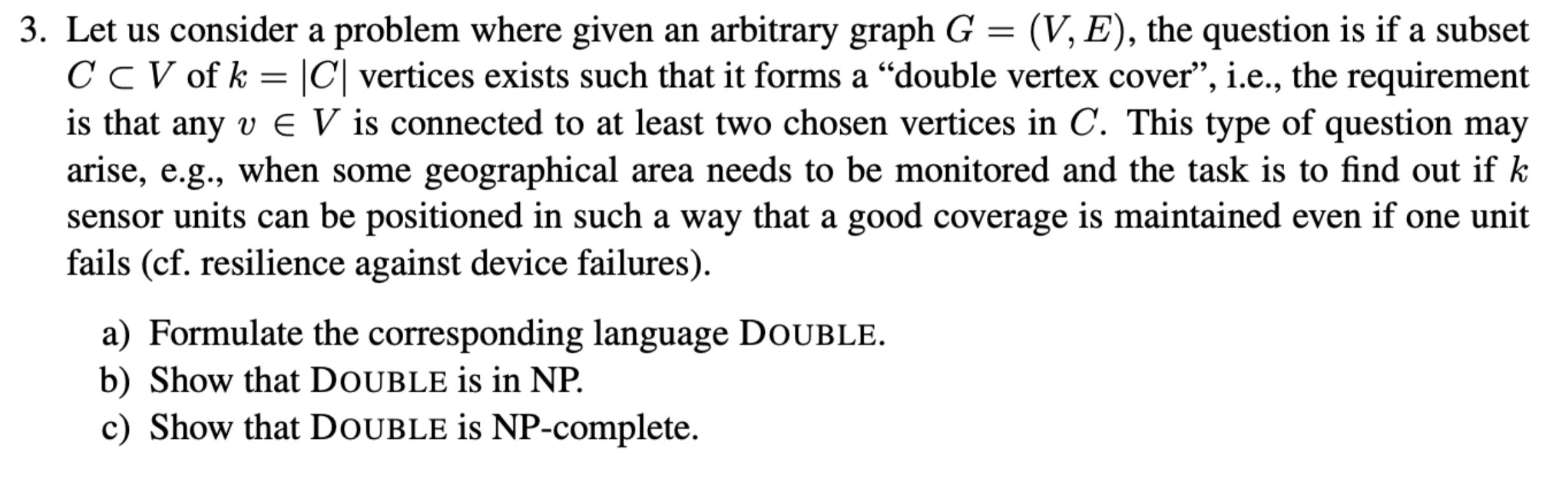
3. Let us consider a problem where given an arbitrary graph G = (V, E), the question is if a subset CCV of k = |C| vertices exists such that it forms a "double vertex cover", i.e., the requirement is that any v EV is connected to at least two chosen vertices in C. This type of question may arise, e.g., when some geographical area needs to be monitored and the task is to find out if k sensor units can be positioned in such a way that a good coverage is maintained even if one unit fails (cf. resilience against device failures). a) Formulate the corresponding language DOUBLE. b) Show that DOUBLE is in NP. c) Show that DOUBLE is NP-complete. 3. Let us consider a problem where given an arbitrary graph G = (V, E), the question is if a subset CCV of k = |C| vertices exists such that it forms a "double vertex cover", i.e., the requirement is that any v E V is connected to at least two chosen vertices in C. This type of question may arise, e.g., when some geographical area needs to be monitored and the task is to find out if k sensor units can be positioned in such a way that a good coverage is maintained even if one unit fails (cf. resilience against device failures). a) Formulate the corresponding language DOUBLE. b) Show that DOUBLE is in NP. c) Show that DOUBLE is NP-complete.
Step by Step Solution
3.58 Rating (151 Votes )
There are 3 Steps involved in it
a Formulating the language DOUBLE The language DOUBLE can be formulated as follows Input An undirect... View full answer

Get step-by-step solutions from verified subject matter experts
 Study Help