







Question: 3. Let X ~ Exponential()) and let t be a constant with 0 0 be any value. (a) Calculate P(X > b) exactly. (b) Now
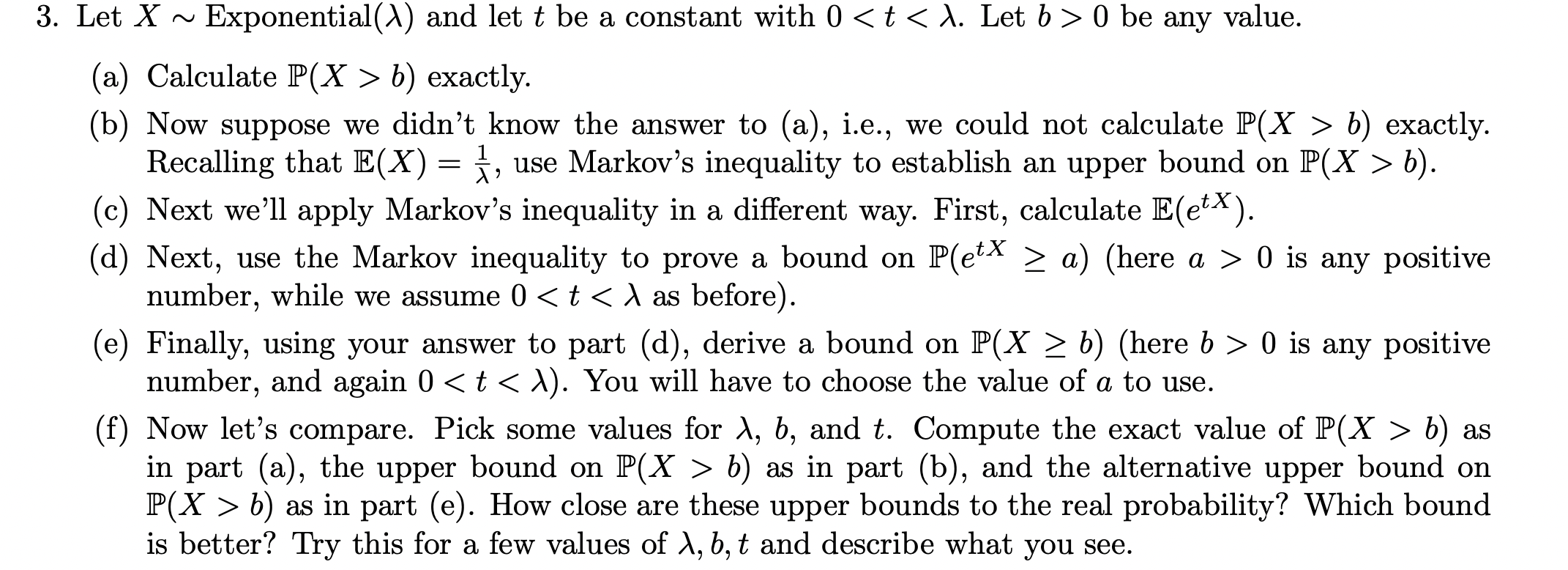
3. Let X ~ Exponential()) and let t be a constant with 0 0 be any value. (a) Calculate P(X > b) exactly. (b) Now suppose we didn't know the answer to (a), i.e., we could not calculate P(X > b) exactly. Recalling that E(X) = -, use Markov's inequality to establish an upper bound on P(X > b). (c) Next we'll apply Markov's inequality in a different way. First, calculate E(ex). (d) Next, use the Markov inequality to prove a bound on P(et > a) (here a > 0 is any positive number, while we assume 0 as before). (e) Finally, using your answer to part (d), derive a bound on P(X 2 b) (here b > 0 is any positive number, and again 0 ). You will have to choose the value of a to use. (f) Now let's compare. Pick some values for 1, b, and t. Compute the exact value of P(X > b) as in part (a), the upper bound on P(X > b) as in part (b), and the alternative upper bound on P(X > b) as in part (e). How close are these upper bounds to the real probability? Which bound is better? Try this for a few values of 1, b, t and describe what you see
Step by Step Solution
There are 3 Steps involved in it

Get step-by-step solutions from verified subject matter experts
 Study Help