







Question: 3 . ( ( mathbf { 1 4 % ) } ) Shortest - path Algorithm. Consider the network shown in
mathbf Shortestpath Algorithm.
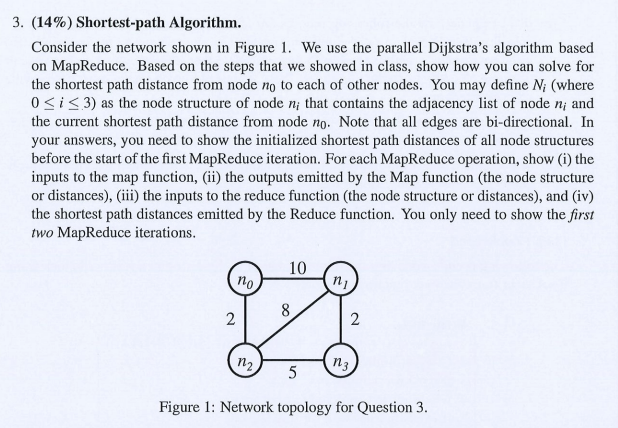
Consider the network shown in Figure We use the parallel Dijkstra's algorithm based on MapReduce. Based on the steps that we showed in class, show how you can solve for the shortest path distance from node n to each of other nodes. You may define Niwhere leq i leq as the node structure of node ni that contains the adjacency list of node ni and the current shortest path distance from node n Note that all edges are bidirectional. In your answers, you need to show the initialized shortest path distances of all node structures before the start of the first MapReduce iteration. For each MapReduce operation, show i the inputs to the map function, ii the outputs emitted by the Map function the node structure or distancesiii the inputs to the reduce function the node structure or distances and iv the shortest path distances emitted by the Reduce function. You only need to show the first two MapReduce iterations.
Figure : Network topology for Question
Step by Step Solution
There are 3 Steps involved in it
1 Expert Approved Answer
Step: 1 Unlock

Question Has Been Solved by an Expert!
Get step-by-step solutions from verified subject matter experts
Step: 2 Unlock
Step: 3 Unlock
 Study Help