







Question: 3: mg F = mg sin 6 E mg6 = mg = x I L Compare to the SHM, k > g w='/E:>w=/E or T=2=275/Z
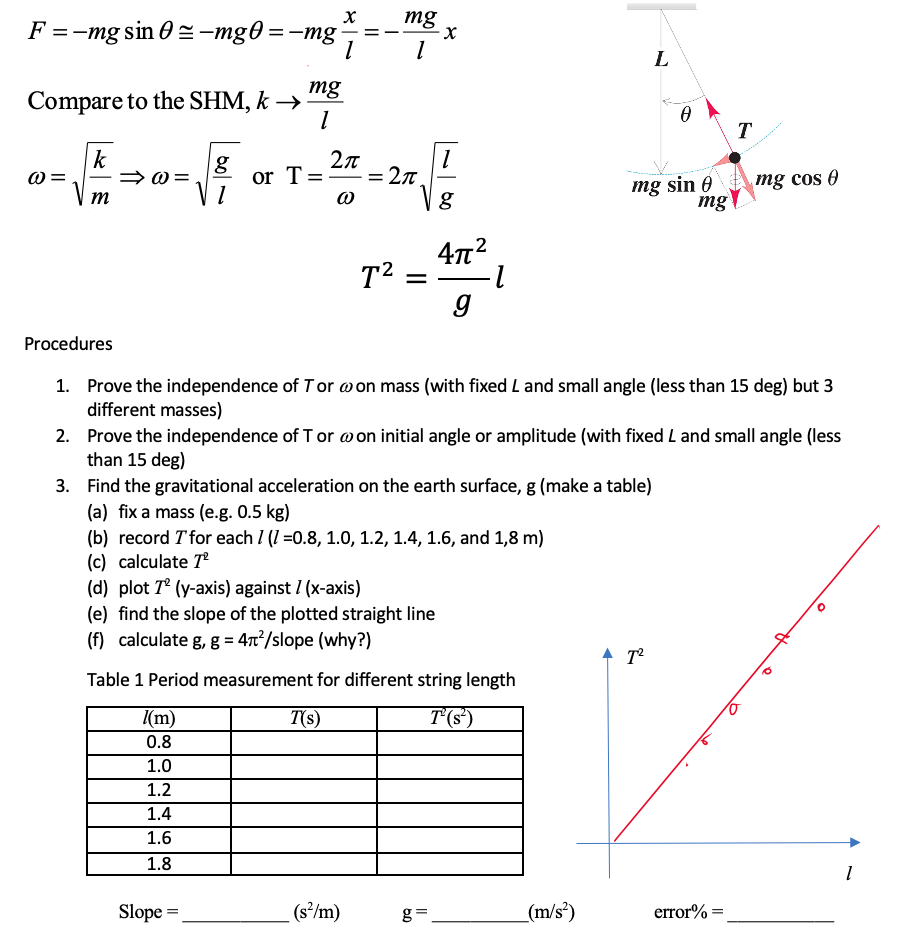
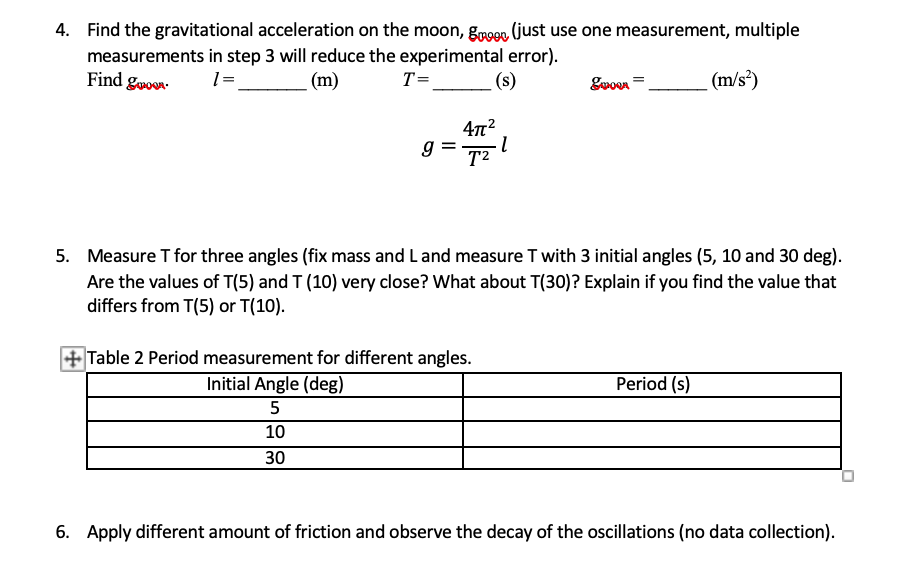
3: mg F = mg sin 6 E mg6 = mg = x I L Compare to the SHM, k > g w='/E:>w=\\/E or T=2\"=275\\/Z m l a) g 2 41:2 T = l 9 Procedures 1. Prouethe independence of Tor won mass {with xed 1. and small angle {less than 15 deg} but 3 different masses} 2. Prove the independence of T or a) on initial angle or amplitude {with fixed l. and small angle {less than 15 deg) 3. Find the gravitational acceleration on the earth surface, g {make a table) {a} x a mass {e.g. 0.5 kg} {b} record Tfor each HI =03, 1.0, 1.2, 1.4, 1.6, and 1,8 m} {c} calculate I\" {d} plot I\" {yaxis} against I {xaxis} {e} nd the slope ofthe plotted straight line (f) calculate g, g = 4n2/slope (why?) Table 1 Period measurement for different string length Slope = (szfm) g = (mfsz) error% = 4. Find the gravitational acceleration on the moon, good (just use one measurement, multiple measurements in step 3 will reduce the experimental error). Find Swoon- (m) T = (s) (m/s?) 4172 g= T2 5. Measure T for three angles (fix mass and L and measure T with 3 initial angles (5, 10 and 30 deg). Are the values of T(5) and T (10) very close? What about T(30)? Explain if you find the value that differs from T(5) or T(10). + Table 2 Period measurement for different angles. Initial Angle (deg) Period (s) 5 10 30 6. Apply different amount of friction and observe the decay of the oscillations (no data collection)
Step by Step Solution
There are 3 Steps involved in it

Get step-by-step solutions from verified subject matter experts
 Study Help