







Question: 3. Model the network topology below using python and capture ECHO packets transmitted from N7 to N4 and Analyze using Wireshark N2 N3 N4 (NO
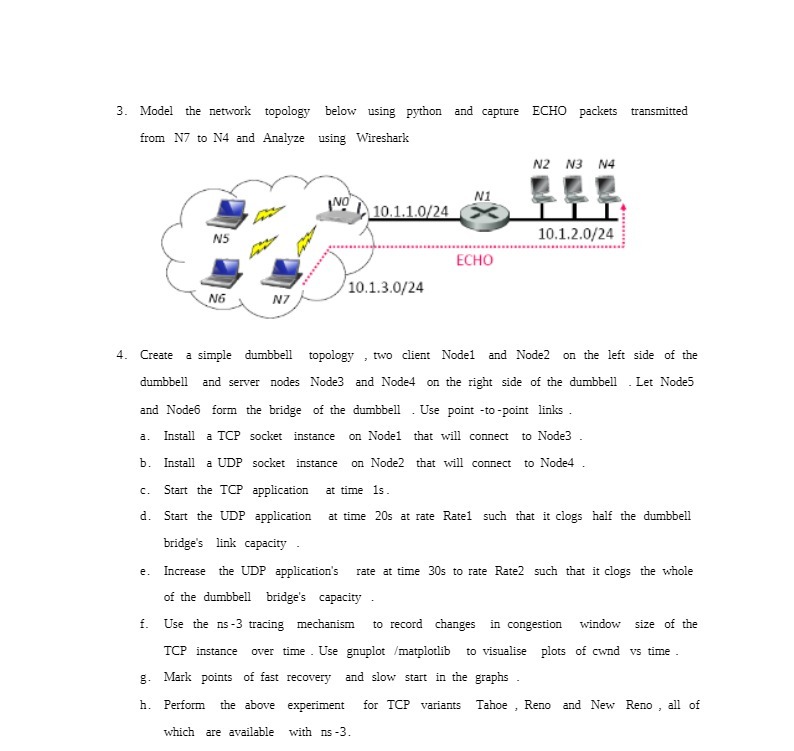
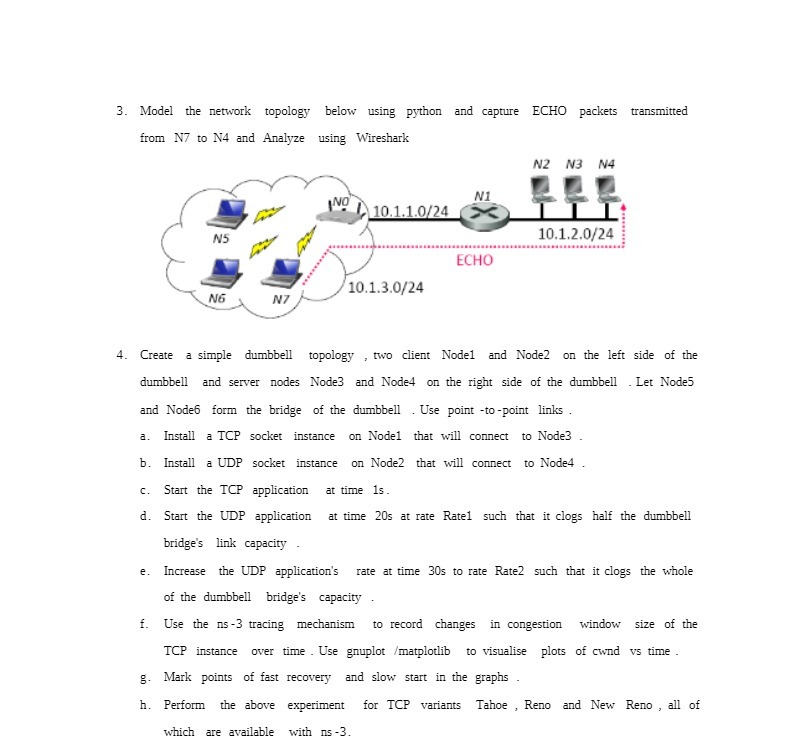
3. Model the network topology below using python and capture ECHO packets transmitted from N7 to N4 and Analyze using Wireshark N2 N3 N4 (NO N1 1 10.1.1.0/24 N5 10.1.2.0/24 ECHO 10.1.3.0/24 N6 N7 4. Create a simple dumbbell topology , two client Nodel and Node2 on the left side of the dumbbell and server nodes Node3 and Node4 on the right side of the dumbbell . Let Node5 and Node6 form the bridge of the dumbbell . Use point -to-point links a. Install a TCP socket instance on Nodel that will connect to Node3 b. Install a UDP socket instance on Node2 that will connect to Node4 . c. Start the TCP application at time Is . d. Start the UDP application at time 20s at rate Ratel such that it clogs half the dumbbell bridge's link capacity e . Increase the UDP application's rate at time 30s to rate Rate2 such that it clogs the whole of the dumbbell bridge's capacity f. Use the ns-3 tracing mechanism to record changes in congestion window size of the ICP instance over time . Use gnuplot /matplotlib to visualise plots of cwnd vs time g. Mark points of fast recovery and slow start in the graphs h . Perform the above experiment for TCP variants Tahoe , Reno and New Reno , all of which are available with ns-3
Step by Step Solution
There are 3 Steps involved in it

Get step-by-step solutions from verified subject matter experts
 Study Help