







Question: 3. Nash Equilibrium: Write down the n-player version of a Tullock contest model (preferably the general form containing the parameter r ) as introduced in
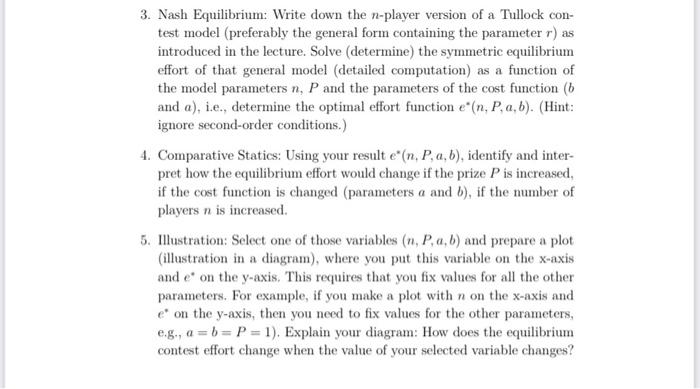
3. Nash Equilibrium: Write down the n-player version of a Tullock contest model (preferably the general form containing the parameter r ) as introduced in the lecture. Solve (determine) the symmetric equilibrium effort of that general model (detailed computation) as a function of the model parameters n,P and the parameters of the cost function ( b and a ), i.e., determine the optimal effort function e(n,P,a,b). (Hint: ignore second-order conditions.) 4. Comparative Statics: Using your result e(n,P,a,b), identify and interpret how the equilibrium effort would change if the prize P is increased, if the cost function is changed (parameters a and b ), if the number of players n is increased. 5. Illustration: Select one of those variables (n,P,a,b) and prepare a plot (illustration in a diagram), where you put this variable on the x-axis and e on the y-axis. This requires that you fix values for all the other parameters. For example, if you make a plot with n on the x-axis and e on the y-axis, then you need to fix values for the other parameters, e.g., a=b=P=1 ). Explain your diagram: How does the equilibrium contest effort change when the value of your selected variable changes? 3. Nash Equilibrium: Write down the n-player version of a Tullock contest model (preferably the general form containing the parameter r ) as introduced in the lecture. Solve (determine) the symmetric equilibrium effort of that general model (detailed computation) as a function of the model parameters n,P and the parameters of the cost function ( b and a ), i.e., determine the optimal effort function e(n,P,a,b). (Hint: ignore second-order conditions.) 4. Comparative Statics: Using your result e(n,P,a,b), identify and interpret how the equilibrium effort would change if the prize P is increased, if the cost function is changed (parameters a and b ), if the number of players n is increased. 5. Illustration: Select one of those variables (n,P,a,b) and prepare a plot (illustration in a diagram), where you put this variable on the x-axis and e on the y-axis. This requires that you fix values for all the other parameters. For example, if you make a plot with n on the x-axis and e on the y-axis, then you need to fix values for the other parameters, e.g., a=b=P=1 ). Explain your diagram: How does the equilibrium contest effort change when the value of your selected variable changes
Step by Step Solution
There are 3 Steps involved in it

Get step-by-step solutions from verified subject matter experts
 Study Help