







Question: 3) Objectivity, which journalists presumably strive for and public relations practitioners help media professionals to achieve, is ideally an attempt A) at pure and complete
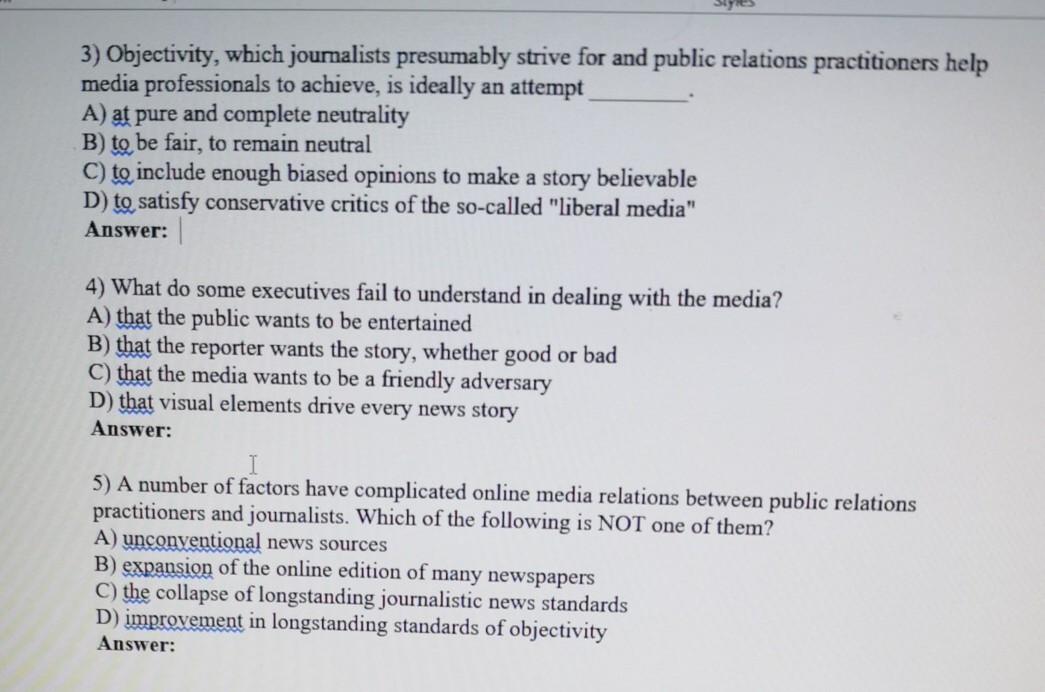
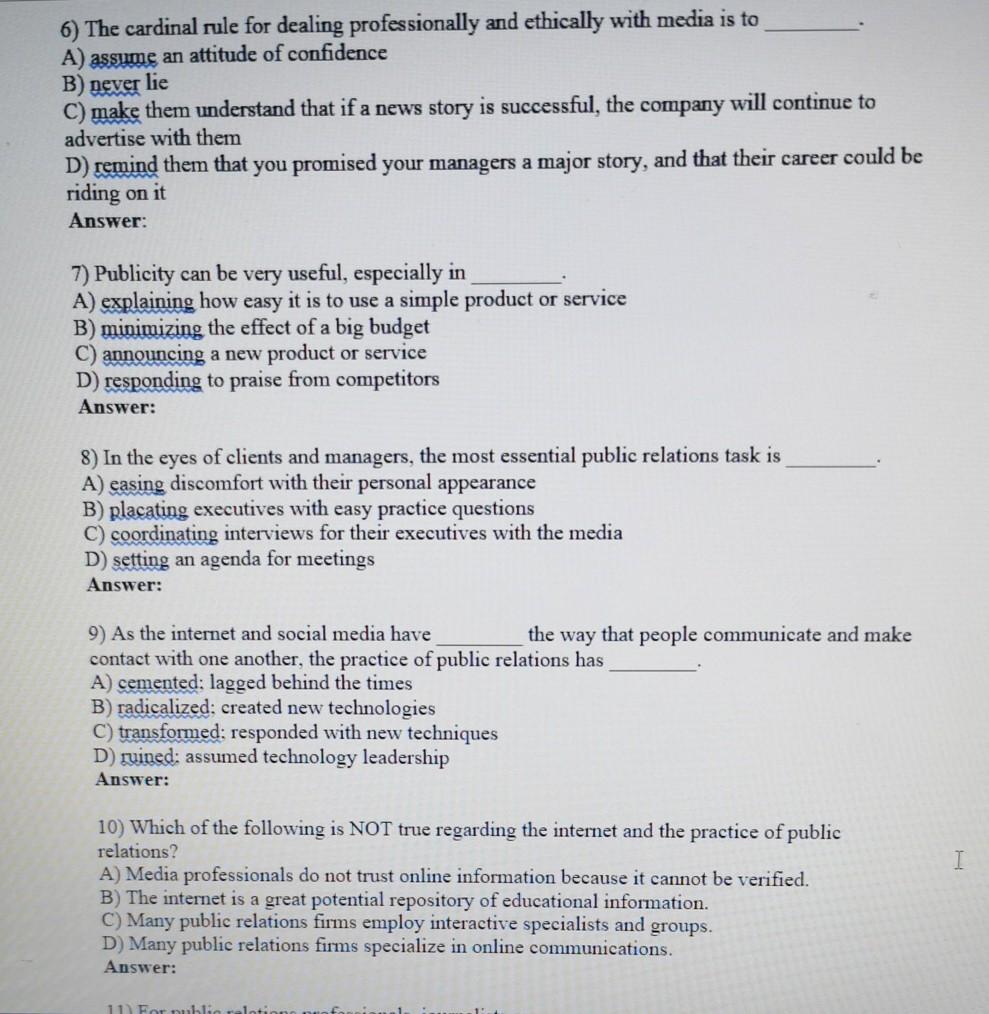
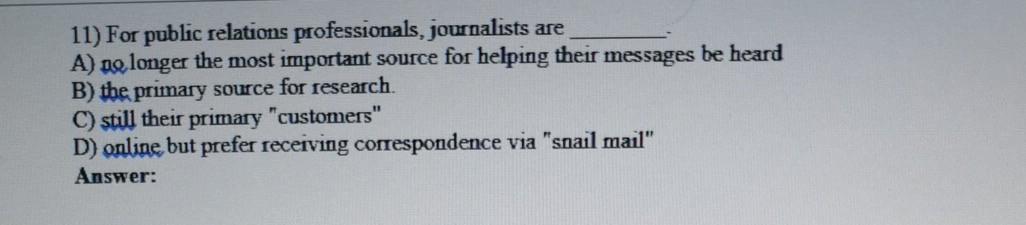
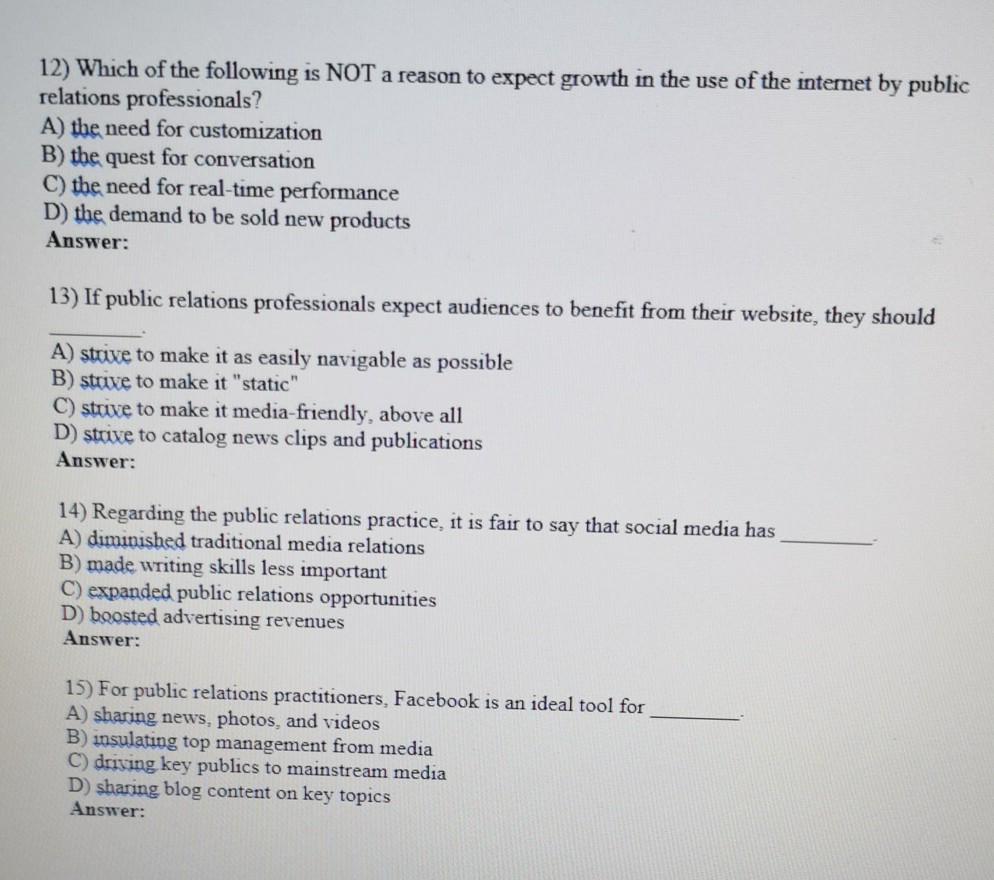
3) Objectivity, which journalists presumably strive for and public relations practitioners help media professionals to achieve, is ideally an attempt A) at pure and complete neutrality B) to be fair, to remain neutral C) to include enough biased opinions to make a story believable D) to satisfy conservative critics of the so-called "liberal media" Answer: 4) What do some executives fail to understand in dealing with the media? A) that the public wants to be entertained B) that the reporter wants the story, whether good or bad C) that the media wants to be a friendly adversary D) that visual elements drive every news story Answer: 5) A number of factors have complicated online media relations between public relations practitioners and journalists. Which of the following is NOT one of them? A) unconventional news sources B) expansion of the online edition of many newspapers C) the collapse of longstanding journalistic news standards D) improvement in longstanding standards of objectivity Answer: 6) The cardinal rule for dealing professionally and ethically with media is to A) assume an attitude of confidence B) never lie C) make them understand that if a news story is successful, the company will continue to advertise with them D) remind them that you promised your managers a major story, and that their career could be riding on it Answer: 7) Publicity can be very useful, especially in A) explaining how easy it is to use a simple product or service B) minimizing the effect of a big budget C) announcing a new product or service D) responding to praise from competitors Answer: 8) In the eyes of clients and managers, the most essential public relations task is A) easing discomfort with their personal appearance B) placating executives with easy practice questions C) coordinating interviews for their executives with the media D) setting an agenda for meetings Answer: 9) As the internet and social media have the way that people communicate and make contact with one another, the practice of public relations has A) cemented: lagged behind the times B) radicalized: created new technologies C) transformed: responded with new techniques D ruined: assumed technology leadership Answer: I 10) Which of the following is NOT true regarding the internet and the practice of public relations? A) Media professionals do not trust online information because it cannot be verified. B) The internet is a great potential repository of educational information. C) Many public relations firms employ interactive specialists and groups. D) Many public relations firms specialize in online communications. Answer: 11) For publin 11) For public relations professionals, journalists are A) ao longer the most important source for helping their messages be heard B) the primary source for research. C) still their primary "customers" D) online but prefer receiving correspondence via "snail mail" Answer: 12) Which of the following is NOT a reason to expect growth in the use of the internet by public relations professionals? A) the need for customization B) the quest for conversation C) the need for real-time performance D) the demand to be sold new products Answer: 13) If public relations professionals expect audiences to benefit from their website, they should A) strive to make it as easily navigable as possible B) strive to make it "static" C) strive to make it media-friendly, above all D) strive to catalog news clips and publications Answer: 14) Regarding the public relations practice, it is fair to say that social media has A) diminished traditional media relations B) made writing skills less important C) expanded public relations opportunities D) boosted advertising revenues Answer: 15) For public relations practitioners, Facebook is an ideal tool for A) sharing news, photos, and videos B) insulating top management from media C) drising key publics to mainstream media D) sharing blog content on key topics
Step by Step Solution
There are 3 Steps involved in it
1 Expert Approved Answer
Step: 1 Unlock

Question Has Been Solved by an Expert!
Get step-by-step solutions from verified subject matter experts
Step: 2 Unlock
Step: 3 Unlock
 Study Help