







Question: #3. On April 1, 1992, New Jersey's minimum wage was increased from $4.25 to $5.05 per hour, while the minimum wage in Pennsylvania stayed at
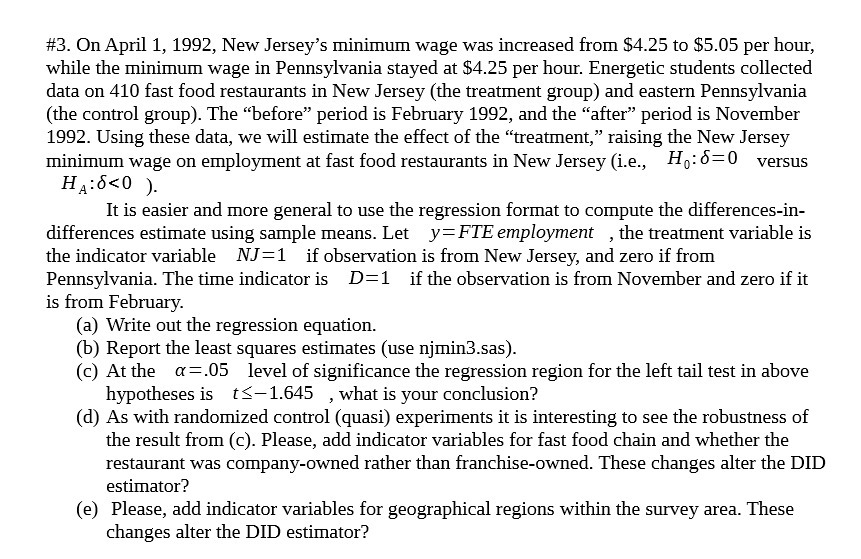
#3. On April 1, 1992, New Jersey's minimum wage was increased from $4.25 to $5.05 per hour, while the minimum wage in Pennsylvania stayed at $4.25 per hour. Energetic students collected data on 410 fast food restaurants in New Jersey (the treatment group) and eastern Pennsylvania (the control group). The \"before\" period is February 1992, and the \"after\" period is November 1932. Using these data, we will estimate the effect of the \"treatment, \" raising the New Jersey roinjnunn wage on employment at fast food restaurants in New Jersey (i. e., Hn' 5 0 versus HA :Scz )_ It is easier and more general to use the regression format to compute the differences-in- differences estimate using sample means. Let yIFIE employment , the u'eamient variable is the indicator variable NJ :1 if observation is from New Jersey, and zero if from Pennsylvania. The time indicator is D: 1 if the observation is from November and zero if it is from February. (a) Write out the regression equation. (b) Report the least squares estimates [use njminBsas). (c) At the {12.05 level of significance the regression region for the left tail test in above hypotheses is til-iS , what is your conclusion? (d) As with randomized control (quasi) experiments it is interesting to see the robustness of the result from (c). Please, add indicator variables for fast food chain and whether the restaurant was company-owned rather than franchise-owned. These changes alter the DID estimator? (e) Please, add indicator variables for geographical regions within the survey area. These changes alter the DID estimator
Step by Step Solution
There are 3 Steps involved in it

Get step-by-step solutions from verified subject matter experts
 Study Help