







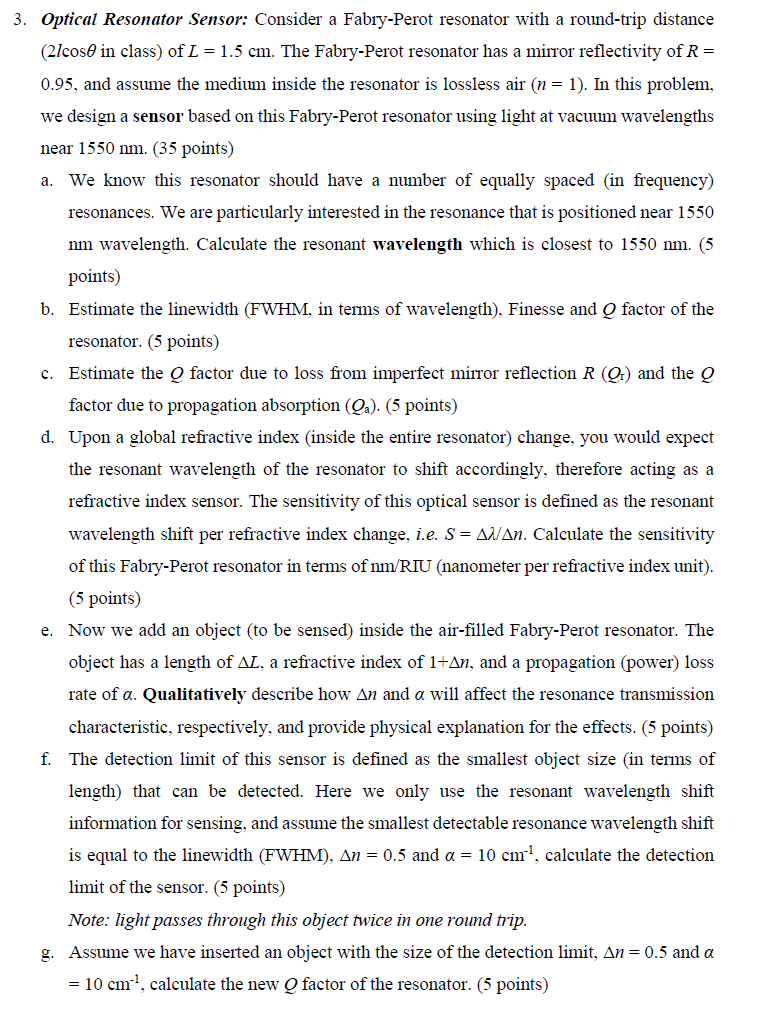
Question: 3 . Optical Resonator Sensor: Consider a Fabry - Perot resonator with a round - trip distance ( ( 2 l cos
Optical Resonator Sensor: Consider a FabryPerot resonator with a roundtrip distance l cos theta in class of Lmathrm~cm The FabryPerot resonator has a mirror reflectivity of R and assume the medium inside the resonator is lossless air n In this problem, we design a sensor based on this FabryPerot resonator using light at vacuum wavelengths near nm points
a We know this resonator should have a number of equally spaced in frequency resonances. We are particularly interested in the resonance that is positioned near nm wavelength. Calculate the resonant wavelength which is closest to nm points
b Estimate the linewidth FWHM in terms of wavelength Finesse and Q factor of the resonator. points
c Estimate the Q factor due to loss from imperfect mirror reflection RleftQmathrmrright and the Q factor due to propagation absorption leftQmathrmaright points
d Upon a global refractive index inside the entire resonator change, you would expect the resonant wavelength of the resonator to shift accordingly, therefore acting as a refractive index sensor The sensitivity of this optical sensor is defined as the resonant wavelength shift per refractive index change, ie SDelta lambda Delta n Calculate the sensitivity of this FabryPerot resonator in terms of nmRIU nanometer per refractive index unit points
e Now we add an object to be sensed inside the airfilled FabryPerot resonator. The object has a length of Delta L a refractive index of Delta n and a propagation power loss rate of alpha Qualitatively describe how Delta n and alpha will affect the resonance transmission characteristic, respectively, and provide physical explanation for the effects. points
f The detection limit of this sensor is defined as the smallest object size in terms of length that can be detected. Here we only use the resonant wavelength shift information for sensing and assume the smallest detectable resonance wavelength shift is equal to the linewidth FWHMDelta n and alphamathrm~cm calculate the detection limit of the sensor points
Note: light passes through this object twice in one round trip.
g Assume we have inserted an object with the size of the detection limitDelta n and alpha mathrm~cm calculate the new Q factor of the resonator. points
Step by Step Solution
There are 3 Steps involved in it
1 Expert Approved Answer
Step: 1 Unlock

Question Has Been Solved by an Expert!
Get step-by-step solutions from verified subject matter experts
Step: 2 Unlock
Step: 3 Unlock
 Study Help