







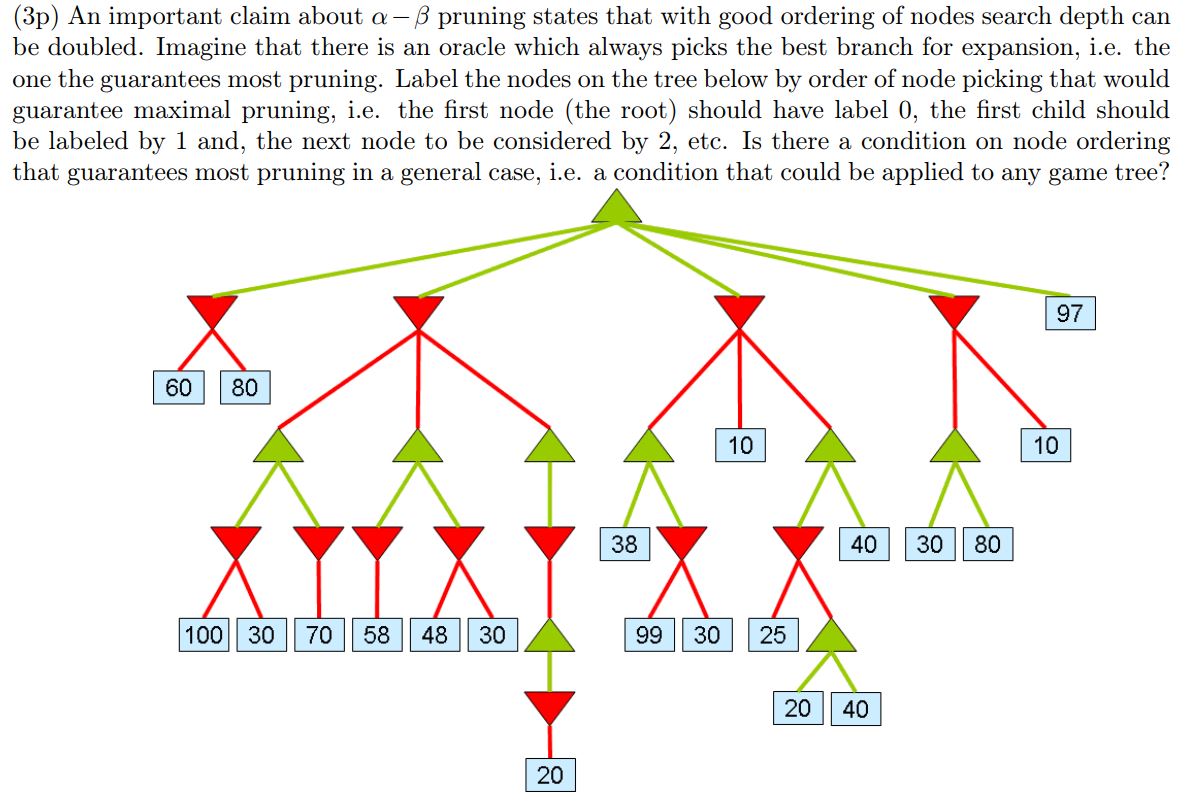
Question: ( 3 p ) An important claim about ( alpha - beta ) pruning states that with good ordering of nodes
p An important claim about alphabeta pruning states that with good ordering of nodes search depth can be doubled. Imagine that there is an oracle which always picks the best branch for expansion, ie the one the guarantees most pruning. Label the nodes on the tree below by order of node picking that would guarantee maximal pruning, ie the first node the root should have label the first child should be labeled by and, the next node to be considered by etc. Is there a condition on node ordering that guarantees most pruning in a general case, ie a condition that could be applied to any game tree? p Apply minimax with right to left alphabeta pruning on the following graph. Show the backed up values, the places where alphabeta prunes the cuts and the reason for each cut. Reasons can be simple ie or Please note that the solution for left to right pruning can be found on the blackboard under "AlphaBeta Pruning Example". p In the simple tree below
the MAX is playing an opponent who plays rationally Minimax of the time, but acts randomly for the remaining For what values of x should the M A X player pick the left branch? Are there any values of x for which the MAX should pick the right branch? Hint: Whichever branch the MAX picks of the the outcome is given by the Minimax, while of the time it is given by Expectimax. p A simple version of a "Grundy's game" is played as follows: Two players have in front of them a single pile of objects, say a stack of pennies. The first player divides the original stack into two stacks that must be unequal. Each player alternatively thereafter does the same to some single stack when it is his turn to play. The game proceeds until each stack has either just one penny or twoat which point continuation becomes impossible. The player who first cannot play is the loser. Show, by drawing a game tree, whether any of the players can always win.
Step by Step Solution
There are 3 Steps involved in it
1 Expert Approved Answer
Step: 1 Unlock

Question Has Been Solved by an Expert!
Get step-by-step solutions from verified subject matter experts
Step: 2 Unlock
Step: 3 Unlock
 Study Help