







Question: 3. (practice with calculus) Consider an annuity that pays C per year with m payments per year for T years. Then each payment would have
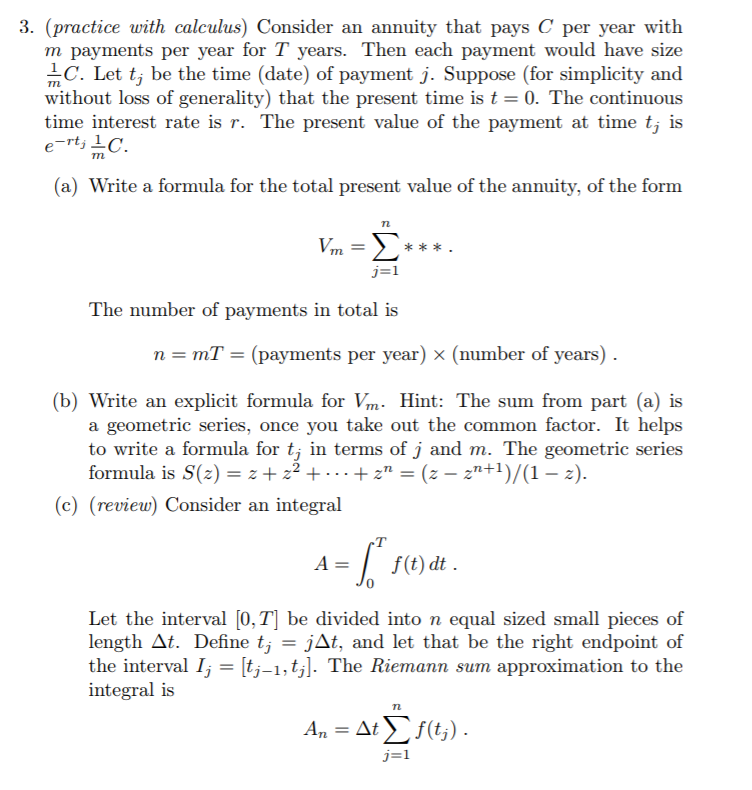
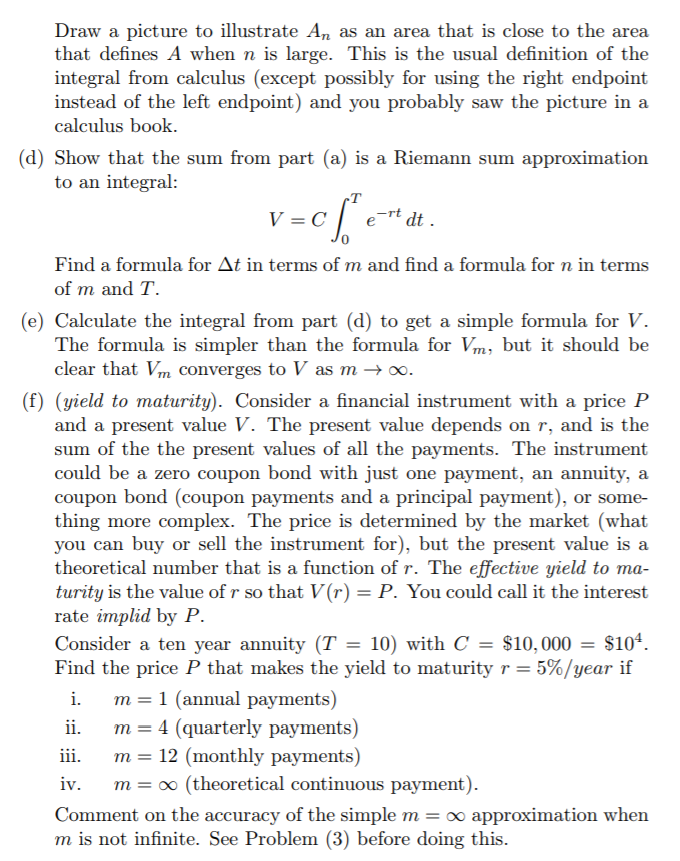
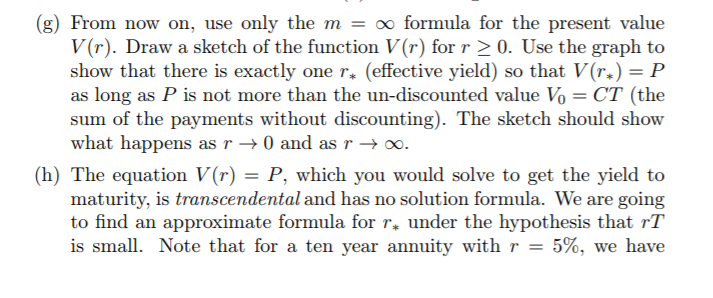
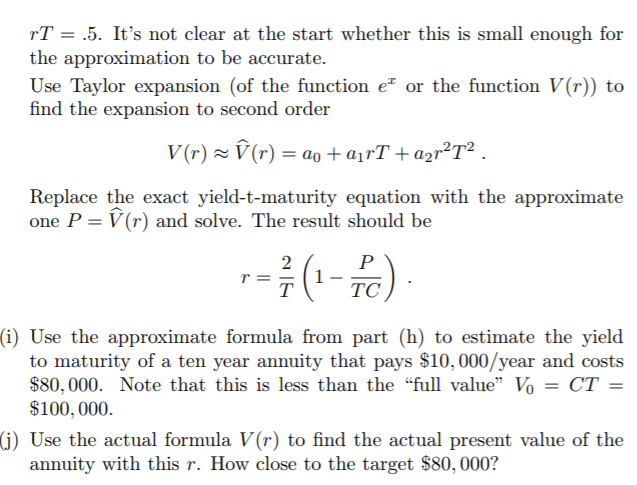
3. (practice with calculus) Consider an annuity that pays C per year with m payments per year for T years. Then each payment would have size C. Let tj be the time (date) of payment j. Suppose (for simplicity and without loss of generality) that the present time is t 0. The continuous time interest rate is r. The present value of the payment at time t, is TL rt 1 7IL (a) Write a formula for the total present value of the annuity, of the form The number of payments in total is n nT-(payments per year) x (number of years) . (b) Write an explicit formula for Vm Hint: The sum from part (a) is a geometric series, once you take out the common factor. It helps to write a formula for tj in terms of j and m. The geometric series formula is S(z) = z + z2 + + zn = (z-zn+1)/(1-z) (c) (review) Consider an integral A-f(t) dt 0 Let the interval [0, T] be divided into n equal sized small pieces of length At. Define tj-jAt, and let that be the right endpoint of the interval I- [t,-1,t,]. The Riemann sum approximation to the integral is Tt Draw a picture to illustrate An as an area that is close to the area that defines A when n is large. This is the usual definition of the integral from calculus (except possibly for using the right endpoint instead of the left endpoint) and you probably saw the picture in a calculus book. (d) Show that the sum from part (a) is a Riemann sum approximation to an integral 0 Find a formula for t n terms of m and find a formula for n in terms of m and T (e) Calculate the integral from part (d) to get a simple formula for V. The formula is simpler than the formula for Vm, but it should be clear that V,n converges to V as m oo (f) (yield to maturity). Consider a financial instrument with a price P and a present value V. The present value depends on r, and is the sum of the the present values of all the payments. The instrument could be a zero coupon bond with just one payment, an annuity, a coupon bond (coupon payments and a principal payment), or some- thing more complex. The price is determined by the market (what you can buy or sell the instrument for), but the present value is a theoretical number that is a function of r. The effective yield to ma- turity is the value of r so that V(r) P. You could call it the interest rate implid by P. Consider a ten year annuity (T 10) with C $10,000 - $104 Find the price P that makes the yield to maturity r-5%/year if i. m-1 (annual payments) ii. m 4 (quarterly payments) iii. m-12 (monthly payments) iv. m00 (theoretical continuous payment) Comment on the accuracy of the simple m-oo approximation when m is not infinite. See Problem (3) before doing this (g) From now on, use only the moo formula for the present value V(r). Draw a sketch of the function V(r) forr2 0. Use the graph to show that there is exactly one r* (effective yield) so that V(n) = P as long as P is not more than the un-discounted value Vo CT (the sum of the payments without discounting). The sketch should show (h) The equation V(r) = P, which you would solve to get the yield to maturity, is transcendental and has no solution formula. We are going to find an approximate formula for r. under the hypothesis that rT is small. Note that for a ten year annuity with r-5%, we have rT = .5. It's not clear at the start whether this is small enough for find the expansion to second order V(r) V(r)aTa22 Replace the exact yield-t-maturity equation with the approximate one P V(r) and solve. The result should be TC (i) Use the approximate formula from part (h) to estimate the yield to maturity of a ten year annuity that pays $10,000/year and costs $80,000. Note that this is less than the "full value"Vo CT- $100,000. G) Use the actual formula V(r) to find the actual present value of the annuity with this r. How close to the target $80, 000? 3. (practice with calculus) Consider an annuity that pays C per year with m payments per year for T years. Then each payment would have size C. Let tj be the time (date) of payment j. Suppose (for simplicity and without loss of generality) that the present time is t 0. The continuous time interest rate is r. The present value of the payment at time t, is TL rt 1 7IL (a) Write a formula for the total present value of the annuity, of the form The number of payments in total is n nT-(payments per year) x (number of years) . (b) Write an explicit formula for Vm Hint: The sum from part (a) is a geometric series, once you take out the common factor. It helps to write a formula for tj in terms of j and m. The geometric series formula is S(z) = z + z2 + + zn = (z-zn+1)/(1-z) (c) (review) Consider an integral A-f(t) dt 0 Let the interval [0, T] be divided into n equal sized small pieces of length At. Define tj-jAt, and let that be the right endpoint of the interval I- [t,-1,t,]. The Riemann sum approximation to the integral is Tt Draw a picture to illustrate An as an area that is close to the area that defines A when n is large. This is the usual definition of the integral from calculus (except possibly for using the right endpoint instead of the left endpoint) and you probably saw the picture in a calculus book. (d) Show that the sum from part (a) is a Riemann sum approximation to an integral 0 Find a formula for t n terms of m and find a formula for n in terms of m and T (e) Calculate the integral from part (d) to get a simple formula for V. The formula is simpler than the formula for Vm, but it should be clear that V,n converges to V as m oo (f) (yield to maturity). Consider a financial instrument with a price P and a present value V. The present value depends on r, and is the sum of the the present values of all the payments. The instrument could be a zero coupon bond with just one payment, an annuity, a coupon bond (coupon payments and a principal payment), or some- thing more complex. The price is determined by the market (what you can buy or sell the instrument for), but the present value is a theoretical number that is a function of r. The effective yield to ma- turity is the value of r so that V(r) P. You could call it the interest rate implid by P. Consider a ten year annuity (T 10) with C $10,000 - $104 Find the price P that makes the yield to maturity r-5%/year if i. m-1 (annual payments) ii. m 4 (quarterly payments) iii. m-12 (monthly payments) iv. m00 (theoretical continuous payment) Comment on the accuracy of the simple m-oo approximation when m is not infinite. See Problem (3) before doing this (g) From now on, use only the moo formula for the present value V(r). Draw a sketch of the function V(r) forr2 0. Use the graph to show that there is exactly one r* (effective yield) so that V(n) = P as long as P is not more than the un-discounted value Vo CT (the sum of the payments without discounting). The sketch should show (h) The equation V(r) = P, which you would solve to get the yield to maturity, is transcendental and has no solution formula. We are going to find an approximate formula for r. under the hypothesis that rT is small. Note that for a ten year annuity with r-5%, we have rT = .5. It's not clear at the start whether this is small enough for find the expansion to second order V(r) V(r)aTa22 Replace the exact yield-t-maturity equation with the approximate one P V(r) and solve. The result should be TC (i) Use the approximate formula from part (h) to estimate the yield to maturity of a ten year annuity that pays $10,000/year and costs $80,000. Note that this is less than the "full value"Vo CT- $100,000. G) Use the actual formula V(r) to find the actual present value of the annuity with this r. How close to the target $80, 000
Step by Step Solution
There are 3 Steps involved in it

Get step-by-step solutions from verified subject matter experts
 Study Help