







Question: (3) Prepare two BASE tapes that are each 12 cm or more in length. Fold one end of each to make a tab or handle
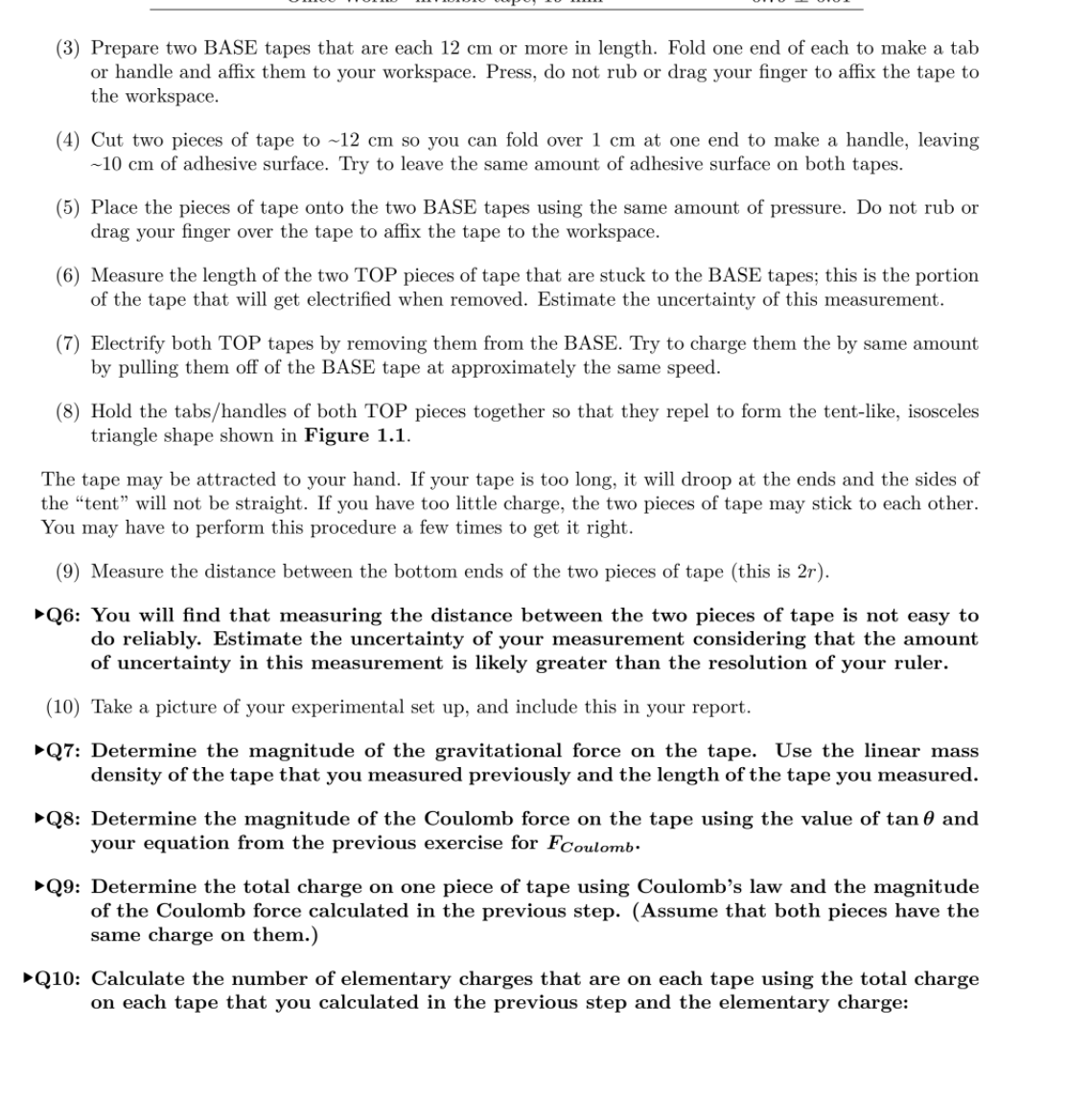
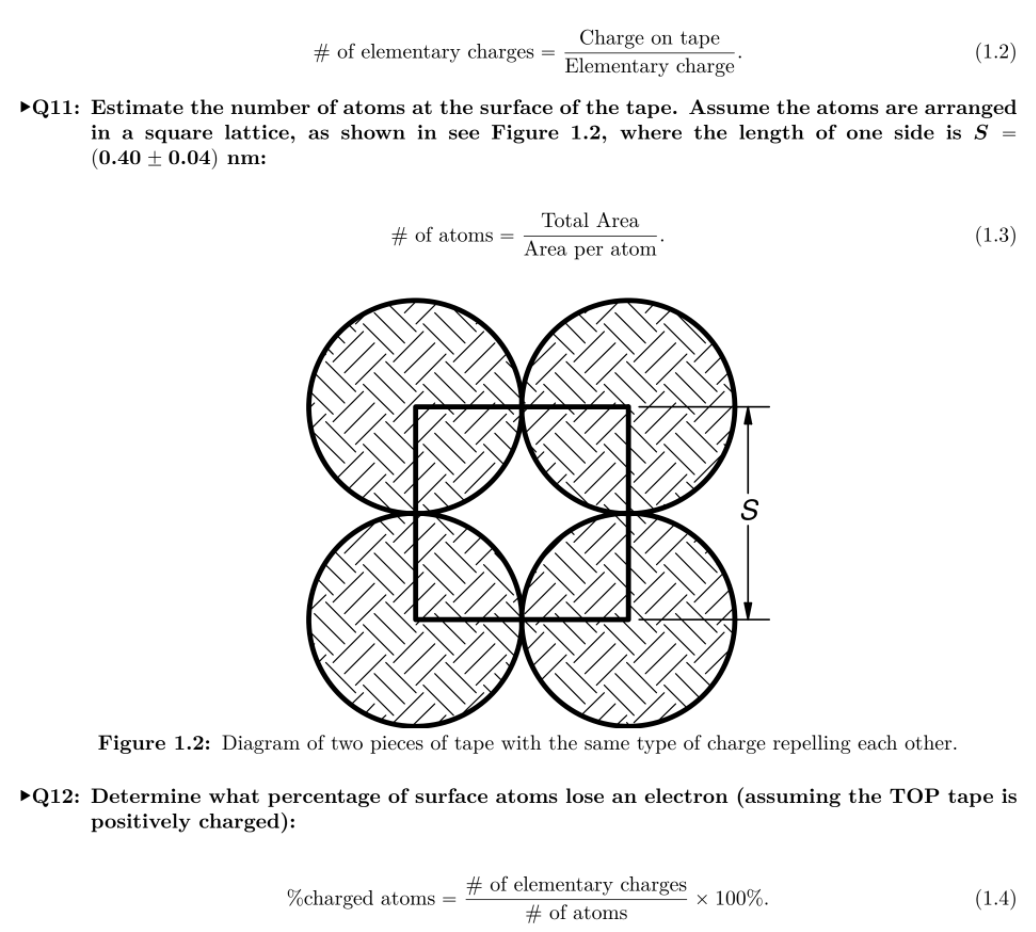
(3) Prepare two BASE tapes that are each 12 cm or more in length. Fold one end of each to make a tab or handle and affix them to your workspace. Press, do not rub or drag your finger to affix the tape to the workspace. (4) Cut two pieces of tape to ~12 cm so you can fold over 1 cm at one end to make a handle, leaving ~10 cm of adhesive surface. Try to leave the same amount of adhesive surface on both tapes. (5) Place the pieces of tape onto the two BASE tapes using the same amount of pressure. Do not rub or drag your finger over the tape to affix the tape to the workspace. (6) Measure the length of the two TOP pieces of tape that are stuck to the BASE tapes; this is the portion of the tape that will get electrified when removed. Estimate the uncertainty of this measurement. (7) Electrify both TOP tapes by removing them from the BASE. Try to charge them the by same amount by pulling them off of the BASE tape at approximately the same speed. (8) Hold the tabs/handles of both TOP pieces together so that they repel to form the tent-like, isosceles triangle shape shown in Figure 1.1. The tape may be attracted to your hand. If your tape is too long, it will droop at the ends and the sides of the "tent" will not be straight. If you have too little charge, the two pieces of tape may stick to each other. You may have to perform this procedure a few times to get it right. (9) Measure the distance between the bottom ends of the two pieces of tape (this is 2r). Q6: You will find that measuring the distance between the two pieces of tape is not easy to do reliably. Estimate the uncertainty of your measurement considering that the amount of uncertainty in this measurement is likely greater than the resolution of your ruler. (10) Take a picture of your experimental set up, and include this in your report. Q7: Determine the magnitude of the gravitational force on the tape. Use the linear mass density of the tape that you measured previously and the length of the tape you measured. Q8: Determine the magnitude of the Coulomb force on the tape using the value of tan 0 and your equation from the previous exercise for FCoulomb. Q9: Determine the total charge on one piece of tape using Coulomb's law and the magnitude of the Coulomb force calculated in the previous step. (Assume that both pieces have the same charge on them.) Q10: Calculate the number of elementary charges that are on each tape using the total charge on each tape that you calculated in the previous step and the elementary charge:Charge on tape Elementary charge ' (1'2) # of elementary charges = lel: Estimate the number of atoms at the surface of the tape. Assume the atoms are arranged in a square lattice, as shown in see Figure 1.2, where the length of one side is S = {0.40 i 0.04) nm: Total Area Area per atom. # of atoms = (1.3) Figure 1.2: Diagram of two pieces of tape with the same type of charge repelling each other. H.212: Determine what percentage of surface atoms lose an electron (assuming the TOP tape is positively charged): # of elementary charges %charged atoms = # of atoms x 100%. (1.4)
Step by Step Solution
There are 3 Steps involved in it

Get step-by-step solutions from verified subject matter experts
 Study Help