







Question: 3. Problem 3 In the next unit, we will start to look at other coordinate systems. One such coordinate system is called spherical coordinates. When
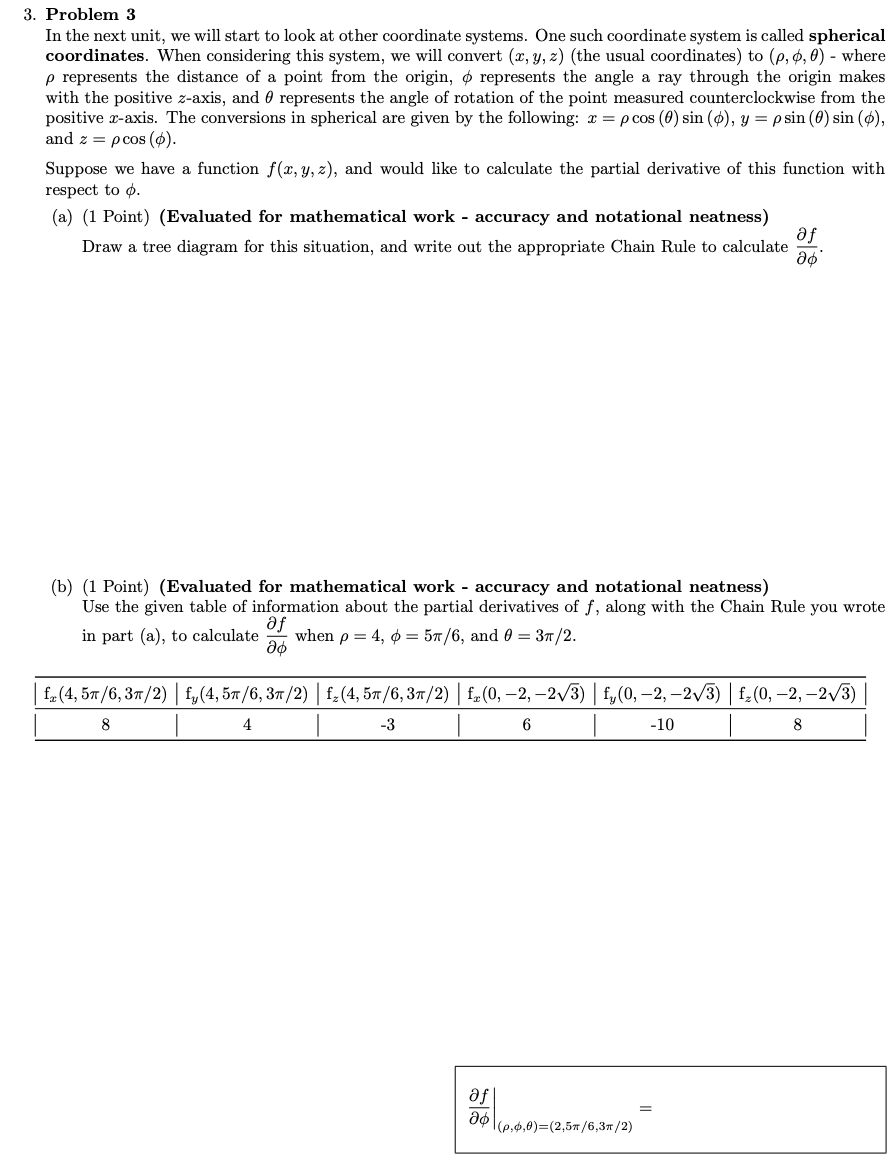
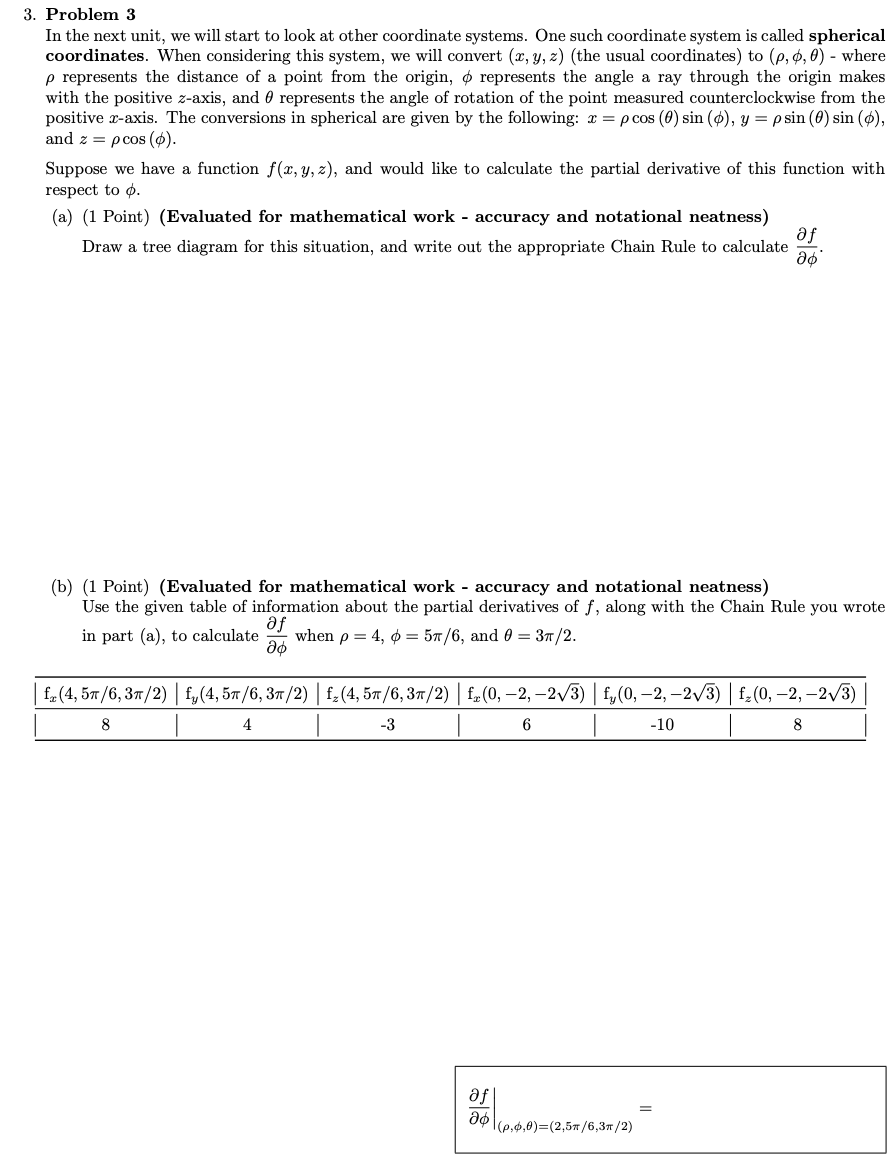
3. Problem 3 In the next unit, we will start to look at other coordinate systems. One such coordinate system is called spherical coordinates. When considering this system, we will convert (r, y, z) (the usual coordinates) to (p, $, 0) - where p represents the distance of a point from the origin, $ represents the angle a ray through the origin makes with the positive z-axis, and 0 represents the angle of rotation of the point measured counterclockwise from the positive r-axis. The conversions in spherical are given by the following: x = pcos (0) sin ($), y = psin (0) sin ($), and z = pcos ($). Suppose we have a function f(x, y, z), and would like to calculate the partial derivative of this function with respect to o. (a) (1 Point) (Evaluated for mathematical work - accuracy and notational neatness) Draw a tree diagram for this situation, and write out the appropriate Chain Rule to calculate of e ag (b) (1 Point) (Evaluated for mathematical work - accuracy and notational neatness) Use the given table of information about the partial derivatives of f, along with the Chain Rule you wrote of in part (a), to calculate at when p = 4, o = 57/6, and 0 = 37 /2. fx (4, 57 /6, 37/2) |fy (4, 57/6, 37 /2) |f= (4, 57 /6, 37/2) | fx(0, -2, -2V/3) | fy (0, -2, -2V/3) | f= (0, -2, -2V/3) 8 4 -3 6 -10 8 of op (p.6,0)=(2,5 /6,37 /2)
Step by Step Solution
There are 3 Steps involved in it

Get step-by-step solutions from verified subject matter experts
 Study Help