Question: 3 Problem 3 This problem concerns three proposed methods for estimating a signal, based on a measurement that is corrupted by a small noise and
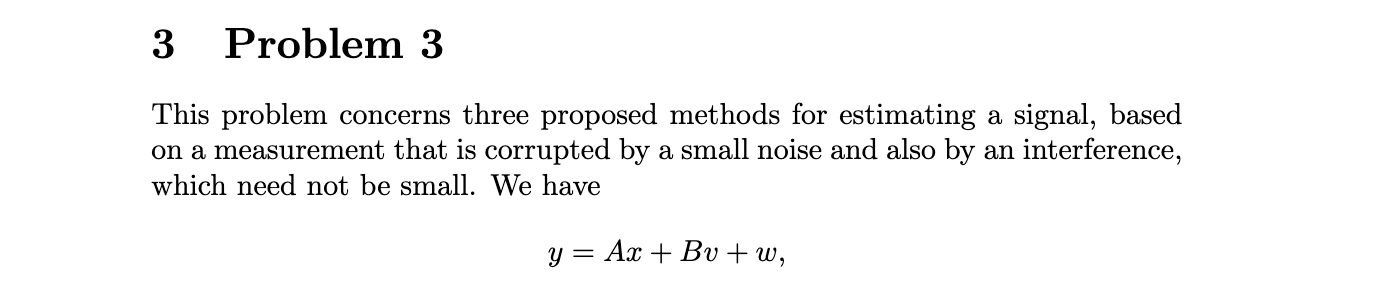
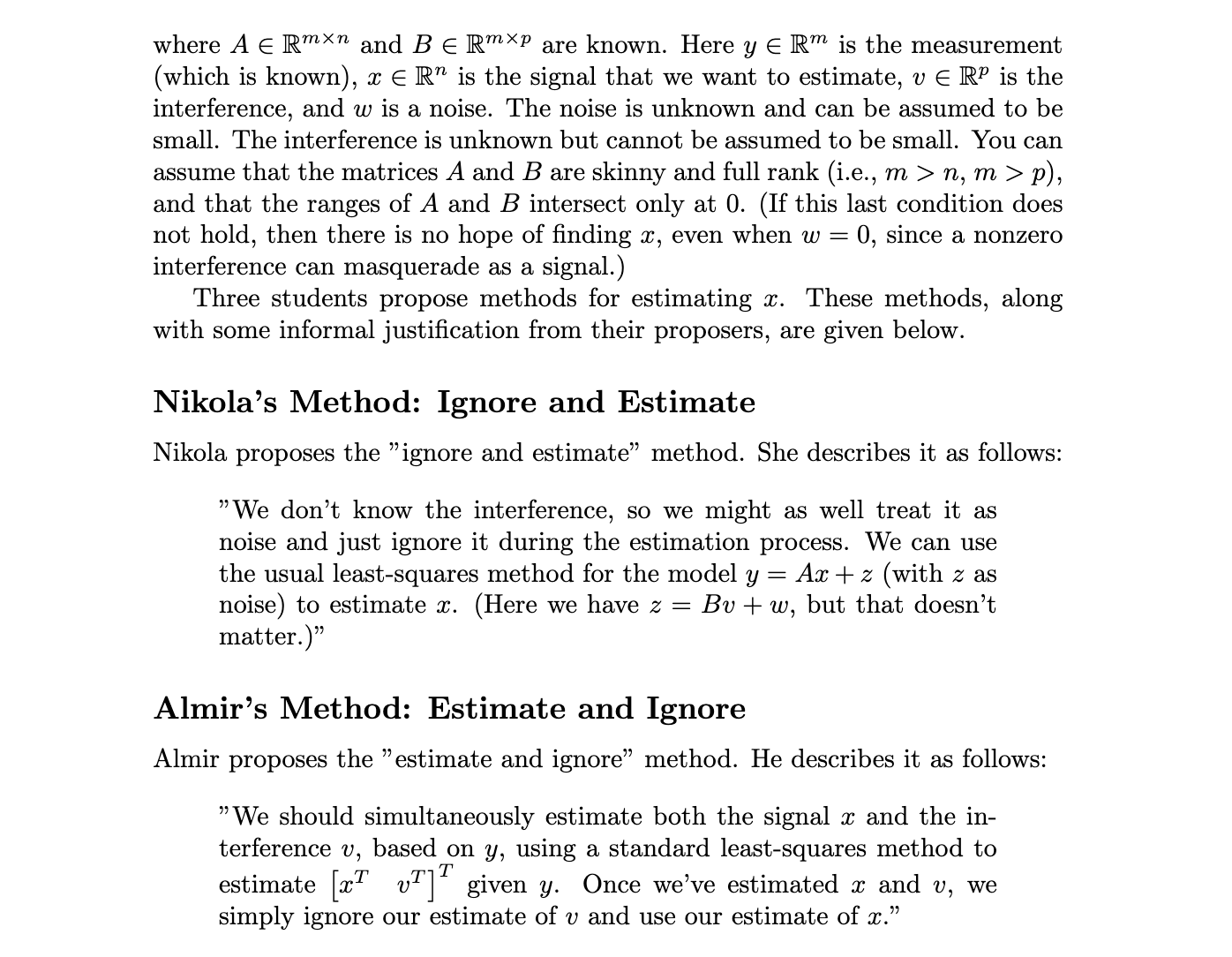
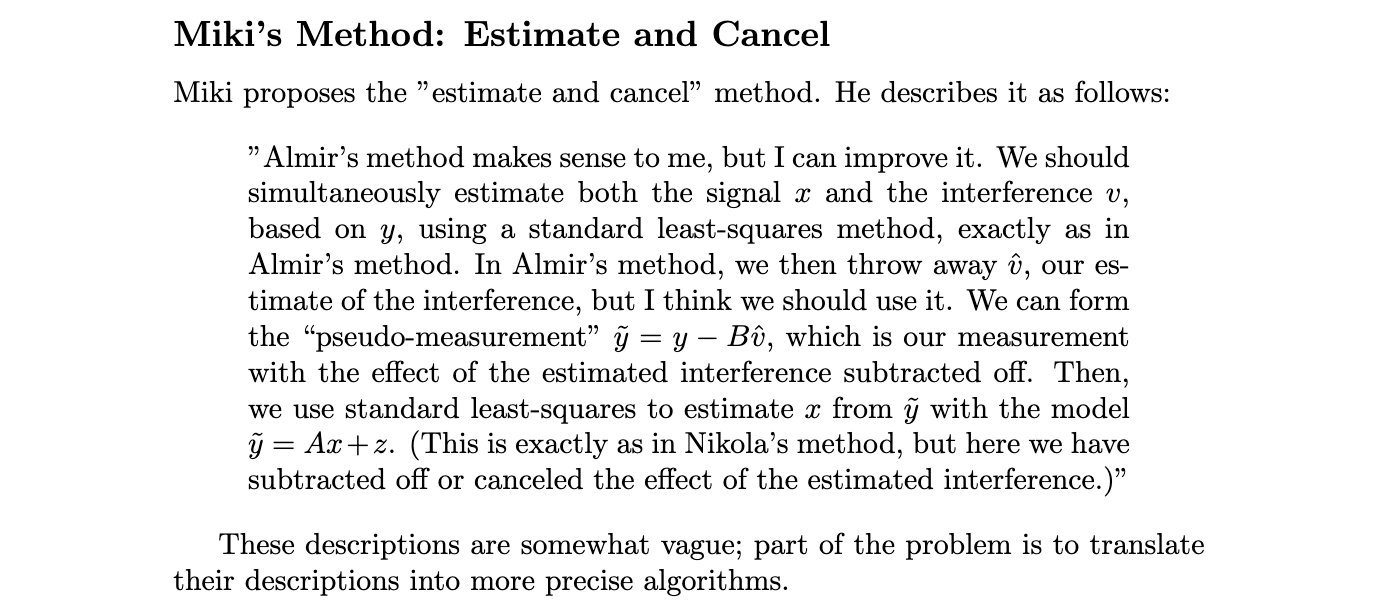
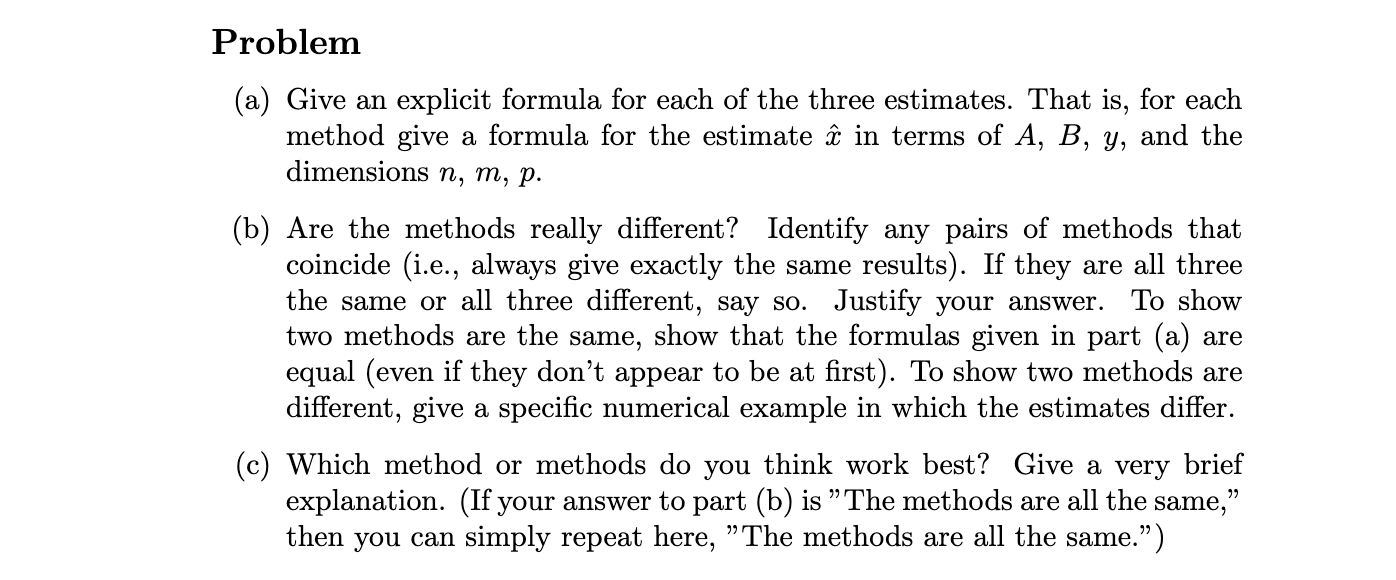
3 Problem 3 This problem concerns three proposed methods for estimating a signal, based on a measurement that is corrupted by a small noise and also by an interference, which need not be small. We have y = Ax + But w,where A R* and B R*P are known. Here y R is the measurement (which is known), z R is the signal that we want to estimate, v R? is the interference, and w is a noise. The noise is unknown and can be assumed to be small. The interference is unknown but cannot be assumed to be small. You can assume that the matrices A and B are skinny and full rank (i.e., m > n, m > p), and that the ranges of A and B intersect only at 0. (If this last condition does not hold, then there is no hope of finding z, even when w = 0, since a nonzero interference can masquerade as a signal.) Three students propose methods for estimating x. These methods, along with some informal justification from their proposers, are given below. Nikola's Method: Ignore and Estimate Nikola proposes the "ignore and estimate\" method. She describes it as follows: "We don't know the interference, so we might as well treat it as noise and just ignore it during the estimation process. We can use the usual least-squares method for the model y = Az + z (with z as noise) to estimate x. (Here we have z = Bv + w, but that doesn't matter.)\" Almir's Method: Estimate and Ignore Almir proposes the \"estimate and ignore\" method. He describes it as follows: \"We should simultaneously estimate both the signal z and the in- terference v, based on y, using a standard least-squares method to estimate [z7 'UT]T given y. Once we've estimated x and v, we simply ignore our estimate of v and use our estimate of x.\" Miki's Method: Estimate and Cancel Miki proposes the \"estimate and cancel\" method. He describes it as follows: \" Almir's method makes sense to me, but I can improve it. We should simultaneously estimate both the signal x and the interference v, based on y, using a standard least-squares method, exactly as in Almir's method. In Almir's method, we then throw away , our es- timate of the interference, but I think we should use it. We can form the \"pseudo-measurement\" = y B, which is our measurement with the effect of the estimated interference subtracted off. Then, we use standard least-squares to estimate x from g with the model y = Az + 2. (This is exactly as in Nikola's method, but here we have subtracted off or canceled the effect of the estimated interference.)\" These descriptions are somewhat vague; part of the problem is to translate their descriptions into more precise algorithms. Problem (a) (b) Give an explicit formula for each of the three estimates. That is, for each method give a formula for the estimate Z in terms of A, B, y, and the dimensions n, m, p. Are the methods really different? Identify any pairs of methods that coincide (i.e., always give exactly the same results). If they are all three the same or all three different, say so. Justify your answer. To show two methods are the same, show that the formulas given in part (a) are equal (even if they don't appear to be at first). To show two methods are different, give a specific numerical example in which the estimates differ. Which method or methods do you think work best? Give a very brief explanation. (If your answer to part (b) is \" The methods are all the same,\" then you can simply repeat here, \"The methods are all the same.\")
Step by Step Solution
There are 3 Steps involved in it
1 Expert Approved Answer
Step: 1 Unlock
Question Has Been Solved by an Expert!
Get step-by-step solutions from verified subject matter experts
Step: 2 Unlock
Step: 3 Unlock
Students Have Also Explored These Related Mathematics Questions!









 Study Help