







Question: 3. Process Scheduling, Concurrency, Memory Management, File Management and Device Management (25 Marks) (a) This question relate to device management: Disk requests are received in
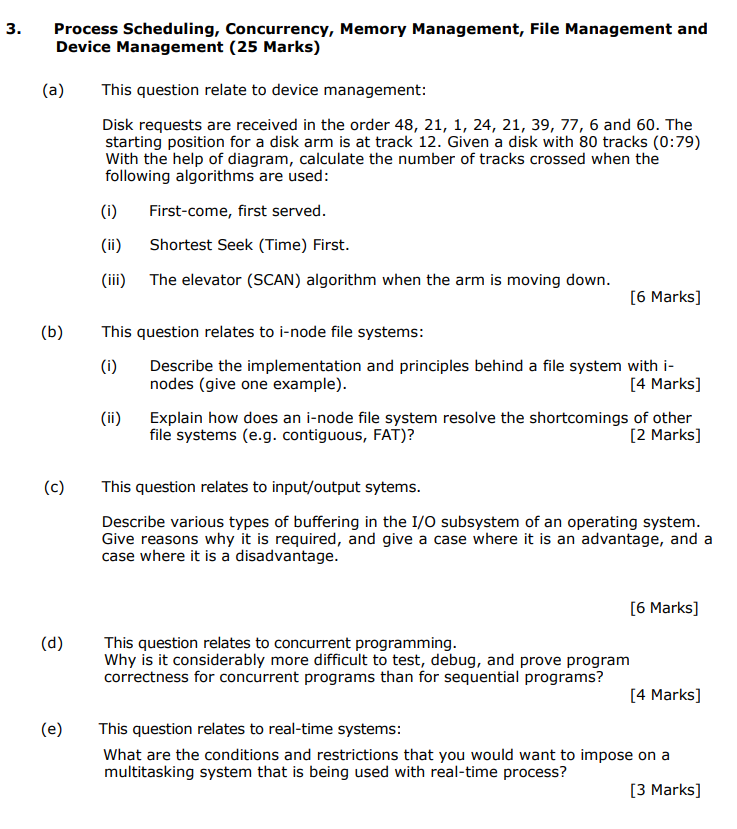
3. Process Scheduling, Concurrency, Memory Management, File Management and Device Management (25 Marks) (a) This question relate to device management: Disk requests are received in the order 48, 21, 1, 24, 21, 39, 77, 6 and 60. The starting position for a disk arm is at track 12. Given a disk with 80 tracks (0:79) With the help of diagram, calculate the number of tracks crossed when the following algorithms are used: (i) First-come, first served. Shortest Seek (Time) First. (ii) (b) (iii) The elevator (SCAN) algorithm when the arm is moving down. [6 Marks] This question relates to i-node file systems: (i) Describe the implementation and principles behind a file system with i- nodes (give one example). [4 Marks] Explain how does an i-node file system resolve the shortcomings of other file systems (e.g. contiguous, FAT)? [2 marks] (c) This question relates to input/output sytems. Describe various types of buffering in the I/O subsystem of an operating system. Give reasons why it is required, and give a case where it is an advantage, and a case where it is a disadvantage. [6 Marks] (d) This question relates to concurrent programming. Why is it considerably more difficult to test, debug, and prove program correctness for concurrent programs than for sequential programs? [4 Marks] This question relates to real-time systems: What are the conditions and restrictions that you would want to impose on a multitasking system that is being used with real-time process? [3 Marks] (e)
Step by Step Solution
There are 3 Steps involved in it

Get step-by-step solutions from verified subject matter experts
 Study Help