







Question: 3. Recall that f (3:) = sin(3:2) is a function that has an antiderivative, but we cannot express 1 it in terms of elementary functions.


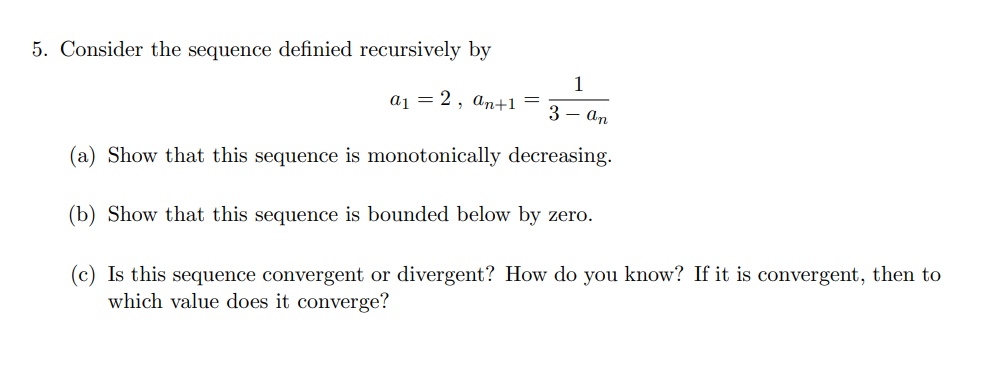


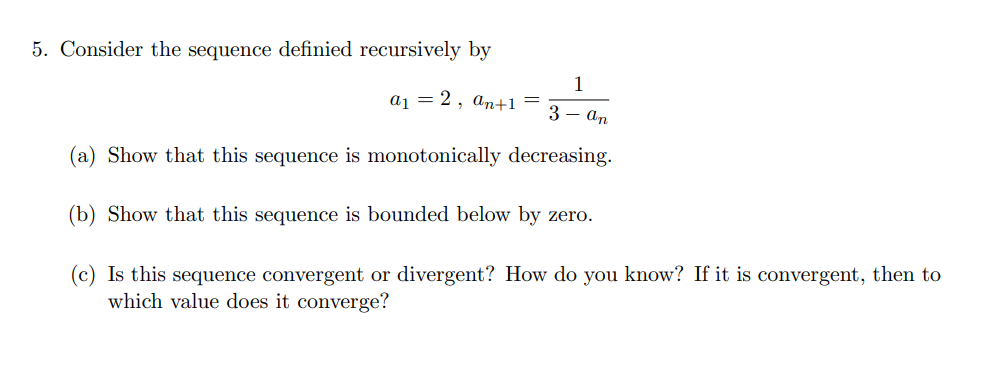
3. Recall that f (3:) = sin(3:2) is a function that has an antiderivative, but we cannot express 1 it in terms of elementary functions. Use a power series to estimate f sin[:1:2} tie: up to ve 0 decimal places. 4. (a) Use graphing software to plot the graph of f(.'I:) = areI as well as its rst, second, and third degree Taylor Polynomials about the value 3: = 1. (b) What is the interval and radius of convergence of the power series expansion of f(3) 2 me\"? 5. Consider the sequence denied recursively by a1225an+1:3_a 11 (a) Show that this sequence is monotonically decreasing. (b) Show that this sequence is bounded below by zero. (c) Is this sequence convergent or divergent? How do you know? If it is convergent, then to which value does it converge
Step by Step Solution
There are 3 Steps involved in it

Get step-by-step solutions from verified subject matter experts
 Study Help