







Question: 3 . Reflect on the challenges presented in sections 9 . 6 to 9 . 1 2 of Chapter 9 and identify which you perceive
Reflect on the challenges presented in sections to of Chapter and identify which you perceive as the most formidable if faced in your professional career. Provide a detailed analysis of why this challenge stands out to you, and suggest strategies for overcoming it drawing on both theoretical concepts and practical approaches. PAYING FOR SPECIAL TREATMENT: THE PROBLEM
OF BRIBERY
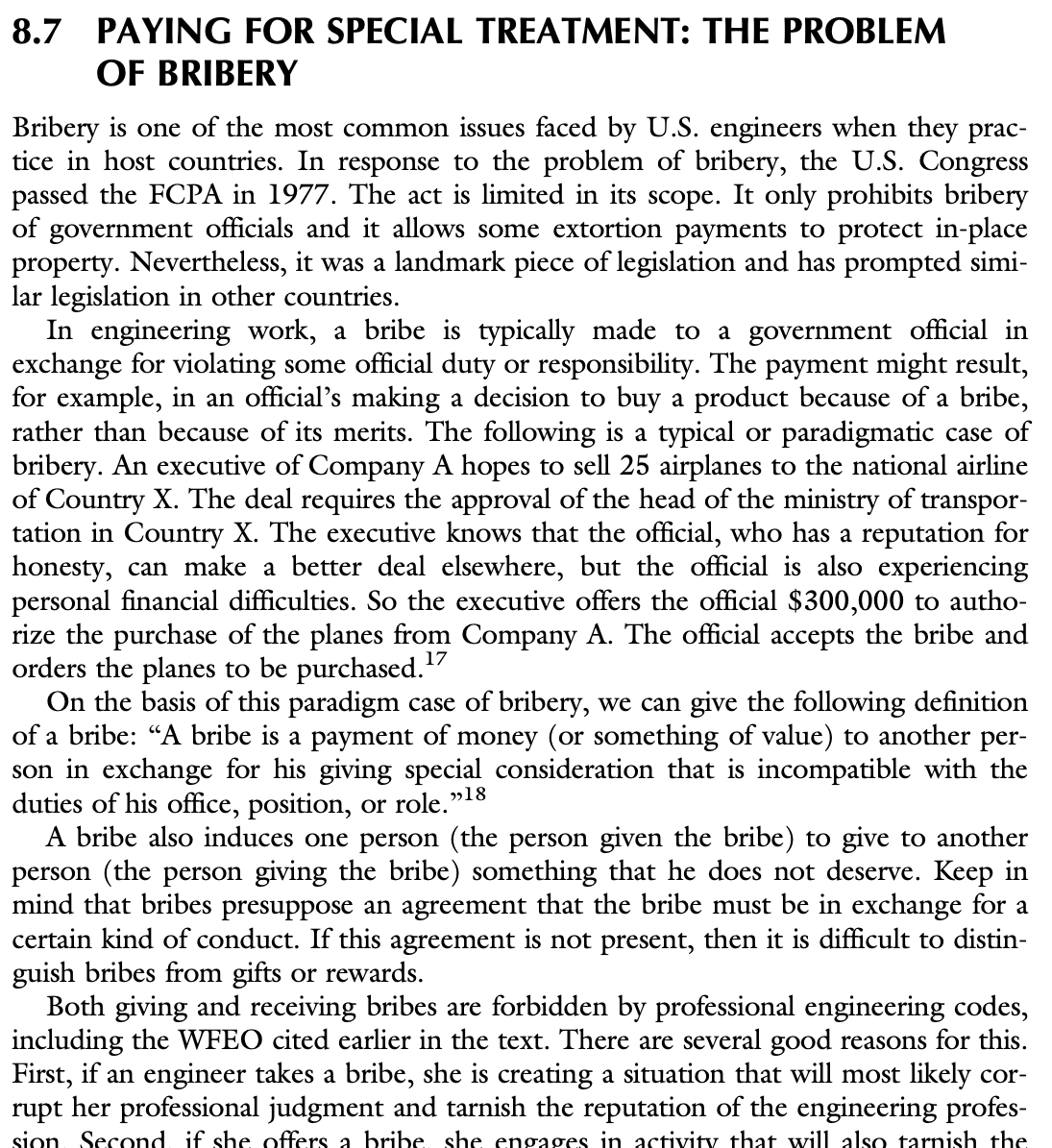
Bribery is one of the most common issues faced by US engineers when they prac
tice in host countries. In response to the problem of bribery, the US Congress
passed the FCPA in The act is limited in its scope. It only prohibits bribery
of government officials and it allows some extortion payments to protect inplace
property. Nevertheless, it was a landmark piece of legislation and has prompted simi
lar legislation in other countries.
In engineering work, a bribe is typically made to a government official in
exchange for violating some official duty or responsibility. The payment might result,
for example, in an official's making a decision to buy a product because of a bribe,
rather than because of its merits. The following is a typical or paradigmatic case of
bribery. An executive of Company A hopes to sell airplanes to the national airline
of Country X The deal requires the approval of the head of the ministry of transpor
tation in Country X The executive knows that the official, who has a reputation for
honesty, can make a better deal elsewhere, but the official is also experiencing
personal financial difficulties. So the executive offers the official $ to autho
rize the purchase of the planes from Company A The official accepts the bribe and
orders the planes to be purchased.
On the basis of this paradigm case of bribery, we can give the following definition
of a bribe: "A bribe is a payment of money or something of value to another per
son in exchange for his giving special consideration that is incompatible with the
duties of his office, position, or role."
A bribe also induces one person the person given the bribe to give to another
person the person giving the bribe something that he does not deserve. Keep in
mind that bribes presuppose an agreement that the bribe must be in exchange for a
certain kind of conduct. If this agreement is not present, then it is difficult to distin
guish bribes from gifts or rewards.
Both giving and receiving bribes are forbidden by professional engineering codes,
including the WFEO cited earlier in the text. There are several good reasons for this.
First, if an engineer takes a bribe, she is creating a situation that will most likely cor
rupt her professional judgment and tarnish the reputation of the engineering profes
Step by Step Solution
There are 3 Steps involved in it
1 Expert Approved Answer
Step: 1 Unlock

Question Has Been Solved by an Expert!
Get step-by-step solutions from verified subject matter experts
Step: 2 Unlock
Step: 3 Unlock
 Study Help