







Question: = 3. Someday, we may try to offset global warming by injecting chemicals into the upper atmosphere to reflect the Sun's rays back to space.
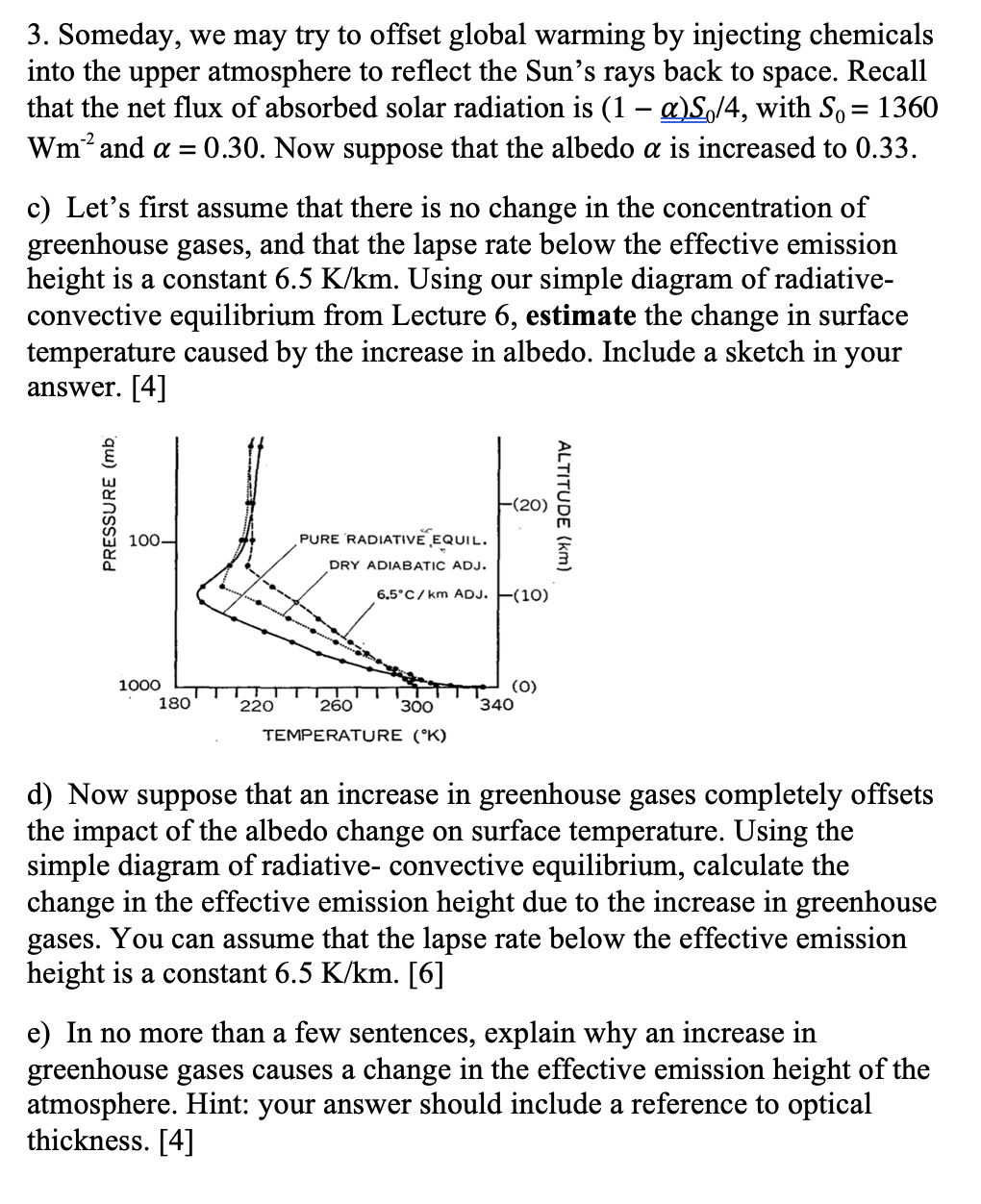
= 3. Someday, we may try to offset global warming by injecting chemicals into the upper atmosphere to reflect the Sun's rays back to space. Recall that the net flux of absorbed solar radiation is (1 a)S/4, with So = 1360 Wm- and a = :0.30. Now suppose that the albedo a is increased to 0.33. c) Let's first assume that there is no change in the concentration of greenhouse gases, and that the lapse rate below the effective emission height is a constant 6.5 K/km. Using our simple diagram of radiative- convective equilibrium from Lecture 6, estimate the change in surface temperature caused by the increase in albedo. Include a sketch in your answer. [4] a PRESSURE (mb -(20) 100% ALTITUDE (km) HE PURE 'RADIATIVE EQUIL. DRY ADIABATIC ADJ. 6.5C/km ADJ. (10) 1000 180 (O) 340 220 260 300 TEMPERATURE (K) d) Now suppose that an increase in greenhouse gases completely offsets the impact of the albedo change on surface temperature. Using the simple diagram of radiative-convective equilibrium, calculate the change in the effective emission height due to the increase in greenhouse gases. You can assume that the lapse rate below the effective emission height is a constant 6.5 K/km. [6] e) In no more than a few sentences, explain why an increase in greenhouse gases causes a change in the effective emission height of the atmosphere. Hint: your answer should include a reference to optical thickness. [4]
Step by Step Solution
There are 3 Steps involved in it

Get step-by-step solutions from verified subject matter experts
 Study Help