







Question: (3) Sometimes we define a function by just setting a variable equal to an expression in terms of other variables. E.g. z = xy
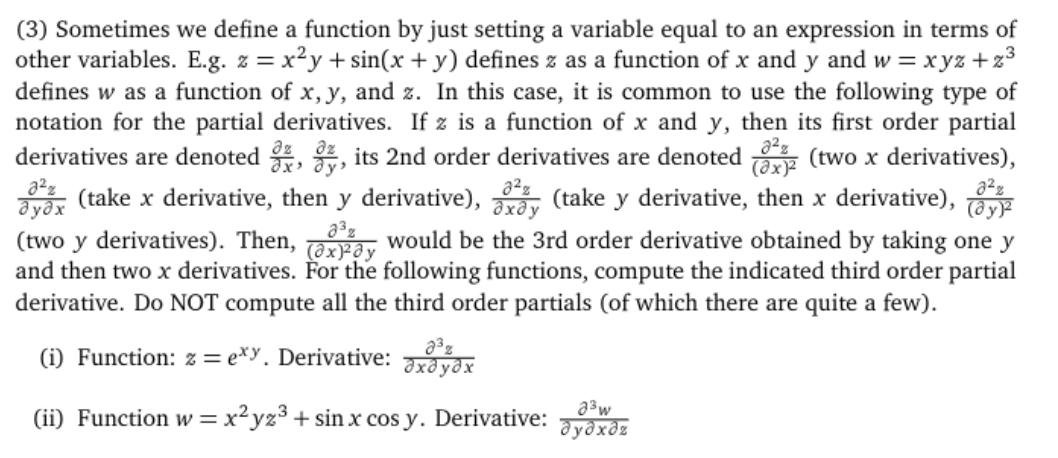
(3) Sometimes we define a function by just setting a variable equal to an expression in terms of other variables. E.g. z = xy + sin(x + y) defines z as a function of x and y and w = xyz + z defines w as a function of x, y, and z. In this case, it is common to use the following type of notation for the partial derivatives. If z is a function of x and y, then its first order partial derivatives are denoted , 3, its 2nd order derivatives are denoted (two x derivatives), 8% 3% (take x derivative, then y derivative), xy (take y derivative, then x derivative), (@y) (two y derivatives). Then, (x2y would be the 3rd order derivative obtained by taking one y and then two x derivatives. For the following functions, compute the indicated third order partial derivative. Do NOT compute all the third order partials (of which there are quite a few). 2% (i) Function: zexy. Derivative: xyx (ii) Function w = = xyz + sin x cos y. Derivative: 2 w yxz
Step by Step Solution
3.46 Rating (156 Votes )
There are 3 Steps involved in it

Get step-by-step solutions from verified subject matter experts
 Study Help