







Question: 3. (Specific Factor Model, Chapter 3) In the simple version of the specific factor model, there are two sectors (goods), one factor (labor) that is
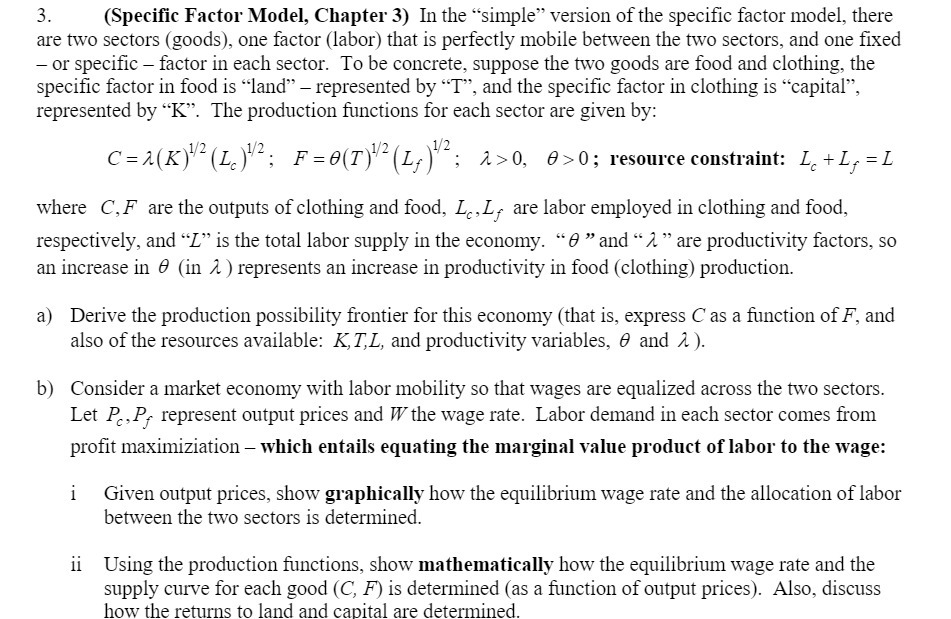
3. (Specific Factor Model, Chapter 3) In the "simple" version of the specific factor model, there are two sectors (goods), one factor (labor) that is perfectly mobile between the two sectors, and one fixed - or specific - factor in each sector. To be concrete, suppose the two goods are food and clothing, the specific factor in food is "land" - represented by "T", and the specific factor in clothing is "capital", represented by "K". The production functions for each sector are given by: C= A(K) ?(L.) 2; F= 0(T) (L.)"; 1>0, 0>0; resource constraint: L, + L = L where C, F are the outputs of clothing and food, L., Ly are labor employed in clothing and food, respectively, and "L" is the total labor supply in the economy. " " and " 2 " are productivity factors, so an increase in @ (in 1 ) represents an increase in productivity in food (clothing) production. a) Derive the production possibility frontier for this economy (that is, express C as a function of F, and also of the resources available: K, T,L, and productivity variables, 0 and 1 ). b) Consider a market economy with labor mobility so that wages are equalized across the two sectors. Let Pc, P- represent output prices and W the wage rate. Labor demand in each sector comes from profit maximizingntails equating the marginal value product of labor to the wage: i Given output prices, show graphically how the equilibrium wage rate and the allocation of labor between the two sectors is determined. ii Using the production functions, show mathematically how the equilibrium wage rate and the supply curve for each good (C, F) is determined (as a function of output prices). Also, discuss how the returns to land and capital are determined
Step by Step Solution
There are 3 Steps involved in it

Get step-by-step solutions from verified subject matter experts
 Study Help