







Question: 3. Stable sort means that Same items maintain the same relative order in the final sorted list as they appeared in the original unsorted list.
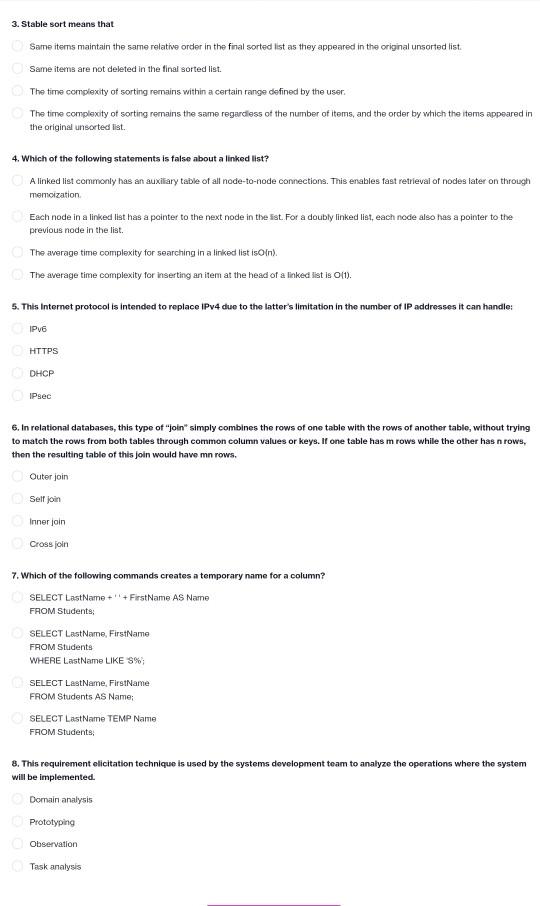
3. Stable sort means that Same items maintain the same relative order in the final sorted list as they appeared in the original unsorted list. Same items are not deleted in the final sorted list. The time complexity of sorting remains within a certain range defined by the user. The time complexity of sorting remains the same regardless of the number of items, and the order by which the items appeared in the original unsorted list. 4. Which of the following statements is false about a linked list? A linked list commonly has an auxiliary table of alt node-to-node connections. This enables fast retrieval of nodes later on through memoization Each node in a linked list has a pointer to the next node in the ist. For a doubly linked list, each node also has a pointer to the previous node in the list. The average time complexity for searching in a linked list isoin) The average time complexity for inserting an item at the head of a linked list is 011). 5. This Internet protocol is intended to replace IPv4 due to the latter's limitation in the number of IP addresses it can handle IPVE HTTPS DHCP IPsec 6. In relational databases, this type of "join" simply combines the rows of one table with the rows of another table, without trying to match the rows from both tables through common column values or keys. If one table has mrows while the other has n rows, then the resulting table of this join would have mn rows. Outer join Self join Inner join Cross join 7. Which of the following commands creates a temporary name for a column? SELECT LastName + "'+FirstName AS Name FROM Students: SELECT LastName, FirstName FROM Students WHERE LastName LIKE 8% SELECT LastName, FirstName FROM Students AS Name: SELECT LastName TEMP Name FROM Students 8. This requirement elicitation technique is used by the systems development team to analyze the operations where the system will be implemented. Domain analysis Prototyping Observation Task analysis
Step by Step Solution
There are 3 Steps involved in it

Get step-by-step solutions from verified subject matter experts
 Study Help