







Question: 3. Suppose that a binary classification experiment with 100 total population (TP+TN+FP+FN), has precision (TP/(TP+FP)), sensitivity (TP/(TP-FN)), false omission rate (FN/(FN+TN)), and specificity (TN/(FP+TN)) all
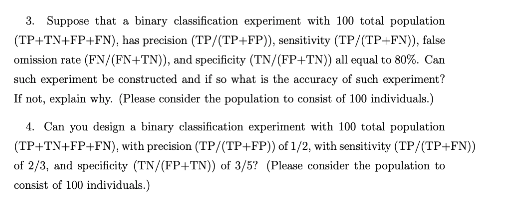
3. Suppose that a binary classification experiment with 100 total population (TP+TN+FP+FN), has precision (TP/(TP+FP)), sensitivity (TP/(TP-FN)), false omission rate (FN/(FN+TN)), and specificity (TN/(FP+TN)) all equal to 80%. Can such experiment be constructed and if so what is the accuracy of such experiment? If not, explain why, (Please consider the population to consist of 100 individuals.) 4. Can you design a binary classification experiment with 100 total population (TP+TN+FP+FN), with precision (TP/(TP+FP)) of 1/2, with sensitivity (TP/(TP+FN)) of 2/3, and specificity (TN/(FP+TN)) of 3/5? (Please consider the population to consist of 100 individuals.) 3. Suppose that a binary classification experiment with 100 total population (TP+TN+FP+FN), has precision (TP/(TP+FP)), sensitivity (TP/(TP-FN)), false omission rate (FN/(FN+TN)), and specificity (TN/(FP+TN)) all equal to 80%. Can such experiment be constructed and if so what is the accuracy of such experiment? If not, explain why, (Please consider the population to consist of 100 individuals.) 4. Can you design a binary classification experiment with 100 total population (TP+TN+FP+FN), with precision (TP/(TP+FP)) of 1/2, with sensitivity (TP/(TP+FN)) of 2/3, and specificity (TN/(FP+TN)) of 3/5? (Please consider the population to consist of 100 individuals.)
Step by Step Solution
There are 3 Steps involved in it

Get step-by-step solutions from verified subject matter experts
 Study Help