







Question: 3. Suppose that the mill in Problem 2 has decided to launch with three product types: blankets, rugs, and sweaters. You have been given the
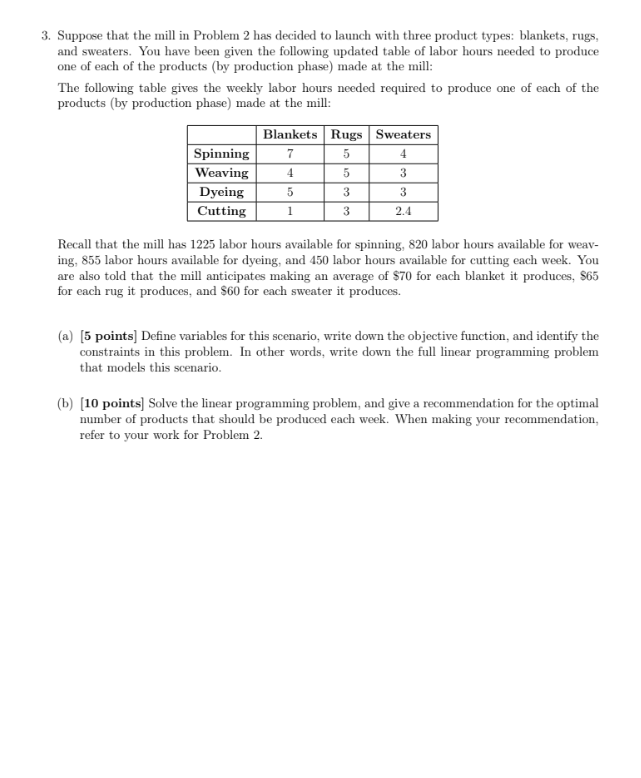
3. Suppose that the mill in Problem 2 has decided to launch with three product types: blankets, rugs, and sweaters. You have been given the following updated table of labor hours needed to produce one of each of the products (by production phase) made at the mill: The following table gives the weekly labor hours needed required to produce one of each of the products (by production phase) made at the mill: Recall that the mill has 1225 labor hours available for spinning, 820 labor hours available for weaving, 855 labor hours available for dyeing, and 450 labor hours available for cutting each week. You are also told that the mill anticipates making an average of $70 for each blanket it produces, $65 for each rug it produces, and $60 for each sweater it produces. (a) [5 points] Define variables for this scenario, write down the objective function, and identify the constraints in this problem. In other words, write down the full linear programming problem that models this scenario. (b) [10 points] Solve the linear programming problem, and give a recommendation for the optimal number of products that should be produced each week. When making your recommendation, refer to your work for Problem 2. 3. Suppose that the mill in Problem 2 has decided to launch with three product types: blankets, rugs, and sweaters. You have been given the following updated table of labor hours needed to produce one of each of the products (by production phase) made at the mill: The following table gives the weekly labor hours needed required to produce one of each of the products (by production phase) made at the mill: Recall that the mill has 1225 labor hours available for spinning, 820 labor hours available for weaving, 855 labor hours available for dyeing, and 450 labor hours available for cutting each week. You are also told that the mill anticipates making an average of $70 for each blanket it produces, $65 for each rug it produces, and $60 for each sweater it produces. (a) [5 points] Define variables for this scenario, write down the objective function, and identify the constraints in this problem. In other words, write down the full linear programming problem that models this scenario. (b) [10 points] Solve the linear programming problem, and give a recommendation for the optimal number of products that should be produced each week. When making your recommendation, refer to your work for Problem 2
Step by Step Solution
There are 3 Steps involved in it

Get step-by-step solutions from verified subject matter experts
 Study Help