







Question: 3. Suppose the endogenous regressor A and the instrument variable Z are binary variables. The dependent variable Y = h(X, U), where U is the
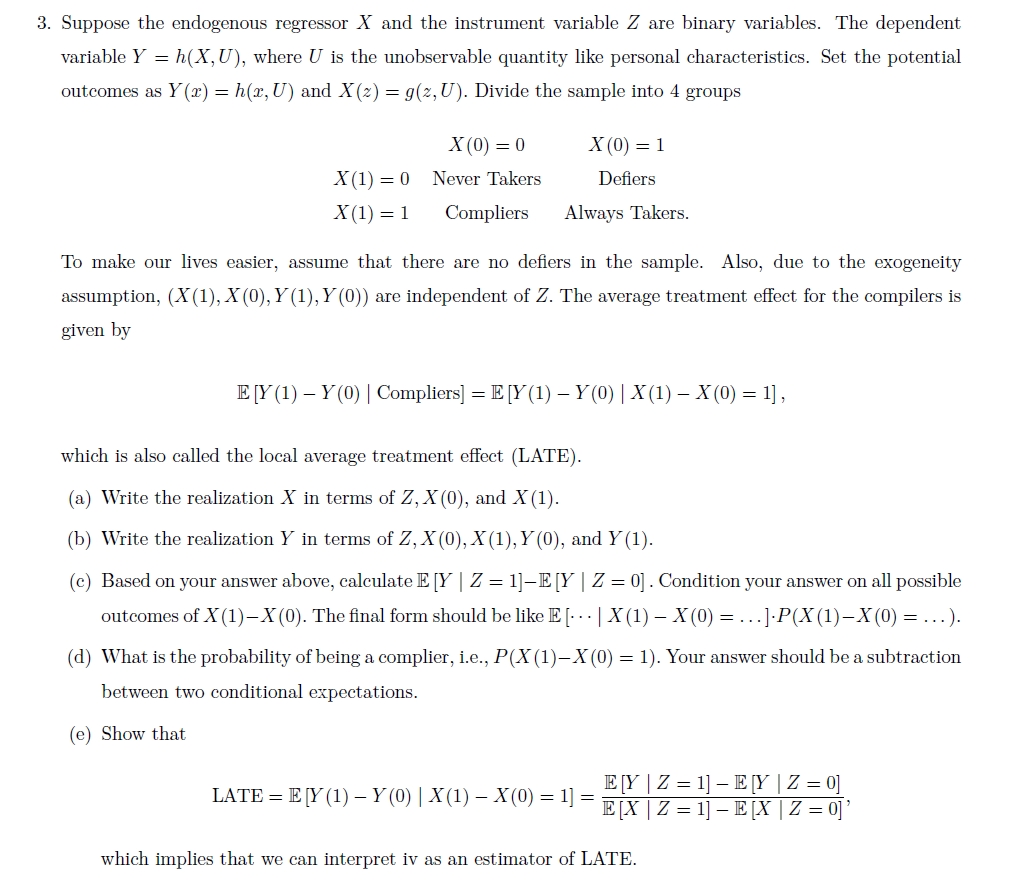
3. Suppose the endogenous regressor A and the instrument variable Z are binary variables. The dependent variable Y = h(X, U), where U is the unobservable quantity like personal characteristics. Set the potential outcomes as Y(x) = h(x, U) and X(2) = g(2, U). Divide the sample into 4 groups X(0) = 0 X(0) = 1 X(1) =0 Never Takers Defiers X(1) =1 Compliers Always Takers. To make our lives easier, assume that there are no defiers in the sample. Also, due to the exogeneity assumption, (X(1), X(0), Y(1), Y(0)) are independent of Z. The average treatment effect for the compilers is given by E[Y (1) - Y(0) | Compliers] = E[Y(1) - Y(0) | X(1) - X(0) = 1], which is also called the local average treatment effect (LATE). (a) Write the realization X in terms of Z, X(0), and X (1). (b) Write the realization Y in terms of Z, X (0), X(1), Y(0), and Y (1). (c) Based on your answer above, calculate E [Y | Z = 1]-E[Y | Z = 0] . Condition your answer on all possible outcomes of X(1)-X(0). The final form should be like E [. . . | X (1) - X(0) = . ..].P(X(1)-X(0) = ...). (d) What is the probability of being a complier, i.e., P(X (1)-X(0) = 1). Your answer should be a subtraction between two conditional expectations. (e) Show that E[Y | Z = 1] - E[Y | Z =0] LATE = E[Y (1) - Y(0) [ X(1) - X(0) = =EX Z = 1]- EX | Z =0] which implies that we can interpret iv as an estimator of LATE
Step by Step Solution
There are 3 Steps involved in it

Get step-by-step solutions from verified subject matter experts
 Study Help