







Question: = 3. Suppose we have a data set with five predictors, X GPA, X = IQ, X3 Level (1 for College and 0 for
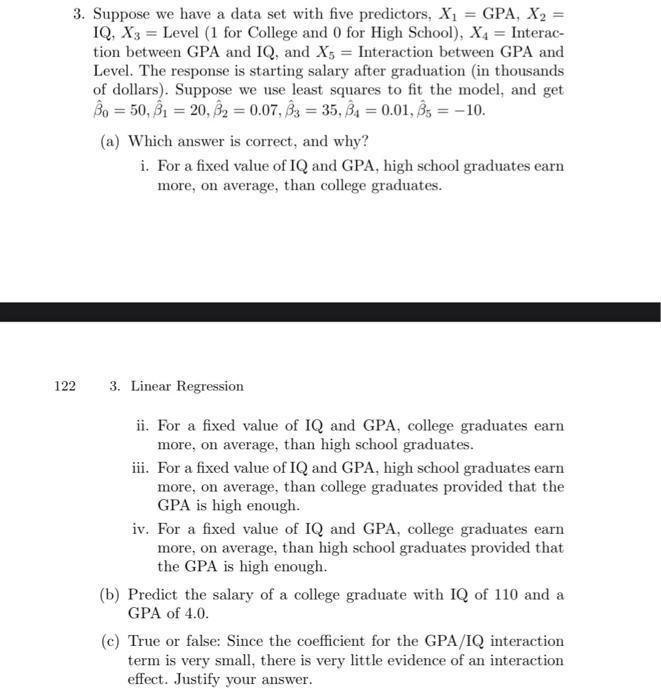
= 3. Suppose we have a data set with five predictors, X GPA, X = IQ, X3 Level (1 for College and 0 for High School), X = Interac- tion between GPA and IQ, and X5 = Interaction between GPA and Level. The response is starting salary after graduation (in thousands of dollars). Suppose we use least squares to fit the model, and get 80 = 50,31 = 20, 32= 0.07, 33 = 35, 34 = 0.01,85 = -10. 122 (a) Which answer is correct, and why? i. For a fixed value of IQ and GPA, high school graduates earn more, on average, than college graduates. 3. Linear Regression ii. For a fixed value of IQ and GPA, college graduates earn more, on average, than high school graduates. iii. For a fixed value of IQ and GPA, high school graduates earn more, on average, than college graduates provided that the GPA is high enough. iv. For a fixed value of IQ and GPA, college graduates earn more, on average, than high school graduates provided that the GPA is high enough. (b) Predict the salary of a college graduate with IQ of 110 and a GPA of 4.0. (c) True or false: Since the coefficient for the GPA/IQ interaction term is very small, there is very little evidence of an interaction effect. Justify your answer.
Step by Step Solution
3.41 Rating (154 Votes )
There are 3 Steps involved in it
1 The third answer iii is correct To see why this is the case suppose we have fixed values for GPA a... View full answer

Get step-by-step solutions from verified subject matter experts
 Study Help